War drones: how to build autonomous systems at a defensive level?
Autonomous warfare is not won just with more drones, but with integrated systems designed to operate in complex and distributed contexts. The US Department of Defense is investing $54.6 billion in the DAWG program to develop multi-domain autonomous capabilities, marking a paradigm shift towards sacrificial, modular, and mass-producible systems.
Modular architectures for multi-domain systems
Designing flexible platforms that operate on air, sea, land, and underwater environments requires common standards and guaranteed interoperability from the design phase.
The DAWG program focuses on autonomous systems distributed across all operational domains. Not just aerial drones, but also ground vehicles, surface naval vessels, and underwater vehicles. Each domain requires different materials and processes: reinforced polymers for lightweight aerial components, printed metals for corrosion-resistant marine parts, ground systems capable of handling vibrations and dust.
- Aerial: lightweight drones for reconnaissance and attack
- Ground: autonomous vehicles for logistics and support
- Surface naval: patrol and maritime surveillance
- Underwater: distributed sensors and countermeasures for underwater threats
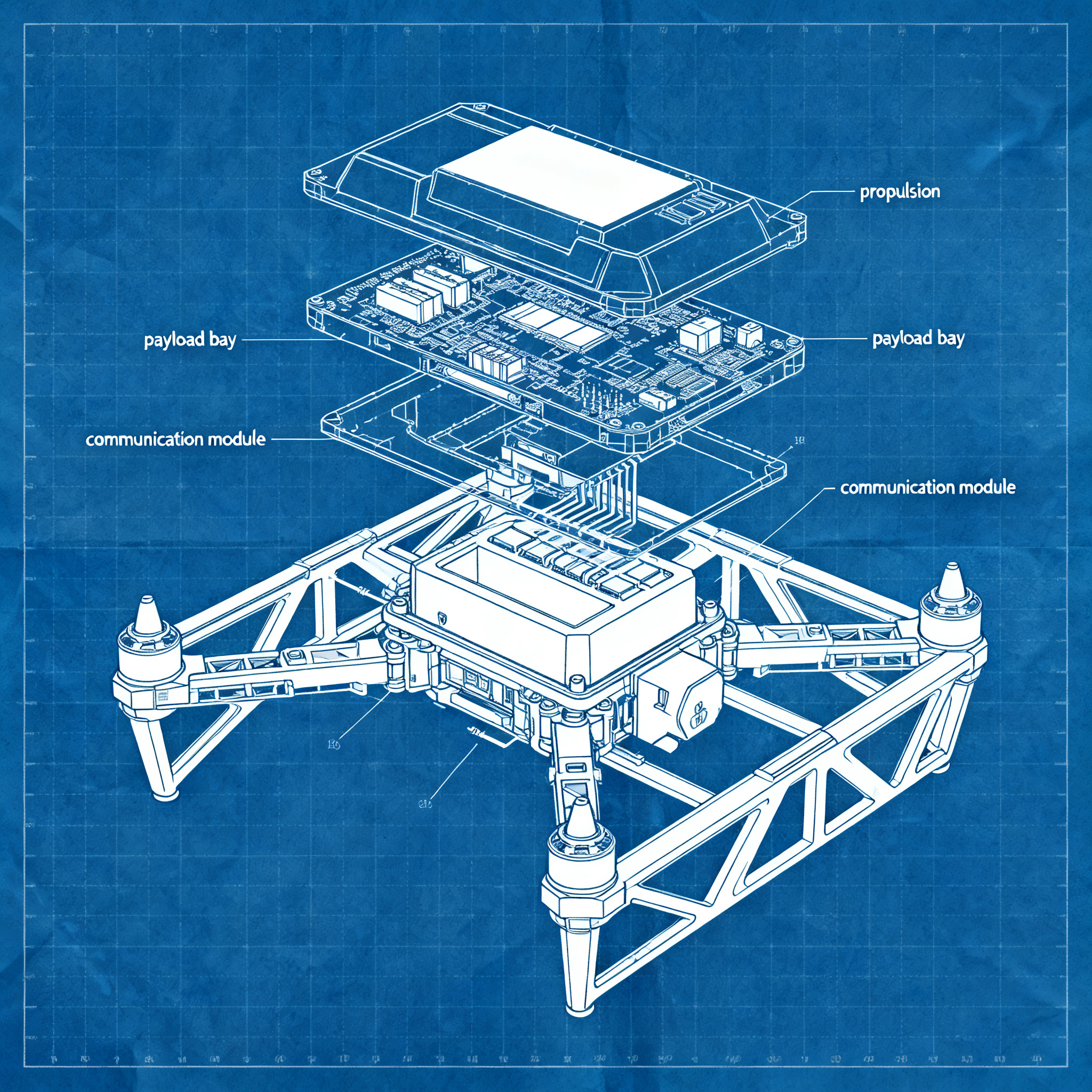
The modular approach allows for sharing electronics, control systems, and software across different platforms. This reduces development costs and accelerates integration. The HANX drone, developed by the Marines, is the first fully 3D-printed system compliant with NDAA requirements, designed to be modified and repaired directly in the field.
Local supply chain and production
Decentralizing production means reducing response times and ensuring operational continuity even when traditional supply lines are compromised.
Additive manufacturing transforms defense logistics. Instead of shipping every spare part from central depots, non-critical or already qualified parts can be produced near the point of use. In programs based on swarms and expendable platforms, maintenance weighs as much as initial production.
The SPARTA drone, developed by the Army Research Laboratory, costs just over $1,000. The 3D-printed frame absorbs most of the damage in the event of a crash. The electronics can be reused by mounting them on a new frame printed in a few hours. This approach eliminates the fear of losing expensive assets and accelerates training.
$1,000 systems allow accepting operational losses without paralyzing missions. Local production reduces replacement times from weeks to hours.
The strategy does not aim to build better drones, but distributed drone factories. Commercial desktop printers have produced devices like Widowmaker, a munition dispensing system designed entirely by soldiers with no prior CAD experience. They created functional prototypes in a few months using standard software and FFF printers.
Technical qualifications and defense standards
Reliability, security, and electromagnetic compatibility requirements determine which systems can be employed in NATO or allied contexts.
The HANX drone obtained provisional flight authorization from NAVAIR after 90 days of iterative development. All components comply with NDAA requirements, excluding potentially compromised technologies or those from restricted suppliers. This standard is fundamental for integration into allied command and control systems.
| Requirement | Military standard | Operational impact |
|---|---|---|
| NDAA compliance | Components from approved suppliers | Integration into NATO C2 systems |
| Modularity | Standardized interfaces | Field repair and upgrade |
| Unit cost | < 2,000 USD per expendable systems | Mass deployment without economic constraints |
Rapid qualification is crucial. The traditional process takes years; new programs aim for cycles of 90-120 days. This means testing printed components in real operational conditions, validating alternative materials, and certifying distributed manufacturing processes.
Electromagnetic compatibility and environmental resistance remain critical. A marine drone must operate in salt water, a land-based system must withstand sand and extreme temperatures. Printed materials must pass sealing, mechanical strength, and thermal stability tests equivalent to traditional components.
Integration with advanced controls (e.g., SAWC)
Autonomy becomes a cross-cutting capability managed by dedicated structures that coordinate multi-domain missions and international collaboration.
SAWC, the new autonomous command of the U.S. Southern Command, marks expansion beyond the Indo-Pacific scenario. Led by General Francis L. Donovan, SAWC employs autonomous platforms to counter narcoterrorist networks, support regional partners, and respond to large-scale natural disasters.
DAWG functions as a “pathfinder”, seeking technologies, testing them with companies, and working on integration. The 2027 budget request includes 39.2 billion for multi-year investments in autonomous systems and national production capacity, plus 14.4 billion for counter-drone systems.
SAWC operational model
- Threat identification: Distributed sensors across multiple domains detect hostile activities or emergencies.
- Autonomous coordination: Semi-autonomous systems link tactical missions to long-term strategic effects.
- Regional collaboration: Allied partners integrate compatible platforms for joint operations.
Ukraine has created a lethal zone that eliminates up to 90% of Russian forces destined for the front using drones of all types. The United States wants to replicate this defensive capability on a global scale. The goal is not only deterrence but the creation of autonomous defensive rings that make any attempt at invasion prohibitive.
Building autonomous defensive capabilities: system before single asset
Building autonomous defensive capabilities requires a paradigm shift. It is not enough to design the best drone, but the entire ecosystem that produces, maintains, updates, and replaces it. Additive manufacturing enables distributed production, rapid qualification, and local maintenance.
The DAWG and SAWC programs show that autonomy is no longer an experiment but a strategic priority with dedicated budgets. Companies that want to participate must demonstrate scalability, compliance with defense standards, and integration with multi-domain architectures.
Explore the specifications of key NATO programs to understand how requirements evolve over time. The window to position yourself in this supply chain is open, but it will close quickly when the first multi-year contracts are awarded.
article written with the help of artificial intelligence systems
Q&A
What is the main objective of the DAWG program?
The DAWG program aims to develop integrated multi-domain autonomous capabilities designed to operate in complex and distributed environments. The goal is to create sacrificial, modular, and large-scale producible systems for defense.
How does additive manufacturing contribute to the described defensive strategy?
Additive manufacturing decentralizes production, enabling local printing of non-critical components. This reduces response times, lowers costs, and allows rapid field repairs, which is essential for sacrificial systems like drones.
What are the economic advantages of low-cost drones such as SPARTA?
Low-cost drones like SPARTA, which cost just over $1,000, allow operational losses to be accepted without serious financial consequences. Additionally, due to their ease of repair, they accelerate training and improve operational availability.
What technical requirements must autonomous systems meet to be integrated into NATO commands?
Systems must comply with standards such as NDAA compliance, use of components from approved suppliers, modularity, standardized interfaces, and security and electromagnetic compatibility requirements. These requirements ensure integration and interoperability with allied systems.
How does the SAWC command utilize autonomous platforms?
SAWC employs autonomous platforms to identify threats, coordinate tactical and strategic missions, and support joint operations with regional partners. It is also used to combat narco-terrorism and respond to large-scale natural disasters.