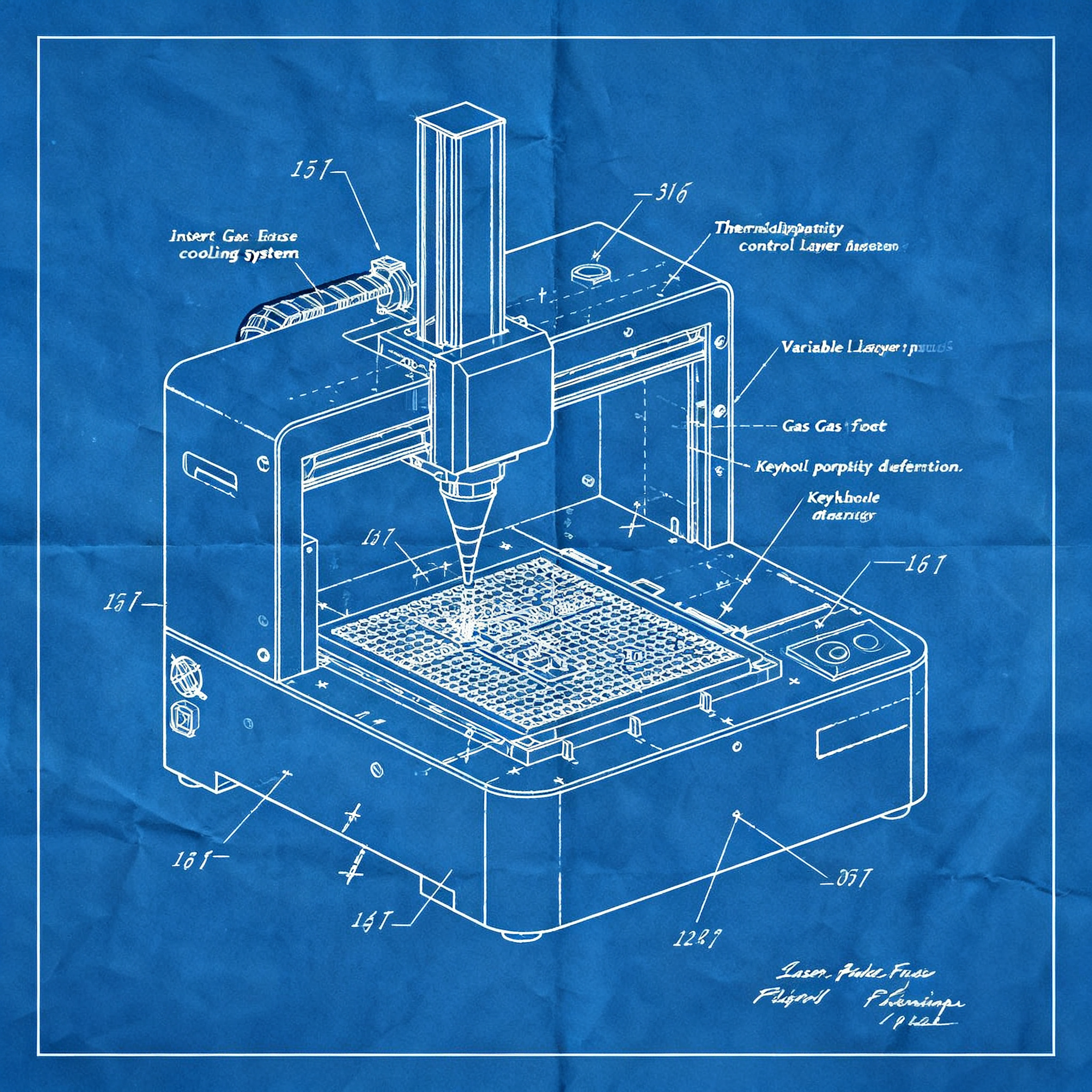
3D printing without overheating? The trick is in the gas
During metal 3D printing, heat accumulated layer by layer can ruin the part before it is even finished. A new patented method promises to solve the problem without slowing down production, indeed: speeding it up by up to 47%.
- HEAT DISSIPATION CONTROL IN ADDITIVE MANUFACTURING — January 28, 2026
The patent introduces a thermal control system that acts on two fronts: variable pauses between layers and regulation of the inert gas temperature. The goal is to keep the temperature below a critical threshold, beyond which irreversible defects form.
Why heat is the enemy of 3D printing
In laser powder bed fusion (PBF-LB) techniques, each layer adds heat to the previous one. When the temperature rises too much, the result is a defective part.
The problem is called “keyhole porosity”: internal cavities that form when the laser penetrates too deeply into the molten material. These porosities compromise the mechanical strength of the component and can cause the entire print to fail.
The risk increases with the height of the part. The higher it goes, the more heat accumulates. Traditional methods involve uniform pauses between one layer and the next, but this approach lengthens times without solving the problem at its root.
The patent that changes the approach
The patented method introduces strategic pauses and active control of the inert gas temperature, calibrated based on the part height and accumulated heat.
The system calculates a “threshold temperature” (Tth) specific to each material. This threshold represents the limit beyond which keyhole porosity forms. The calculation is based on a comprehensive physical model that considers melting properties, vaporization, and melt pool depth.
Layer pauses are no longer constant. They increase gradually with the part height, following the actual heat accumulation. The inert gas is cooled progressively as printing proceeds, providing greater dissipation exactly where it is needed most.
How thermal control works
- Threshold calculation: A physical model determines the maximum allowable temperature for the specific material.
- Continuous monitoring: The temperature on the upper surface of the part is controlled layer by layer.
- Graduated pauses: The waiting time between layers increases with height, following the heat accumulation.
- Cooled gas: The temperature of the inert gas is progressively lowered in the upper layers.
The patent also describes a nozzle system that directs cooled inert gas towards specific areas of the part. This allows for targeted cooling without wasting energy or gas.
Tangible benefits and measurable results
Tests show a 47% reduction in total print time compared to constant pauses, while maintaining the same part quality.
The difference between constant and graduated pauses is clear. With uniform pauses, time is uselessly stretched in the lower layers where heat is not yet critical. With optimized pauses, every second of waiting is justified by the real need for dissipation.
| Parameter | Constant pauses | Graduated pauses |
|---|---|---|
| Total print time | Reference | -47% |
| Porosity risk | Controlled | Controlled |
| Superficial quality | Standard | Improved |
The reduction of porosity risk is the main benefit. Fewer defects mean less waste and lower need for post-printing heat treatments. In a production department, this translates into shorter cycles and lower costs per piece.
Repeatability improves because thermal control eliminates one of the main sources of variability in the process. Each piece is produced under the same thermal conditions, regardless of its position in the powder bed.
- Up to 47% reduction in total print time
- Elimination of keyhole porosity above the critical threshold
- Improved surface finish
- Greater repeatability across different batches
Adoption: easy to integrate?
The method adapts to existing PBF-LB systems but requires precise thermal models and may not work on all machinery.
Integration does not require radical hardware changes. Modern laser fusion machines already have inert gas control systems and the ability to handle variable pauses. The real requirement is the control software and the physical model to calculate the threshold temperature.
The patent specifies that the method is applicable to “any appropriate AM technique” and “any appropriate AM system.” This leaves room for interpretation: not all machines may have the necessary sensors or computing power.
The system requires accurate physical models for each material. Obsolete machines may not have the necessary control over gas temperature or pause times. The benefit also varies based on the part geometry: low and wide components may not gain the same advantage as tall and thin structures.
The need for precise thermal models represents a barrier for small workshops. These models require specific expertise and experimental data on material behavior. Companies that already use advanced simulations are at an advantage.
The patent does not specify which machinery is compatible or what modifications are needed for older systems. This lack of practical details suggests that implementation will require collaboration between machine manufacturers and end-users.
Managing heat: a solution already patented
Intelligent thermal control in metal 3D printing is no longer a theoretical hypothesis. It is a patented method with measurable results: fewer defects, reduced times, better quality.
Adoption will depend on the ability of machine manufacturers to integrate these controls into their systems. For those producing critical components in series, the benefit justifies the investment in thermal models and software updates.
Evaluate whether your production process can benefit from this technique. Analyze your current thermal models, verify the compatibility of your machines, and consider whether the reduction in defects and time justifies the development of the necessary physical models.
article written with the help of artificial intelligence systems
Q&A
What is the main heat-related issue during metal 3D printing?
The accumulated heat layer by layer can cause the formation of keyhole porosity, which refers to internal cavities that compromise the mechanical strength of the component. This phenomenon worsens with part height and can lead to print failure.
How does the patented thermal control method work?
The method involves graduated pauses between layers and adjusting the inert gas temperature based on part height and thermal accumulation. It uses a physical model to calculate a specific threshold temperature for each material, preventing defect formation.
What are the main advantages of the patented system compared to traditional methods?
Benefits include up to a 47% reduction in total printing time, elimination of keyhole porosity, improved surface finish, and greater consistency between different batches. Additionally, the system avoids unnecessary pauses in lower layers.
What requirements are needed to implement this technology?
Accurate thermal models for each material, inert gas control systems, and the ability to manage variable pauses are required. Although it doesn't require major hardware modifications, it may not be compatible with outdated machinery or equipment lacking proper sensors.
What limitations does this patented solution have?
The technology requires specific expertise to develop accurate physical models and may not adapt to all part geometries or machines. Furthermore, practical implementation details are not fully outlined in the patent, requiring collaboration between manufacturers and users.