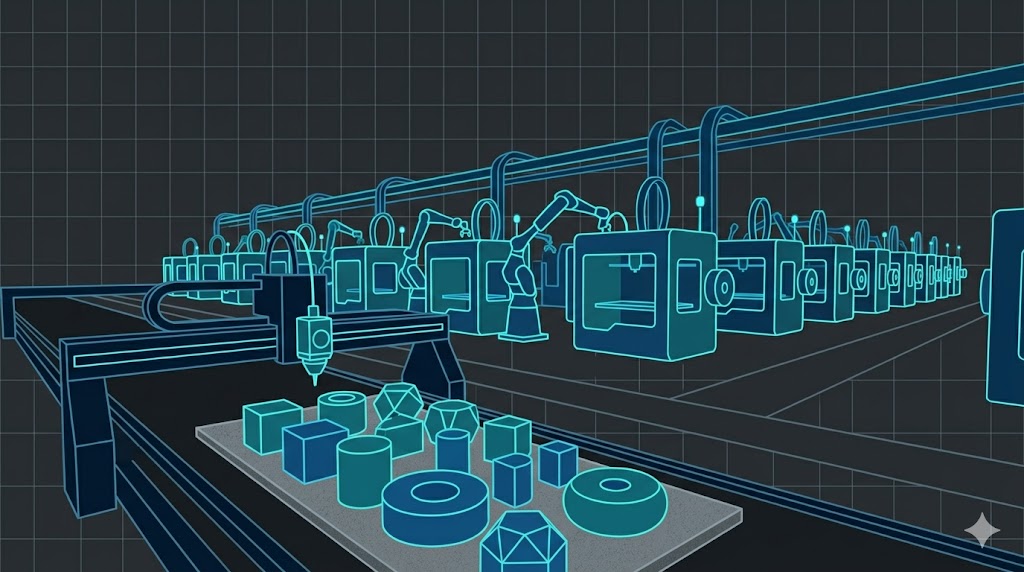
3D printing enters production
In recent years, additive manufacturing has surpassed the perimeter of rapid prototyping to establish itself as a full-fledged production technology. More and more companies are evaluating 3D printing not only to validate designs but to produce final components in series.
In this context comes 3D ShapeFarm, a structured reality designed to manage scalable productions, with volumes ranging from tens to thousands of pieces.
The printing farm model: distributed but controlled production
The operational core of 3D ShapeFarm is a 3D printing farm designed to work continuously. This approach allows:
- distribute production across multiple machines
- reduce the risk of total downtime
- increase scalability based on demand
Unlike traditional services, oriented towards prototyping, the printing farm model requires a higher level of process standardization. Every phase must be replicable to ensure uniformity between parts, regardless of the machine used.
Mass production: the “economic zone” of 3D printing
One of the most interesting aspects of the positioning of 3D ShapeFarm is the focus on medium-large batches (10–10,000 pieces).
This specific area represents a true and proper industrial equilibrium zone:
- too large for traditional prototyping
- too small (or variable) to justify injection molds
- ideal for additive manufacturing
In this scenario, 3D printing becomes competitive because it eliminates setup costs and allows for flexible production, even in the presence of product variants.
Integrated service: beyond 3D printing
A distinctive element is the “turnkey” offer, which covers the entire production cycle:
- 3D Printing: component manufacturing according to technical specifications
- Assembly: integration into sub-assemblies or finished products
- Logistics: packaging and shipping management
This approach reduces complexity for the customer, who can rely on a single point of contact instead of coordinating multiple suppliers.
Reliability and repeatability: the real industrial challenges
Bringing 3D printing into production means facing typically industrial challenges, including:
- machine maintenance, to ensure operational continuity
- quality control, both dimensional and functional
- material management, with traceability and controlled storage conditions
- post-processing, necessary to meet technical specifications and finishes
In this context, the declared benefits — reliability, constant quality, and reduced lead times — depend on the ability to rigorously control every phase of the process.
Materials and applications: from theory to real production
Another key factor is the use of certified technical materials, which make it possible to use the printed components in final applications.
3D printing is no longer limited to aesthetic models, but finds a place in:
- functional components
- spare parts
- small customized batches
- complex products difficult to realize with traditional technologies
Structure and expertise: an industrial approach
3D ShapeFarm presents itself as a structured reality, with physical headquarters in Bareggio (MI) and an organization that includes:
- technical support for feasibility
- quoting and cost analysis
- complete project management
This approach is consistent with an industrial model, where 3D printing is not an accessory service but a primary production process.
Evolutions: evolved outsourcing of additive manufacturing
The case of 3D ShapeFarm highlight a key point: 3D printing as an outsourced production infrastructure.
For companies, the main value lies in the ability to:
- avoid investments in machinery
- reduce operational complexity
- access specialized expertise
- scale production flexibly
Additive manufacturing thus enters a new phase, where the issue is no longer “whether to use it”, but how to integrate it effectively into industrial processes.
Q&A
What is a printing farm in 3D printing?
A printing farm is a group of coordinated 3D printers working in parallel, enabling scalable component production with greater efficiency and operational continuity.
When is it convenient to use 3D printing for serial production?
It is cost-effective for small-to-medium and medium-to-large production batches (typically from 10 to 10,000 parts), especially when traditional tooling costs are too high or design flexibility is required.
What are the advantages compared to injection molding?
3D printing eliminates tooling costs, allows rapid design modifications, and reduces production startup times, making it ideal for variable or customized batches.
Is the quality comparable to traditional manufacturing methods?
With industrialized processes and proper quality controls, 3D printing can ensure high quality and repeatability, especially when using certified engineering-grade materials.