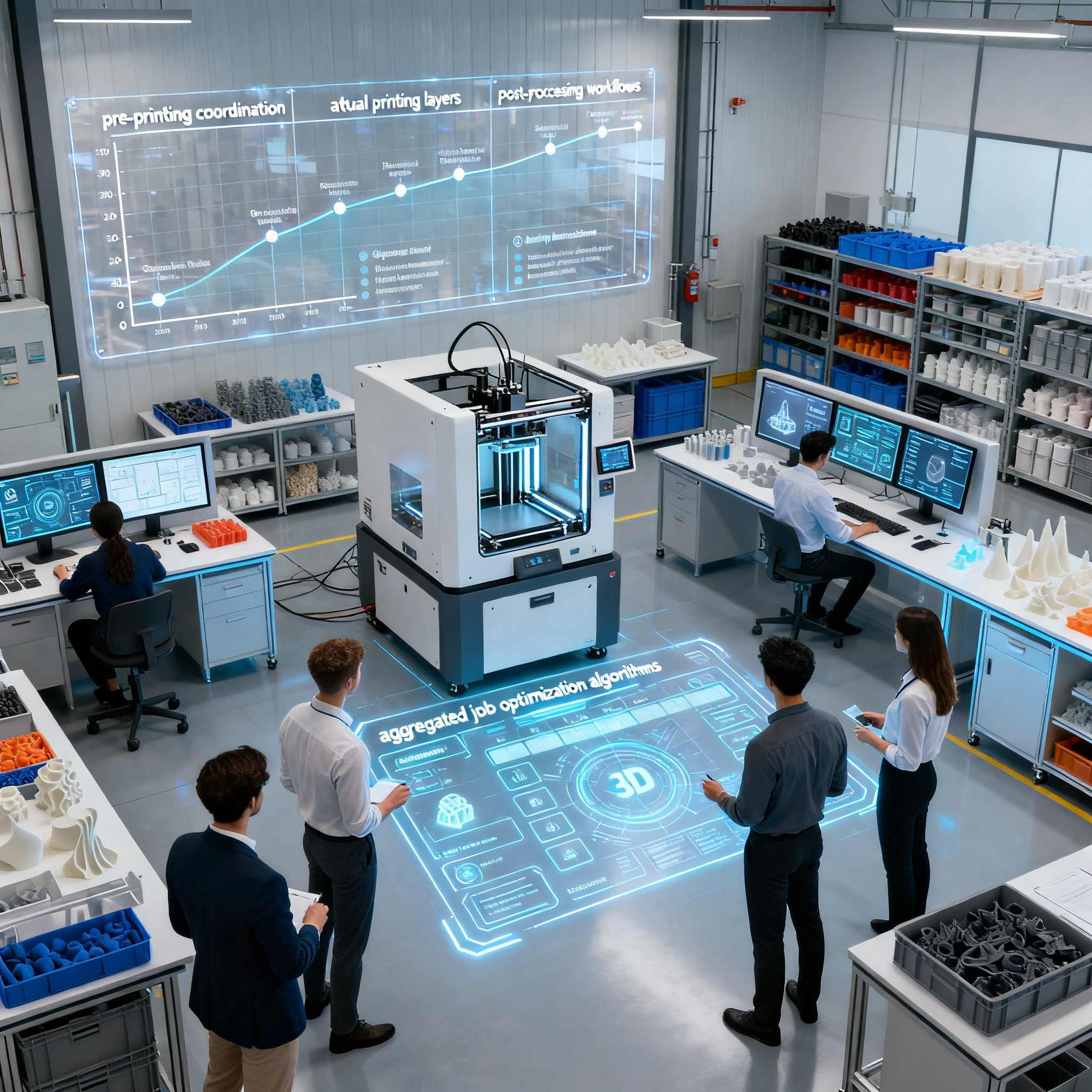
3 hours, not 3 days: how to really optimize production?
Effective planning in additive production requires a holistic vision that goes far beyond estimating print time. The true bottleneck is almost never the machine, but everything that happens before and after.
Beyond print time: mapping the complete workflow
Most planning software focuses on layer-by-layer print time, ignoring the phases that truly determine delivery times.
Pre-print estimation systems accurately calculate build, warm-up, and cool-down durations. But this is only a fraction of the actual production process.
Additive production begins long before the machine turns on. Critical operational decisions concern order intake, build preparation, and job combination. Without visibility into these phases, delivery forecasts are systematically inaccurate.
- Build preparation and order aggregation decisions
- Effective print time (the only phase tracked by standard software)
- Post-processing: removal of supports, heat treatments, surface finishes
- Inspection and quality control
The paradox of planning emerges right here. A single build can contain parts that require completely different post-processing. Some only need support removal, others need heat treatments, painting, or secondary mechanical processing.
Each process has its own times, capacities, and resource constraints. This creates diverging paths that nullify any optimization based solely on machine time.
How to combine jobs to maximize efficiency
Effectively aggregating orders requires the simultaneous balancing of volume, materials, orientation, priority, and deadlines.
The most critical decision in additive production occurs before printing: which parts to print together. This choice directly impacts delivery times, machine utilization, and customer satisfaction.
Planners must manage multiple constraints simultaneously. Available build volume, material compatibility, orientation requirements, total print time, and order priorities create a complex optimization problem.
| Criterion | Impact on efficiency | Risk if ignored |
|---|---|---|
| Volume build | Machine usage 60-95% | High unit costs |
| Material compatibility | Zero additional setup | Cross-material contamination |
| Part orientation | Optimal surface quality | Post-print rework |
| Order deadlines | On-time deliveries | Penalties and customer loss |
Inefficient builds delay urgent orders or create bottlenecks in post-processing. Conversely, overly cautious builds leave expensive printers underutilized.
Systems like SYNOPTIK have demonstrated savings of 15-30% by treating the entire production chain as a single interconnected optimization problem. The traditional sequential approach systematically leaves value on the table.
Complexity grows exponentially when facilities manage multiple printing technologies. Each technology has its own rules for defining an “optimal” build. Without system-level intelligence, planning depends on tribal knowledge or manual trial and error.
Decision criteria for build construction
Concrete operational guidelines for deciding what to print together, considering process stability and downstream requirements.
Building an effective build requires clear and repeatable decision criteria. It is not enough to maximize occupied volume.
First criterion: absolute material compatibility. No compromise is acceptable. Different materials in the same build cause contamination and waste.
Second criterion: compatible orientation requirements. Parts that require very different optimal orientations should not share the same build. The surface quality of some parts would inevitably be compromised.
Build evaluation procedure
- Material screening: Group orders by identical material and process parameters.
- Volumetric analysis: Verify that aggregated parts fit within the build volume with safety margins.
- Orientation evaluation: Check that all parts can be optimally oriented simultaneously.
- Post-processing mapping: Identify downstream paths to anticipate bottlenecks.
- Deadline prioritization: Balance order urgency with machine usage efficiency.
Third criterion: post-processing load forecast. A build optimized for print time can create saturation in subsequent stages. If all parts require heat treatment and the furnace capacity is limited, the build generates a new bottleneck.
The goal is not to print faster, but to deliver faster. This distinction is fundamental.
Monitoring and feedback: close the loop
The integration of real-time monitoring systems allows for the collection of operational data and continuous improvement of planning decisions.
Optimal planning requires continuous learning. Historical production data is the raw material for improving future forecasts.
Real-time monitoring systems track operational events: urgent orders, machines out of service, material shortages. These events require immediate re-optimization of the production plan.
Advanced systems use statistical control to identify recurring patterns and discover new cost reduction rules. Optimization becomes a learning process, not a static configuration.
End-to-end integration allows for configuring multiple objectives simultaneously: cost, CO2 emissions, delivery time, or weighted combinations. This flexibility is crucial when customers require sustainability demonstrations without sacrificing profitability.
Operational feedback closes the loop. Each completed build generates data on actual times, issues encountered, deviations from forecasts. These data feed algorithms that continuously refine estimates and aggregation rules.
Conclusion
Optimizing additive production requires a systemic approach. It is not enough to accelerate printing if preparation and post-processing remain bottlenecks.
Smart planning considers the entire flow: from order intake to final delivery. Only in this way can one move from 3 days to 3 hours.
Start tracking every phase of the production process today: only in this way can you cut 3 days and reach 3 hours. Map real times, identify true bottlenecks, and build decision criteria based on data, not intuition.
article written with the help of artificial intelligence systems
Q&A
What is the real bottleneck in additive manufacturing according to the article?
The real bottleneck is not the machine, but the phases that happen before and after printing, such as order intake, build preparation, and post-processing. These phases actually determine delivery times.
Why is the traditional planning approach ineffective?
The traditional approach focuses only on printing time, ignoring crucial phases like preparation and post-processing. This leads to inaccurate forecasts and inefficiencies in resource utilization.
What criteria are essential for building an effective build?
The main criteria are: absolute material compatibility, compatible orientation requirements, post-processing load forecasting, and deadline prioritization. These help avoid waste and bottlenecks.
How does post-processing affect build planning?
Post-processing can become a bottleneck if not considered during planning. For example, if all parts require heat treatment and capacity is limited, it creates significant delays.
What is the advantage of integrating real-time monitoring systems?
It allows collecting operational data to continuously improve planning decisions. It also helps react quickly to unexpected events like breakdowns or urgent orders.