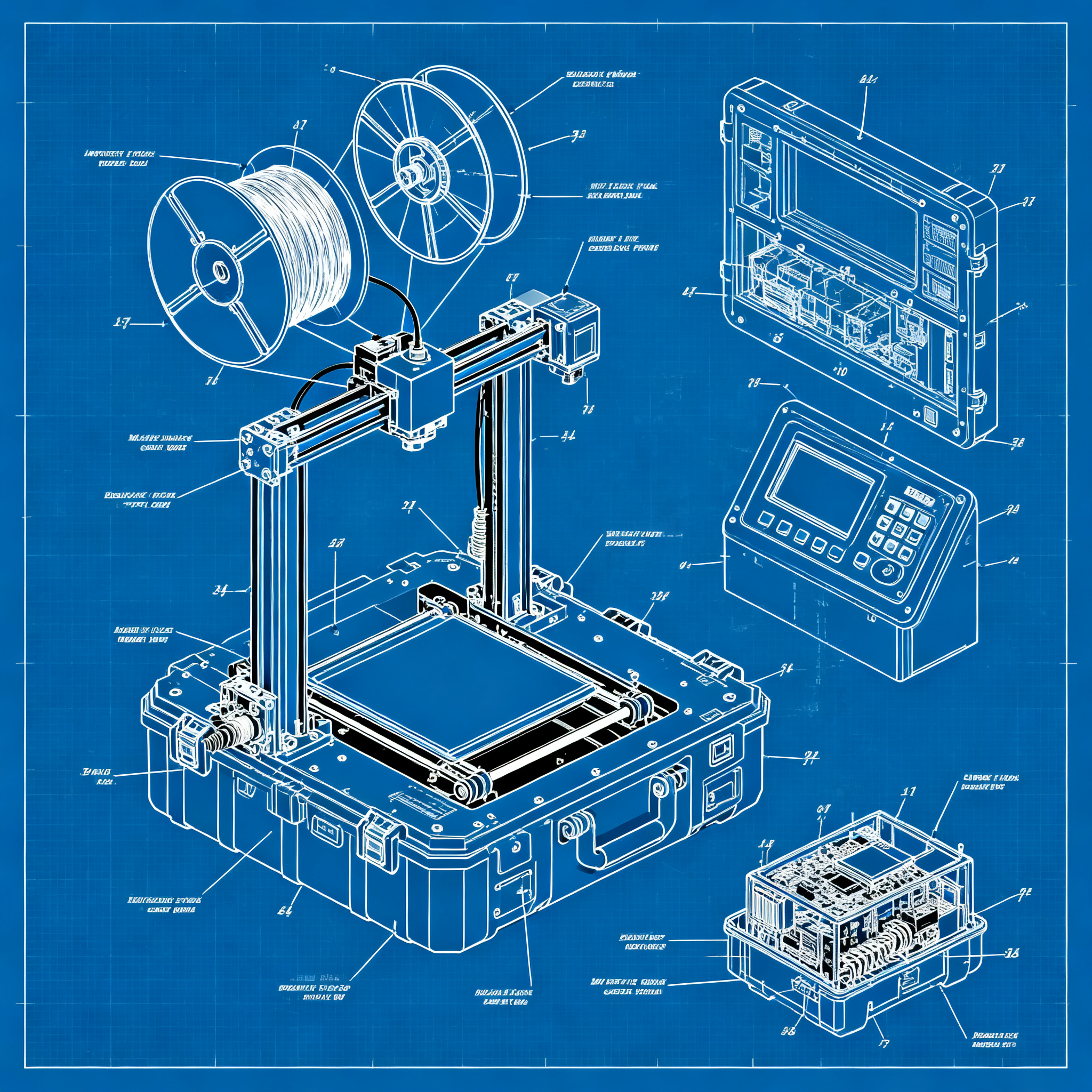
How the army prints on a mission: the operational model of the armed forces
Additive production is transforming the field operational logistics capabilities of the armed forces. Success does not depend on advanced machinery, but on the ability to train qualified personnel and integrate technology into existing operational processes.
United States military units are already producing critical spare parts directly in the operational area. The model implemented by the Marines at Camp Lejeune demonstrates how a structured approach can drastically reduce supply times.
Field logistics with 3D printing
The local production of critical components allows units to maintain operational capability even in complex logistical contexts, reducing dependence on traditional supply chains.
The II Marine Expeditionary Force Innovation Campus at Camp Lejeune has produced over 100 replacement antenna trees for the MUOS satellite communication system. Every piece costs 10 dollars in materials and requires 10 hours of printing, compared to 5.000 dollars and almost a year for traditional channels.
- 107 antennas produced for bases in North Carolina and California
- Direct savings: 600.000 dollars
- Production time: from 12 months to 10 hours
- Unit cost reduced by 99.81%
Field exercises demonstrate the effectiveness of the model. Between April 28 and May 8, 2026, the 1st Maintenance Battalion tested a complete manufacturing ecosystem with Wire Arc Additive Manufacturing technologies, EOS M290 printers, and Markforged X7 systems. The goal: critical maintenance and drone production directly in the field.
The Tennessee Army National Guard produced a Battle Lock handle for MRAP vehicles in less than 10 hours, including design, printing, heat treatment, and machining. Delivery was made by drone, eliminating transport through contested territory.
Digital operational training
The adoption of additive production requires a rethinking of technical-military training programs, focusing on the ability to rapidly transform a need into a physical solution.
The limiting factor is not the number of available machines, but the annual capacity to train new qualified operators. Before increasing investment in machinery, the armed forces must define a standard model to create the right mix of skills.
Training path implemented
- Extended access: The Camp Lejeune campus offers 10 CAD stations and continuous access to equipment for all Marines and Sailors on the base.
- Practical training: Lance Cpl. Eirick Schule, former CNC machinist, learned to use 3D printers in a dedicated course and then trained other operators throughout 2025.
- Immediate application: Operators transform real operational problems into usable prototypes, with an emphasis on operational readiness.
The training model must incorporate feedback from trainees in the field. A dialogue is needed between Pentagon decision-makers and institutions like the MIT Initiative for New Manufacturing, extended to all advanced manufacturing processes, not just additive production.
Hybrid supply chain management
Integrating additive production means redefining traditional logistics flows without completely eliminating them, creating a system that combines local production and centralized procurement.
Additive production does not replace the traditional supply chain but integrates it. Phillips Federal's containerized systems combine additive and subtractive technologies in scalable solutions for advanced operating bases and remote environments.
| Parameter | Traditional supply chain | Field production |
|---|---|---|
| Delivery time | 6-12 months | 10 hours |
| MUOS antenna cost | $5.000 | $10 |
| Logistical dependency | High | Minimum |
| Design flexibility | Low | Immediate |
Systems like FieldFab by Craitor operate in extreme conditions: variable temperatures, altitude, continuous vibrations. In October 2025, US troops printed drone components inside a flying UH-60 Black Hawk helicopter, demonstrating the technological maturity achieved.
Scalability and replicability of models
Winning deployment models require rigorous standardization and documentation to be replicable in other operational theaters, ensuring consistency across different units and bases.
The Camp Lejeune campus occupies approximately 280 m² and includes “The Lab” with 10 CAD workstations, machine tools, electronic equipment, and 3D printers. This configuration was designed to be replicable, not as an isolated experiment.
ASTM International received a NATO project to identify gaps and opportunities in the standardization of advanced technologies, providing practical recommendations for collaboration between standardization organizations, industry, and defense industrial base stakeholders.
Results already implemented include external supports for JLTV vehicles and covers for Harris tactical radios. These components have moved from prototyping to operational adoption, demonstrating that the model works beyond the laboratory.
Patrick Tucker, former regimental commander of the I Marine Expeditionary Force, leads the integration of additive and subtractive technologies into containerized solutions for tactical air mobility. The approach enables production in remote locations previously considered too constrained to support manufacturing activities.
Process before technology
Additive manufacturing in the armed forces is not a matter of advanced technology, but of process and human preparation. Success depends on the ability to train operators, standardize procedures, and integrate new workflows with existing ones.
The Camp Lejeune model demonstrates that a relatively modest investment in space and equipment, combined with targeted training and extended access, generates significant savings and increases operational readiness. The key is to start from the assumption that the limiting factor is the number of new trainable workers annually, not the budget for machinery.
Explore official armed forces case studies to understand how your department can launch a similar program, adapting the model to specific operational needs.
article written with the help of artificial intelligence systems
Q&A
What is the main success factor in implementing 3D printing in the armed forces according to the article?
Success depends mainly on the ability to train qualified personnel and integrate the technology into existing operational processes, rather than on purchasing advanced machinery.
How much time and money are saved thanks to local production of MUOS antennas at Camp Lejeune?
Each antenna costs $10 and requires 10 hours of printing, compared to $5,000 and almost a year needed through traditional channels. A total of $600,000 has been saved.
What logistics innovations have been introduced for field maintenance?
Technologies such as Wire Arc Additive Manufacturing and industrial printers have been implemented to produce drones and critical components directly in the field, drastically reducing response times.
How is personnel training addressed for using additive manufacturing?
The training program includes continuous access to equipment, hands-on courses, and a focus on immediately applying acquired skills to solve real operational problems.
How does additive manufacturing integrate with the traditional supply chain?
Additive manufacturing does not replace the classic supply chain but integrates it, allowing greater flexibility and reducing logistical dependence in complex operational contexts.