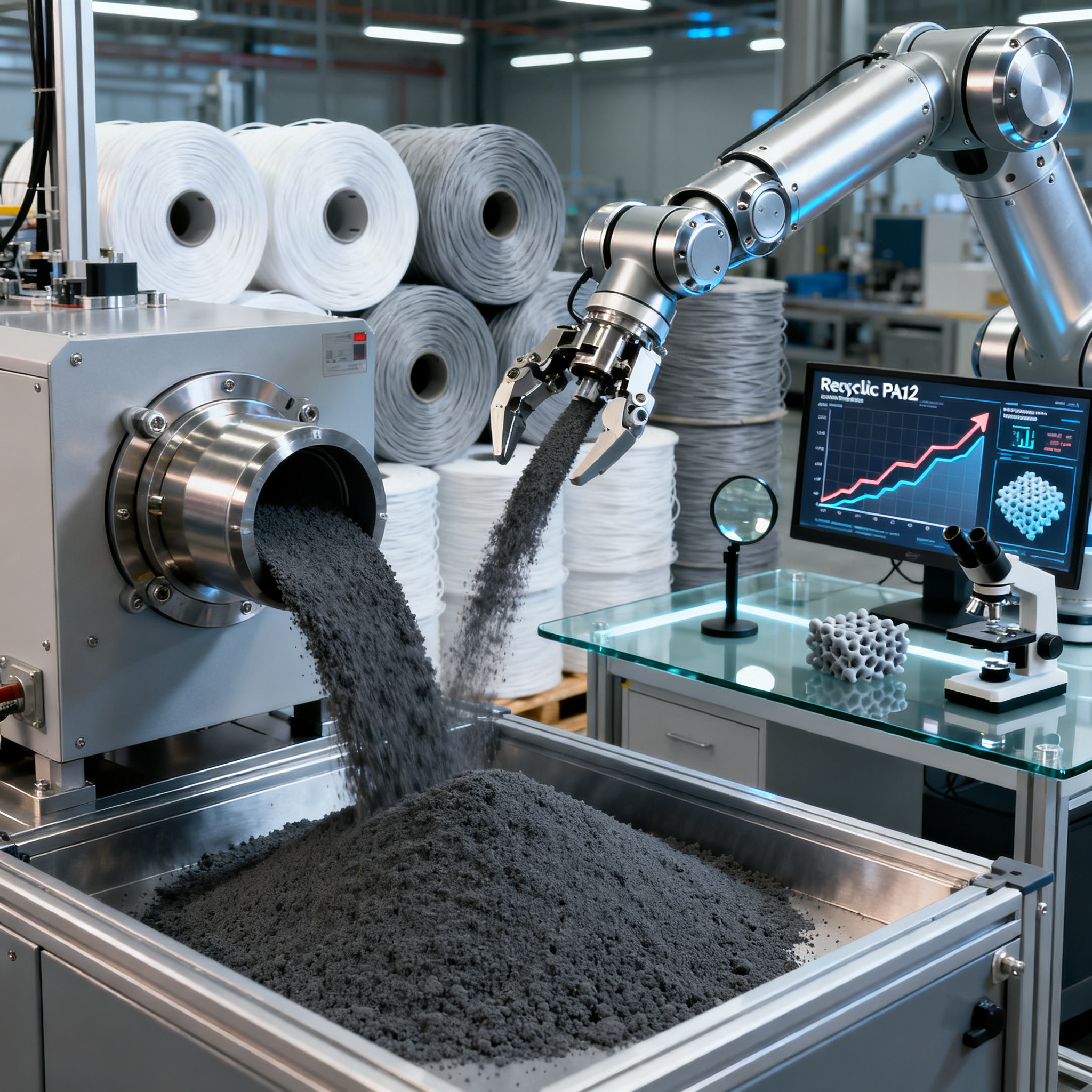
Recycle to compete? The hidden advantage of high-performance polymers
In the high-performance polymer sector, the true competitive advantage no longer lies solely in new formulations, but in closing the loop of the production cycle. Recovering powder from the print bed to produce recycled filaments reduces material costs by up to 30%, offering companies a strategic weapon against supply chain instability.
From powder to filament: the economics of industrial recycling
Transforming waste powder into ready-to-use filament represents an economic and environmental breakthrough for companies using high-performance 3D printing technologies.
PA12 powder that is no longer suitable for Multi Jet Fusion printing can become functional filament. High-volume service bureaus and internal departments of large OEMs are experimenting with this closed-loop model for prototypes, tooling, and auxiliary components.
Material remains within the additive supply chain. This reduces the need for new production of nylon and shifts the waste flow from landfill to concrete functional applications.
- Reduction of material costs by up to 30% for non-critical applications
- Elimination of dependence on new production of virgin nylon
- Tensile strength of 46 MPa maintained in recycled rPA12 filament
The recycled rPA12 filament maintains the performance of standard nylon 12. The mechanical strength allows for use in secondary structural applications, where specifications do not require certified virgin material.
Quality control: the Achilles' heel of recycled feedstock
Reprocessing high-performance materials requires rigorous protocols to guarantee homogeneity and mechanical stability in the final product.
Production scale determines final quality. In-line drying systems, diameter tolerances of ±0.02 mm, and automated winding allow for consistency across different batches.
Controlling recycled feedstock requires more stringent checks compared to virgin material. The origin of the MJF powder, the material's thermal history, and the presence of contaminants directly influence the final mechanical properties.
Feedstock validation process
- Selection: Verification of the powder origin and usage history in previous MJF cycles.
- Extrusion: Control of temperature and speed to guarantee homogeneity of the polymer melt.
- Qualification: Mechanical tests on samples from each batch to certify the declared properties.
Companies producing technical filaments show how process control is decisive. Precise extrusion temperatures and hardened nozzles become necessary when working with recycled materials that may contain residues of reinforcements or additives.
Independence from the supplier: when recycling becomes strategy
Companies that manage to close the internal production and recycling cycle optimize lead times and costs, increasing their resilience to market crises.
Control of the internal supply chain eliminates dependence on external suppliers. High-volume MJF operators can transform their waste into raw material for other production lines.
This operational autonomy protects against fluctuations in the price of virgin material. During supply crises, those who have closed the internal cycle continue to produce while competitors wait for external supplies.
Companies with closed cycles reduce supply lead times from weeks to days, maintaining internal material buffers without the costs of storing expensive virgin material.
The closed-loop model requires initial investments in extrusion lines and quality control systems. The economic return comes when waste volumes justify the amortization of the recycling infrastructure.
The same raw material is reused multiple times in the additive manufacturing supply chain. This creates a measurable competitive advantage: fewer external purchases, lower exposure to market risk, greater control over operating costs.
Conclusion
The future of high-performance polymers lies not only in chemical innovation but in the ability to integrate circular systems within production processes. Companies that master industrial recycling build entry barriers based on process expertise, not just proprietary formulations.
Evaluate today the impact of industrial recycling on your operating costs and the sustainability of your production process. The competitive advantage belongs to those who close the loop first.
article written with the help of artificial intelligence systems
Q&A
What is the main economic advantage of recycling high-performance polymers?
Recycling allows for up to a 30% reduction in material costs, representing a significant advantage especially for non-critical applications. Additionally, it reduces dependence on purchasing virgin nylon, protecting against market fluctuations.
How is waste powder reused in high-performance 3D printing?
PA12 powder no longer suitable for Multi Jet Fusion printing can be transformed into ready-to-use recycled filament. This process keeps the material within the additive manufacturing supply chain, avoiding waste and creating a closed production cycle.
What are the main challenges related to quality control of recycled feedstock?
Quality control of recycled material requires more rigorous protocols compared to virgin material. Factors such as powder origin, thermal history, and presence of contaminants affect final properties, making precise controls necessary for drying, dimensional tolerances, and polymer melt homogeneity.
What operational benefits does the closed-loop model offer to companies using additive technologies?
Companies adopting a closed-loop model reduce procurement lead times, eliminate dependence on external suppliers, and improve resilience to market crises. They can also internally reuse waste as raw material, reducing operational costs.
What mechanical properties does recycled rPA12 filament retain?
The recycled rPA12 filament retains a tensile strength of 46 MPa, comparable to standard nylon 12. This allows its use in secondary structural applications where certified virgin material specifications are not required.