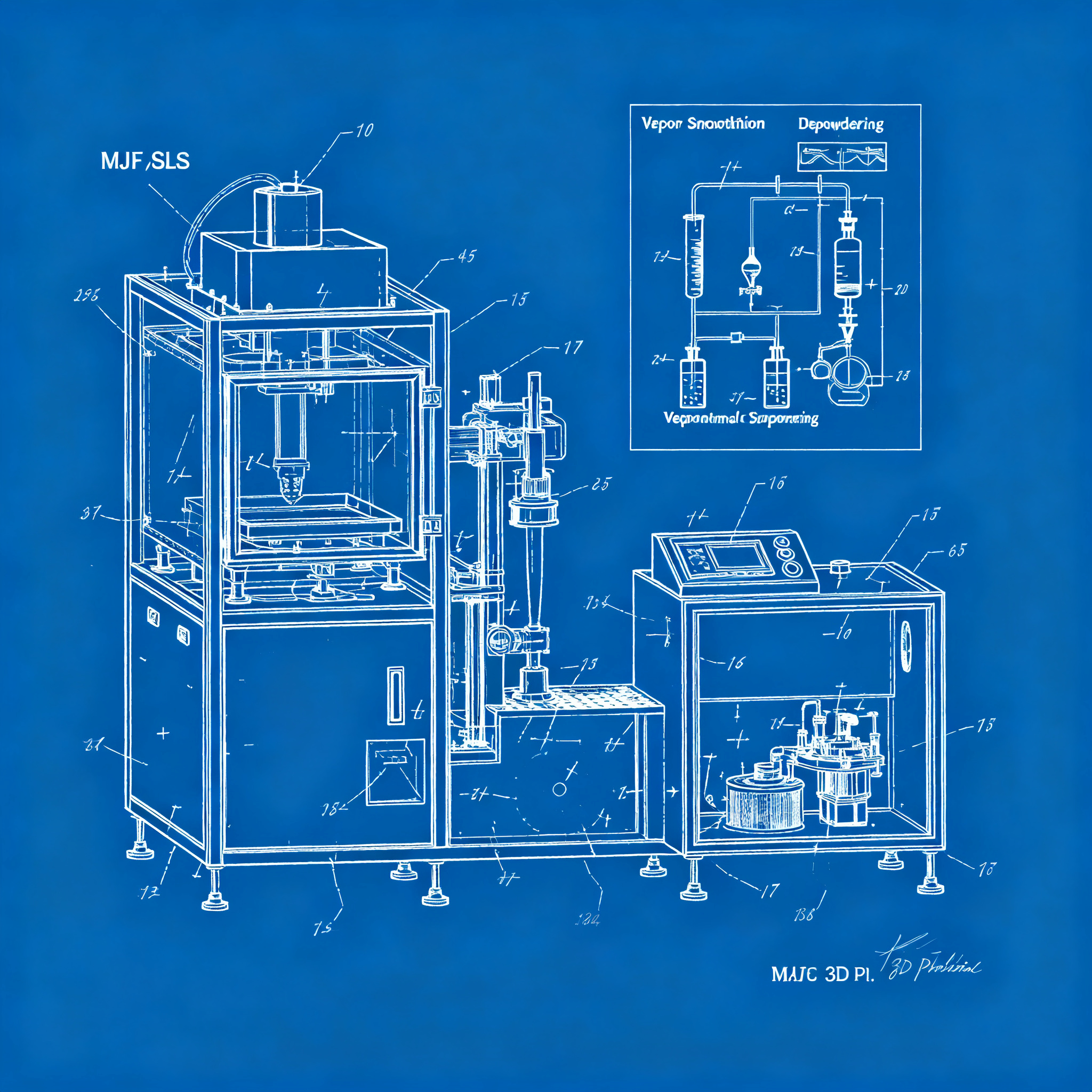
MJF/SLS Post-Processing: 3 Accessible Solutions for Small Labs
A new generation of automated systems is making MJF and SLS post-processing accessible to productive small labs, eliminating the bottleneck of manual processing.
Post-processing accounts for up to 60% of the total cost of a 3D printed component. For small workshops adopting technologies like HP MJF 1200, this critical phase risks negating the benefits of additive manufacturing.
DyeMansion has developed the Powershot, a compact system that automates the traditionally manual PolyShot process. The goal is clear: to make a technology previously reserved for large industrial plants accessible to low-volume labs.
- Reduction of post-processing costs by up to 60%
- Elimination of variability related to the manual process
- Standardized cycle times between 1.5 and 2 hours
Compact Automation for Small Labs
DyeMansion's Powershot represents a scalable alternative to traditional manual methods, specifically designed for workshops using systems like HP MJF 1200.
Automated vapour smoothing systems use controlled chemical vapours to smooth polymer surfaces. The process melts the surface layer, reducing roughness without compromising the internal structure of the part.
AMT's PostPro technology offers benchtop solutions like the PostPro SFX, with an 11.5-litre chamber, up to the SF100 with 100 litres of capacity. These systems are compatible with SLS, MJF, and FFF materials, using low-impact environmental chemistry.
The PostPro SF2X, arriving in June 2026, doubles the processing volume (24.4 litres) while maintaining a compact footprint. This feature facilitates integration into existing production environments without requiring significant structural modifications.
Time and Operational Simplicity
Automation drastically reduces post-processing times and minimizes errors related to manual handling, making final quality repeatable.
Standard vapour smoothing cycles require 1.5-2 hours. With the PostPro AI platform, times drop to 30-45 minutes thanks to automatic parameter optimization: steam flow, temperature, and duration are calibrated based on material and geometry.
The automated process guarantees consistent results across different batches. Treated parts show less than 0.4% dimensional variation and an increase in elongation at break, without loss of tensile strength.
| Parameter | Manual Process | Vapour Smoothing |
|---|---|---|
| Cycle time | Variable | 1.5-2 hours (30-45 min with AI) |
| Dimensional variation | ±2-5% | <0,4% |
| Repeatability | Low | High |
Treated surfaces become airtight and waterproof. This opens up new applications for functional components that require sealing, while also improving aesthetics and facilitating subsequent operations such as painting or coloring.
Costs vs Benefits: When It Pays to Invest
An economic analysis shows how the initial investment pays off in terms of efficiency and quality for workshops with even modest production volumes.
The initial cost of a PostPro SFX system starts at accessible figures for small-sized laboratories. The return on investment depends on the production volume and the added value that post-processing brings to the final components.
For workshops producing 50-100 pieces per month, automation eliminates hours of manual labor. The reduction of waste due to process errors further contributes to overall savings.
Automation becomes cost-effective when the labor cost for post-processing exceeds 30% of the value of the finished part, typically with volumes greater than 30-40 components per month.
The partnership between Raise3D and AMT to integrate vapour smoothing into the workflow of the SLS RMS220 printer demonstrates the direction of the market. The goal is to offer complete production chains, from printing to finishing, with accessible industrial quality.
Automated depowdering systems such as the PostPro DP Max complete the offering. They combine powder removal and sandblasting in a single solution, with three guns to maximize productivity.
Conclusion
Automated post-processing solutions are democratizing access to industrial-quality finishes. Compact systems such as DyeMansion's Powershot make it possible for small laboratories to compete with larger realities.
The integration of hardware and intelligent software reduces the learning curve. Even operators with limited experience can achieve professional and repeatable results.
Evaluate today the integration of systems such as the Powershot into your production workflow. Investment in post-processing automation can transform 3D printing from a prototyping tool into a complete production solution.
article written with the help of artificial intelligence systems
Q&A
What is the main problem of manual post-processing in small laboratories using MJF/SLS technologies?
Manual post-processing accounts for up to 60% of the total cost of a 3D printed component and introduces variability in results. For small labs, this bottleneck can negate the economic and quality advantages of additive manufacturing.
How does DyeMansion solve the post-processing issue for small laboratories?
DyeMansion has developed the Powershot, a compact system that automates the PolyShot process. This system reduces costs by 60%, eliminates manual-related variability, and standardizes cycle times between 1.5 and 2 hours.
What are the key benefits of automated vapor smoothing systems like those from AMT?
Automated systems reduce surface roughness without altering the internal structure of the component. They ensure high repeatability, minimal dimensional variation (<0.4%), and optimized cycle times through artificial intelligence.
When is it convenient to invest in an automated post-processing system for small laboratories?
Automation becomes convenient when labor costs exceed 30% of the finished part's value, typically with volumes above 30-40 components monthly. For labs producing 50-100 pieces per month, the investment pays off thanks to reduced waste and processing times.
What innovations will the PostPro SF2X bring in 2026?
Arriving in June 2026, the PostPro SF2X will double the process volume compared to previous models (24.4 liters) while maintaining a compact footprint. It will be ideal for labs seeking higher productivity without needing to modify their production environment.