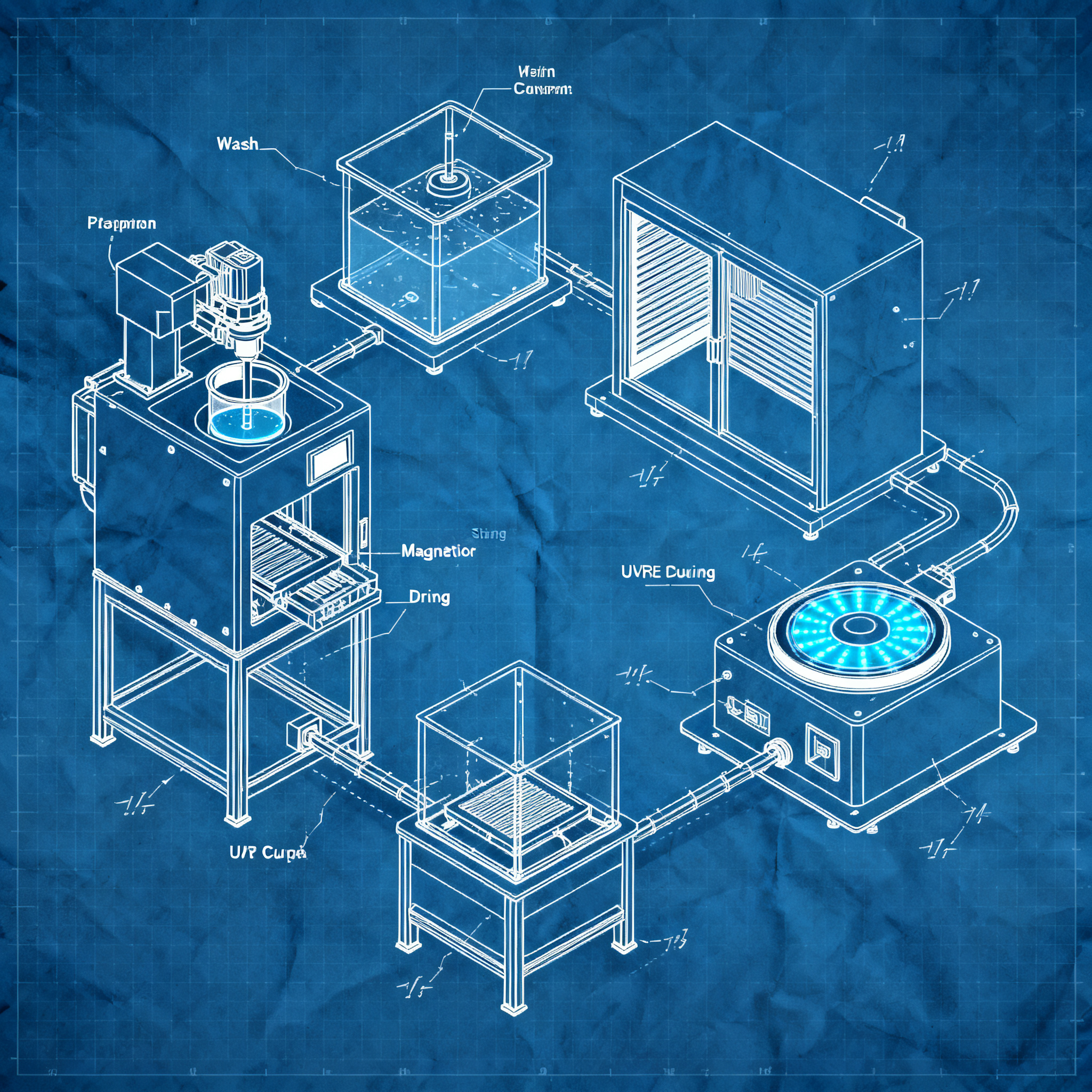
Can you automate the post-processing of the resin?
Building a modular workflow for resin printing means integrating the printer, post-processing, and data into a coherent and repeatable chain. Resin 3D printing offers excellent detail, but the real bottleneck comes after: washing, drying, and UV curing require precise parameters that vary for each material.
A modular system allows adapting each phase to the specifics of the resin used. Automating parameters along the flow reduces human errors, which is crucial when using biocompatible or certified resins.
Modularity in printing and post-processing systems
A modular workflow allows dynamically adapting processes to the specifics of the material used, improving precision and repeatability.
The growing variety of resines makes it impossible to apply the same treatment to all materials. A resin for modeling, a burnable for jewelry, a dental resin, and a technical resin require different parameters.
Viscosity, light sensitivity, washing time, curing time, and solvent compatibility change radically. If the user sets each step manually, the risk of error increases. A system that transfers data between stations reduces this dependence on the operator.
- More printers can share fewer washing and curing stations
- Optimal flow scaling based on the times of the different phases
- Reduction of occupied space and costs per workstation
The modular setup is consistent with the different timings of the various phases. Printing can take hours, while washing and curing require shorter times. In a lab, it doesn't always make sense to have a dedicated station for each individual printer.
Intelligent parameter automation
Profile-based material automation helps avoid critical errors, especially in medical or engineering applications.
The goal is not to make a single device smarter, but to build a chain where each station knows what was printed and how it should be treated. The printing platform becomes an identifying element that carries process data with it.
This approach is particularly important in a professional setting. An aesthetic model can tolerate some finishing differences. A dental bite, a surgical guide, or a biocompatible component, however, require controlled parameters.
Certified workflows for biocompatible resins in dentistry require that the correct material processing be a documented part of the process that allows for the use of components in contact with the patient.
All resin materials require post-processing for optimal results. Different resins require variable washing times. Post-curing influences mechanical properties, and each material has unique settings.
Device interoperability for certified workflows
Devices that communicate directly with each other guarantee process continuity and traceability without manual intervention.
Device-to-device communication enables certified and reproducible workflows without manual intervention. Systems like the Prusa SL1S combined with CW1S units for washing, drying, and polymerization represent concrete examples of this integration.
The station detects the presence of the IPA tank, uses a magnetic propeller to stir the liquid, and combines fans, UV LEDs, and a rotating platform for drying and curing. Data transfer via the platform and tag eliminates the need to manually reset parameters.
Automated workflow type
- Print: The printer completes the job and records the material parameters on the platform.
- Transfer: The platform is moved to the washing station, which reads the data automatically.
- Post-processing: Washing, drying, and curing follow the material-specific parameters without manual input.
In an environment with multiple users, materials, and jobs, the greatest risk is confusing parameters. A system with data following the platform can provide a more orderly basis for recording what was done: material, washing cycle, curing cycle, and operation sequence.
Practical cases: end-to-end workflow with technical resins
Real-world examples show how a modular and automated setup improves efficiency and quality in the industrial context.
Surgical guides, splints, models for aligners, gingival masks, and temporary crowns depend not only on geometric accuracy but also on proper material treatment. Certified workflows with dental resin manufacturers are designed for biocompatible applications.
3D printing services also benefit from this approach. When managing many orders with different materials, post-processing risks becoming the least tracked part of the process.
| Phase | Manual approach | Modular approach |
|---|---|---|
| Parameter selection | Manual search and setting | Automatic reading from material profile |
| Traceability | Manual or absent annotations | Automatic recording of every phase |
| Risk of error | High with multiple materials | Reduced by data transfer |
The printer produces a file, but washing and curing often remain manual activities annotated little or not at all. Connecting stations through shared data can reduce this gray area and increase predictability on times and performance.
Conclusion
A modular, automation-oriented workflow transforms resin printing from a manual process into a reliable production chain. The key lies not in the intelligence of a single device, but in the ability of stations to share information throughout the flow.
More printers, materials, and certified profiles can coexist without proportionally increasing the risk of error. Traceability becomes an integral part of the process, not a later addition.
Design your modular system starting from the material requirements: every step must communicate with the next. Device compatibility, profile openness, and the possibility of integrating third-party materials will determine the real success of these systems in the professional market.
article written with the help of artificial intelligence systems
Q&A
What are the main post-processing stages in resin 3D printing?
The main post-processing stages include washing, drying, and UV curing. Each stage requires specific parameters that vary depending on the type of resin used.
Why is it important to automate the workflow in resin 3D printing?
Automation reduces human errors, especially with biocompatible or certified resins. It also enables greater process repeatability and traceability.
How does modularity contribute to post-processing systems?
Modularity allows each process stage to be dynamically adapted to the material characteristics. Additionally, it enables sharing of workstations among multiple printers, optimizing space and costs.
What happens during an automated post-processing workflow?
After printing, the platform with the part is transferred to the washing station, which automatically reads the material parameters. Washing, drying, and curing are then performed without manual intervention.
What advantages does interoperability between devices offer in post-processing?
Devices that communicate with each other ensure process continuity and traceability. They eliminate the need to manually re-enter parameters and reduce the risk of human error.