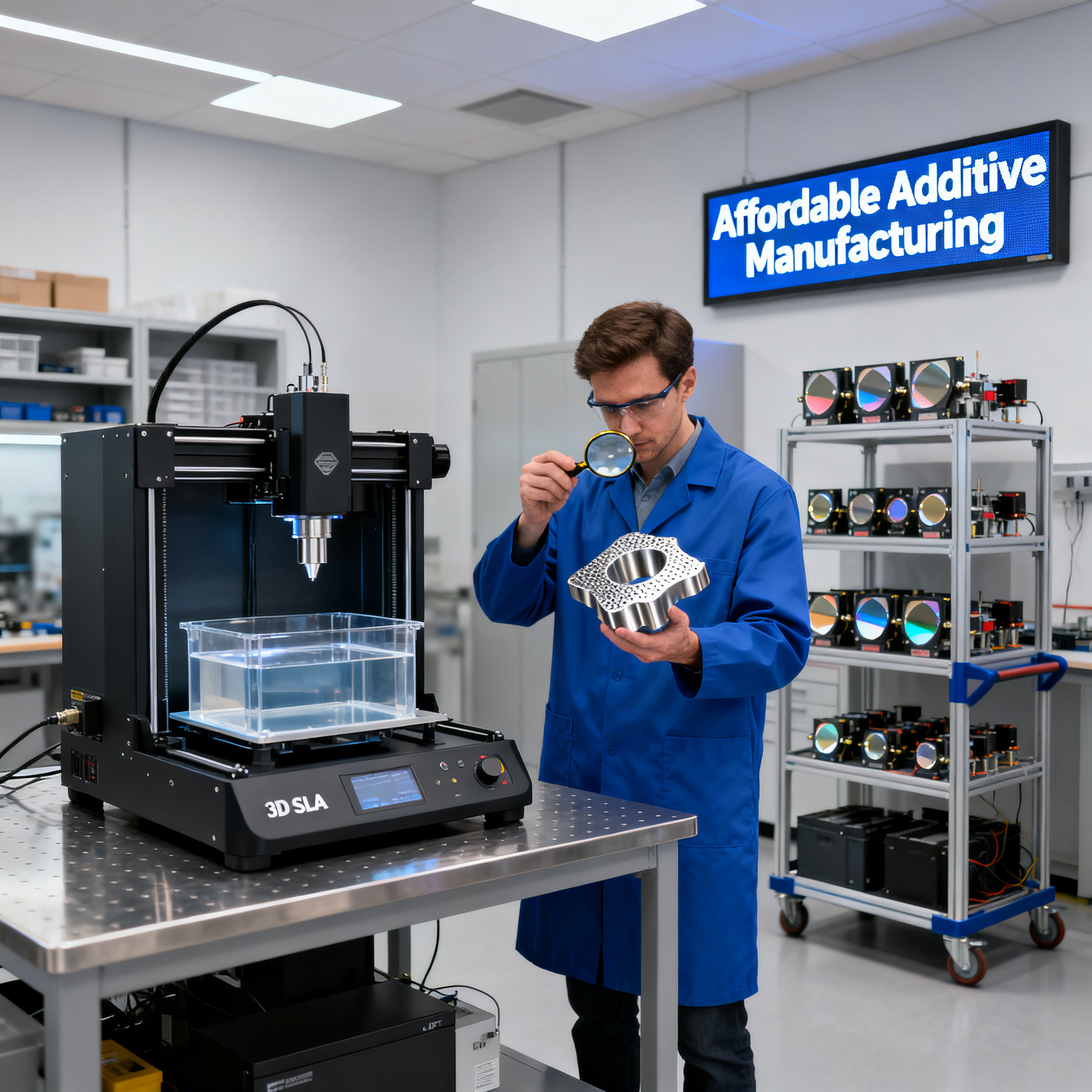
Who is in charge when costs dictate the law?
The evolution of additive manufacturing is more a story of low-cost key components than of individual machines: here is how the ongoing change really works.
Low-cost key components: the engine of change
The price reduction of critical components such as lasers and light engines is democratizing access to LPBF and SLA technologies, redefining the barriers to entry in the sector.
Advances in low-cost lasers are transforming the additive manufacturing market. Companies like Metal Base can now produce metal LPBF printers for under $10,000, continuing the same wave that allowed Sinterit, Sintratec, and Formlabs to make polymer LPBF systems accessible.
The real revolution is not in the individual machines but in the components that power them. Low-cost lasers and new diode laser formats are driving developments in both LPBF and SLA.
- Metal LPBF printers now available for under $10,000
- Advances in low-cost lasers enable new market players
- Vat polymerization depends on Texas Instruments DMD mirror setups
In vat polymerization, Texas Instruments' DMD mirror technology has made large-scale production possible. Companies like Scanlab and Visitech have centralized complex science into mountable and affordable packaging, doing the heavy lifting to make new printing platforms possible.
Modularity and scalability: the legacy of open platforms
The standardization of components such as scan heads and DMD mirrors allows new industrial realities to compete without massive R&D investments, focusing innovation on specific applications.
Component suppliers have made advanced technology accessible. Scanlab, Visitech, and others have transformed complex scientific processes into standardized modules that startups can integrate directly.
This modularization has shifted the focus from hardware to operational support. Industrial scalability has become a matter of support, not hardware.
In inkjet processes, the billions invested by printhead manufacturers drive much of the functionality. This model is also replicating in other additive technologies.
Companies must focus less on machine releases and more on developments in light engines. Looking at individual products means counting cup holders while ignoring the electrification of the vehicle.
Standardized training and professional installation are becoming critical factors. When print farms scale beyond ten units, the artisanal approach fails because inadequate support multiplies every small problem across the entire fleet.
New leaders for new markets
With increased adaptability to specific use cases, companies that focus on ease of use and contained costs gain market share, redefining the very concept of technological leadership.
Absolute quality is no longer the only competitive parameter. Parts produced by cheap metal 3D printers do not match those of industrial systems, but that is not the point.
| Parameter | Industrial system | Economic system |
|---|---|---|
| Part quality | Maximum | Suitable for the use case |
| Cost | High | Under 10,000 $ |
| Ease of transport | Limited | High |
| Indoor use | Complex | Simplified |
Like a shovel cannot dig as much as a Liebherr R9800 excavator weighing 800 tons, but it costs less and is easier to use indoors. Everything depends on the use case, the user, and the value proposition.
Many people want access to metal parts. We do not yet know if current quality and cost will be enough to convince them, but this value proposition depends on understandings that we still do not have.
Ecosystems do not scale through control but through openness. Global logistics works not because one actor dominates, but because many specialized actors operate in a shared framework.
Conclusion
The future of additive manufacturing will not be dominated solely by technological power, but by the ability to scale based on the real needs of the market. The democratization of critical components is reshaping competitive dynamics.
Adaptability to the specific use case matters more than extreme performance in emerging market segments. Economical and easy-to-use systems are opening opportunities that traditional industrial systems cannot reach.
Analyze how your value chain can benefit from these new operational dynamics. A rising tide lifts all boats, but only if we are willing to build the conditions that allow that tide to rise.
article written with the help of artificial intelligence systems
Q&A
What is the main factor that is democratizing access to additive manufacturing technologies?
The reduction in prices of critical components such as lasers and light engines is lowering entry barriers to the sector, allowing more companies to access technologies like LPBF and SLA.
How have low-cost lasers impacted the metal 3D printer market?
Low-cost lasers have enabled the production of metal LPBF printers priced under $10,000, opening the market to new players and applications.
Which companies have contributed to the spread of additive technologies thanks to component modularity?
Companies like Scanlab and Visitech have simplified the integration of complex technologies through standardized modules, enabling startups and new industrial players to focus on applications rather than hardware research.
How is the strategic focus of companies in the additive manufacturing sector changing?
Companies are shifting their attention from individual hardware products to developing light engines and operational support, since scalability requires professional rather than artisanal solutions.
Why are cost-effective systems gaining market share compared to industrial ones?
Because they offer a good quality-to-price ratio suitable for specific use cases, being easier to use, transport, and install, even though they do not match the maximum quality of industrial systems.