3 hours, not 3 days for assembly?
Industrial 3D printing goes beyond the prototype: today it's about producing functional parts ready for assembly, and threaded inserts are a strategic ally.
Why inserts change the industrial game
Threaded inserts transform printed components into assembleable parts, eliminating the weak point of plastic threads subject to repeated wear.
For many companies, 3D printing is no longer just rapid prototyping. It's used to produce components destined for machines, electronic devices, equipment, and small functional series. The problem isn't printing the geometry well, but delivering a part that is mountable, dismountable, and reusable without the screw point becoming the weak point.
Those who design plastic parts know the limit of threads made directly in the material. A printed threaded hole can work in simple applications, but it wears out when the screw is inserted and removed multiple times. The problem worsens with small threads, repeated assemblies, axial loads, or vibrations.
- Resistance to repeated assembly and disassembly cycles
- Load capacity up to 64 kg for M2 inserts in specific tests
- Integration with standard commercial components
- Elimination of wear on plastic threads
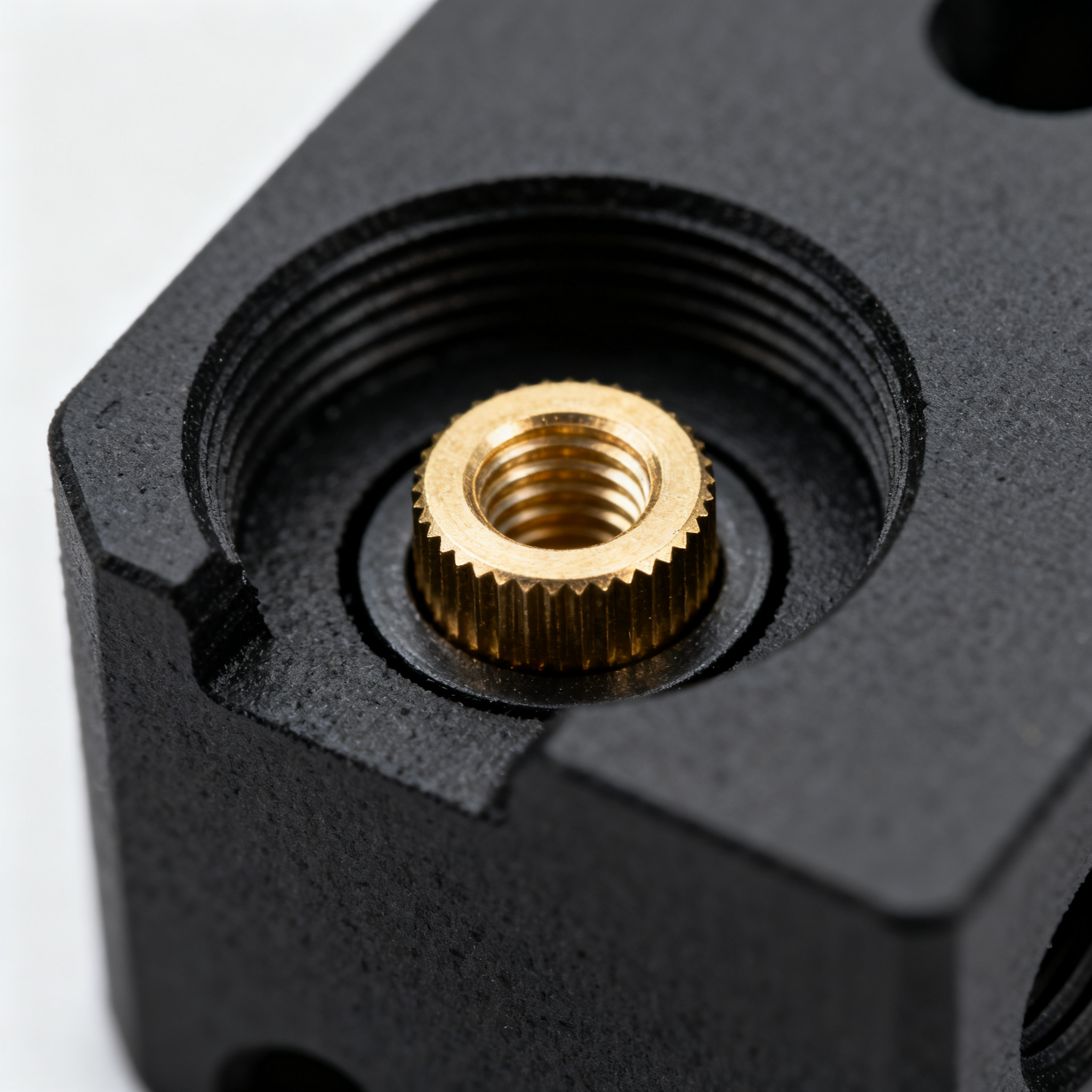
Threaded inserts solve this limitation: instead of relying on the plastic for retention, a metal element with an internal thread is inserted. The screw works on metal, while the body of the insert is anchored in the molded part. An electronic housing that must be opened for maintenance, a sensor support, or an industrial jig cannot depend on a fragile thread.
Smart quote: when CAD speaks of inserts
Integrating inserts into online quoting systems eliminates manual steps and reduces errors, bringing post-processing into the digital flow of the order.
3D People, an industrial 3D printing service based in London, has integrated the configuration of threaded inserts directly into its online quoting tool. The goal is to allow customers to specify these elements already during the order phase, reducing manual steps between CAD model submission, post-processing request, and technical confirmation.
The main novelty concerns the order flow. Bringing critical post-processing into the digital flow forces a better definition of fixation points and reduces the risk of receiving a printed part that requires unplanned further processing.
This approach reflects a broader trend. Protolabs offers a quoting platform where the price updates in real-time based on user choices. Hubs promises quotes in a few seconds after uploading the CAD file. The customer is not looking for a “printed part,” but a directly usable component.
Ultrasonic, thermal, or press-fit? How to choose
Each insertion technology has specific requirements for material, geometry, and application. The wrong choice compromises the entire assembly.
3D People has dedicated a white paper to the performance of threaded inserts in 3D printed polymer materials. The document evaluates various metric sizes with axial extraction resistance tests and behavior after load cycles.
| Insert type | Ideal application | Material requirements |
|---|---|---|
| Ultrasonic | High-load repeated assemblies | Rigid thermoplastics |
| Thermal | Permanent or semi-permanent fixings | Materials with good heat resistance |
| Press-fit | Quick installation without tools | Geometries with precise tolerances |
You cannot choose how many fasteners to use without knowing the load capacity of the insert in the specific material. Geometry, material, orientation, thickness, and installation all affect the result. It is essential to treat the insert not as an accessory, but as a design element to be sized.
Practical cases: from prototype to continuous production
Companies that have automated insertion into the production flow report drastic reductions in assembly times and waste.
In an electronic enclosure, the insert allows the cover to be opened and closed multiple times without wearing out the plastic. In a robotics component, it enables fixing motors, sensors, or commercial plates with standard screws. In an industrial jig, it allows replacing worn parts without remaking the entire component.
Integrating inserts into the quoting tool reduces steps between design and production. Velocity CNC reported a 10x reduction in quoting time, contributing to a doubling of annual sales.
3D People presents itself as a partner for polymer components produced additively, with orders via an online portal and production in its London facility. The company was founded in 2017 by Sasha Bruml and Felix Manley. Their approach combines internal production capacity, a digital platform, and technical support.
Conclusion
Integrating threaded inserts intelligently is not only a technical choice but a strategic one. It can reduce assembly time by up to 70%, eliminating rework and ensuring reliability in repeated cycles.
The value of 3D printing lies not only in geometric freedom but in the ability to deliver parts ready for real systems. Threaded inserts fit into this logic: they are small, but often determine whether a part can be mounted reliably.
Evaluate today the implementation of a quoting system that supports native insertion: your process will gain in speed and precision. The difference between a printed component and an assembleable one also passes through these details.
article written with the help of artificial intelligence systems
Q&A
Why do threads cut directly into 3D printed plastic material represent a problem for industrial assembly?
Plastic threads wear easily when the screw is inserted and removed repeatedly, compromising the seal over time. The problem is aggravated with small threads, repeated assemblies, axial loads or vibrations, making the screwing point the weak point of the component.
What concrete advantages do metal threaded inserts offer in parts produced by 3D printing?
Threaded inserts guarantee resistance to repeated cycles of assembly and disassembly and can withstand loads up to 64 kg for M2 inserts in specific tests. Additionally, they eliminate wear on plastic threads and allow integration with standard commercial screws and components.
How does the workflow change when threaded inserts are integrated directly into the online quote system?
Integration into the quoting system eliminates manual steps between CAD model submission, post-processing request, and technical confirmation. This brings post-processing into the digital order flow, reduces errors, and ensures that the customer receives a part ready to be assembled without unplanned machining.
What are the main insert installation technologies and in which cases are they most suitable?
The three main technologies are ultrasonic insertion, ideal for repeated high-load assemblies on rigid thermoplastics, thermal insertion, suitable for permanent fastening on materials with good thermal resistance, and press-fit, appropriate for rapid installations without equipment on geometries with precise tolerances.
What is the impact of using threaded inserts on assembly times and production?
Strategic use of inserts can reduce assembly time by up to 70%, eliminating rework and ensuring reliability in repeated cycles. Integration of this option into digital quotation systems also drastically reduces quoting times, accelerating the transition from design to production.