HyCAT: 300 km/h in 3 days? Testing hypersonics at a rapid cycle
Traditional aerodynamic testing cycles take months and cost too much. New industrial scenarios require flexibility and speed.
The future of industrial aerodynamics relies on faster, cheaper, and more repeatable hypersonic testing. The Pentagon's HyCAT program demonstrates how dedicated test vehicles can accelerate technological development without compromising quality.
By 2034, rocket engines will be the main source of value for manufacturers of components made with additive technologies. For this scenario to become a reality, the testing phase must become much more frequent and accessible.
Changing course: why old methods fail
Wind tunnels and traditional tests represent a bottleneck. Limited availability slows innovation and inflates costs.
The Pentagon's Defense Innovation Unit (DIU) launched HyCAT – Hypersonic and High-Cadence Airborne Testing Capabilities – to overcome the limits of traditional infrastructure. Wind tunnels are few, expensive, and overloaded with requests.
Current hypersonic programs cannot afford timelines of months between one test and the next. Every delay translates into unresolved technological risks and delayed operational capabilities.
- Limited availability of wind tunnels
- High costs for single test campaigns
- Test cycles spaced months apart
- Unresolved technological risks in useful times
HyCAT and the dedicated test vehicle model
The American program shows how specialized vehicles drastically reduce qualification times without sacrificing accuracy.
HyCAT focuses on test platforms that can be produced and launched with much closer cycles. The goal is to provide usable flight vehicles to validate the entire hypersonic value chain.
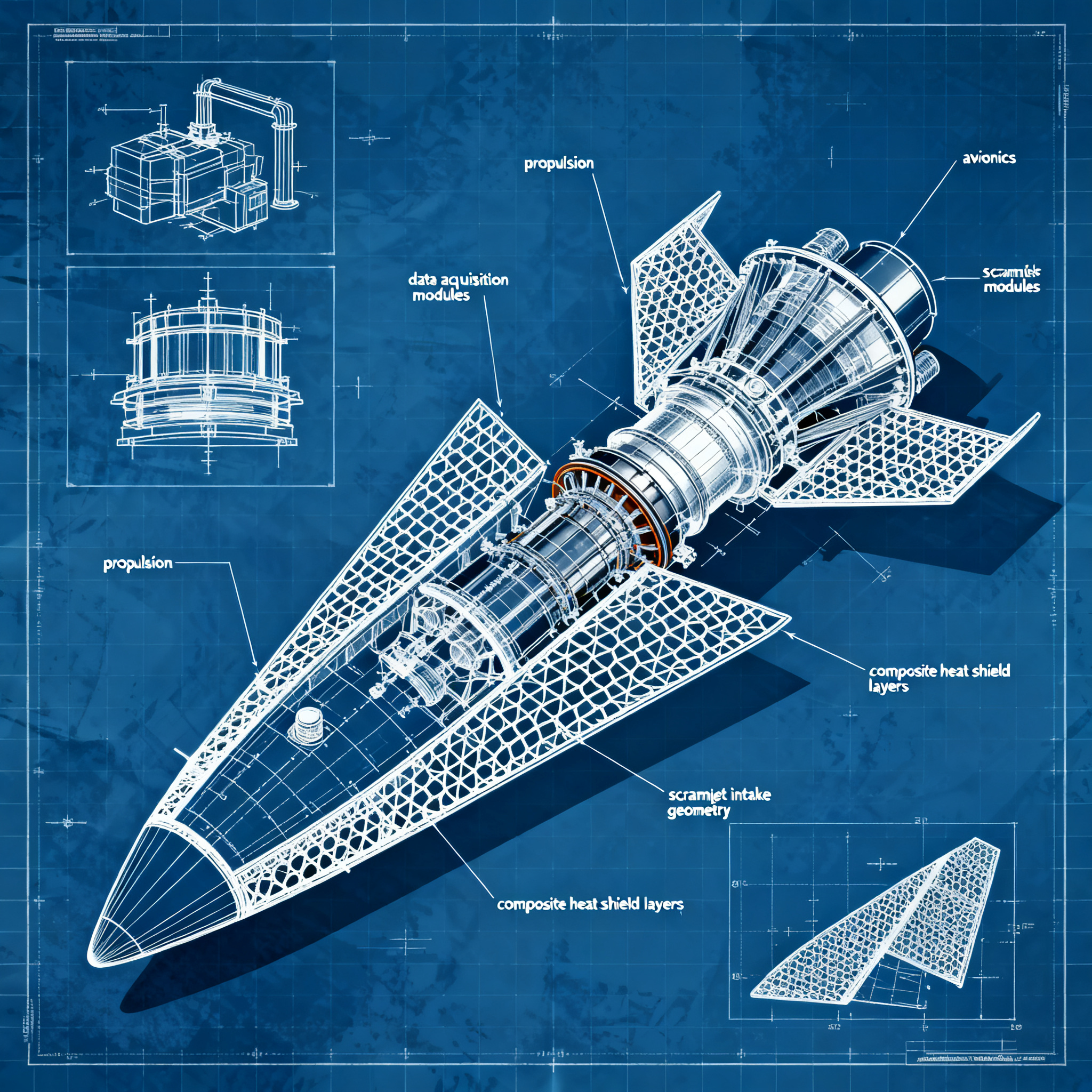
In the first test, the DIU used the DART AE platform from Hypersonix Launch Systems. The vehicle was launched with HASTE, a variant of Rocket Lab's Electron rocket optimized for suborbital missions.
DART AE is 3 meters long and is entirely produced with digital processes. This combination allows for a more industrial testing model based on frequent iterative cycles.
Variant of the Electron launcher optimized for flight profiles suitable for hypersonic experimentation. Allows repeatable access to specific Mach numbers, altitudes, and aerodynamic loads.
Integrated production and testing: the closed-loop approach
Directly connecting manufacturing and testing enables immediate corrections and rapid iterations, essential in hypersonic projects.
HyCAT validates not only scramjet engines and high-temperature materials. The program also tests avionics, guidance systems, control surfaces, thermal protection systems, and integration interfaces.
A high-cadence testing infrastructure is essential to support the numerous hypersonic programs funded by the Pentagon. It reduces technological risks and compresses timelines from development to operational capability.
The combination of a qualified commercial launcher and a test vehicle produced entirely with digital processes eliminates isolated campaigns with high unit value. It shifts to frequent and controllable cycles.
Integrated test cycle
- Digital design: Rapid CAD changes without constraints of traditional tooling.
- Additive manufacturing: Test vehicle produced in days, not months.
- Launch and data acquisition: Real-world hypersonic testing with full telemetry.
- Analysis and iteration: Immediate corrections for the next cycle.
How to scale: frequency vs cost in aerodynamic testing
More tests mean less risk. But only if each session costs less and is executed with greater continuity.
The HyCAT model aims to make hypersonic tests cheaper and faster to produce. The goal is to facilitate platform reuse and reduce costs per flight.
A higher testing frequency allows for validating more design variants in parallel. This approach reduces technical uncertainty and accelerates the maturation of critical technologies.
The availability of commercial launchers like HASTE further lowers the barriers. There is no longer a need to wait for slots in overloaded government infrastructures.
| Parameter | Traditional approach | HyCAT Model |
|---|---|---|
| Time between tests | Months | Days/weeks |
| Cost per test | Very high | Content |
| Infrastructure availability | Limited | Commercial/flexible |
| Iteration capability | Low | High |
Conclusion: test often, quickly, and at low cost
Testing often, quickly, and at low cost is no longer a dream. It is a competitive necessity for those operating in industrial aerodynamics and hypersonic systems.
The HyCAT program demonstrates that combining additive manufacturing, dedicated test vehicles, and commercial launchers creates a new paradigm. Tight cycles and contained costs enable integrated validation of the entire value chain.
Evaluate your testing infrastructure today: how many weeks can you save? The adoption of tight production and launch cycles is the critical factor for future competitiveness in the aerospace sector.
article written with the help of artificial intelligence systems
Q&A
What is the main objective of the HyCAT program?
HyCAT aims to reduce the time and costs of hypersonic aerodynamic tests, shifting from cycles of months to cycles of days. The program seeks to make tests more frequent, economical, and repeatable to accelerate technological development.
What are the main limitations of traditional aerodynamic testing methods?
Traditional methods have limited availability of wind tunnels, high costs, and widely spaced test cycles. These factors slow down innovation and increase unresolved technological risks.
How does the dedicated test vehicle model introduced by HyCAT work?
The model relies on rapidly produced test platforms through digital processes and launched with commercial launchers. This enables iterative, frequent, and low-cost test cycles while maintaining high accuracy.
What is the role of HASTE in the HyCAT program?
HASTE is a variant of Rocket Lab's Electron rocket, optimized for suborbital missions. It is used to launch test vehicles such as DART AE, ensuring repeatable access to controlled hypersonic conditions.
How does HyCAT's integrated cycle improve technological development?
By directly linking design, production, and testing, HyCAT allows immediate corrections and fast iterations. This makes it possible to validate critical components such as scramjet engines, guidance systems, and thermal protections in short timeframes.