Latest additive manufacturing news

Sustainability in Industrial 3D Printing: Understanding Environmental and Technological Trade-offs

Sustainability in Industrial 3D Printing: Understanding Environmental and Technological Trade-offs

Industrial 3D printing can reduce environmental impact, but it requires strategic choices on materials, energy efficiency and life cycle management. Although it offers advantages such as less waste and simplification of the supply chain, the real benefit depends on sustainable feedstocks, efficient processes and recovery policies. Studies show that the use of recycled material and energy sources

Implementing Innovations in Mechanical Testing and Quality Assurance: An Operational Plan for Advanced Industry

Implementing Innovations in Mechanical Testing and Quality Assurance: An Operational Plan for the Advanced Industry

The article presents an operational plan to integrate innovations in mechanical testing and quality assurance in the advanced industry, particularly in metal additive production. The importance of qualifying feedstock, machinery, and production processes from the initial stages is emphasized to ensure reliability, traceability, and compliance in critical sectors such as aerospace and defense. Ve

Advanced Photopolymerization: When Speed Meets Precision

Advanced Photopolymerization: When Speed Meets Precision

Advanced photopolymerization in 3D printing includes technologies such as TVAM, which is fast but less precise, and 2PP, which is extremely detailed but slow. Both offer complementary advantages: TVAM for rapid volumes, 2PP for micro-details. Hybrid solutions integrate the two technologies to maximize productivity and precision, opening up new possibilities in fields such as bio-engineering and micro-optics.

Prusa PETG Ultraglow vs. Alternatives: Is it the True Leap Forward for Nighttime 3D Printing?

Prusa PETG Ultraglow vs. Alternatives: Is it the True Leap Forward for Nighttime 3D Printing?

Prusa launches PETG Ultraglow, a high-quality phosphorescent filament. Superior to glow-in-the-dark PLA for brightness and durability. Ideal for technical and safety applications thanks to the resistance of PETG and its ability to shine for a long time. Requires hardened nozzles for printing. High cost but justified for professional use.

Microscale Mechanical Analysis: How MultiScale Technology Revolutionizes Non-Destructive Testing

Microscale Mechanical Analysis: How MultiScale Technology Revolutionizes Non-Destructive Testing

Plastometrex's MultiScale technology revolutionizes non-destructive testing through microscale mechanical analysis. It enables the characterization of thin or complex components, with thicknesses up to 0.75 mm, without damaging them. Using indenters of different sizes and a spacing of 1.5 mm, it generates high-resolution maps of mechanical properties, revealing local variations invisible to the

Metamaterials in Nitinol for Medical Applications and Actuators: How Geometric Design Restores Superelasticity

Metamaterials in Nitinol for Medical Applications and Actuators: How Geometric Design Restores Superelasticity

Researchers from IMDEA Materials Institute and UPM have developed metamaterials in 3D printed Nitinol with interwoven structures that restore superelasticity, overcoming the limits of traditional 3D printing. Thanks to geometries inspired by fabrics, it is possible to obtain advanced biomedical devices and smart actuators, opening new perspectives for clinical and engineering applications

Implementing Industrial Adoption of 3D Printing in Non-Traditional Sectors

Implementing Industrial Adoption of 3D Printing in Non-Traditional Sectors

Industrial adoption of 3D printing in non-traditional sectors, such as automation, robotics, and energy infrastructure, is growing thanks to structured operational plans. By integrating digital design, simulations, and rapid production, companies like Boston Dynamics and Siemens are optimizing products and processes, reducing costs, times, and the number of components.

Large-Scale Customization and Retail Integration: How the New Production Model Really Works

Large-Scale Customization and Retail Integration: How the New Production Model Really Works

The convergence between additive manufacturing and retail is redefining custom production, extending it from consumer goods to industrial sectors. Thanks to 3D printing, it is possible to produce multiple variants without additional costs, while artificial intelligence manages design complexity. Retail points are transforming into production and data collection nodes, enabling personalization

How Large-Scale Directed Energy Deposition Works: Advanced Melt Pool Control and Precision in Deposition

How Large-Scale Directed Energy Deposition Works: Advanced Melt Pool Control and Precision in Deposition

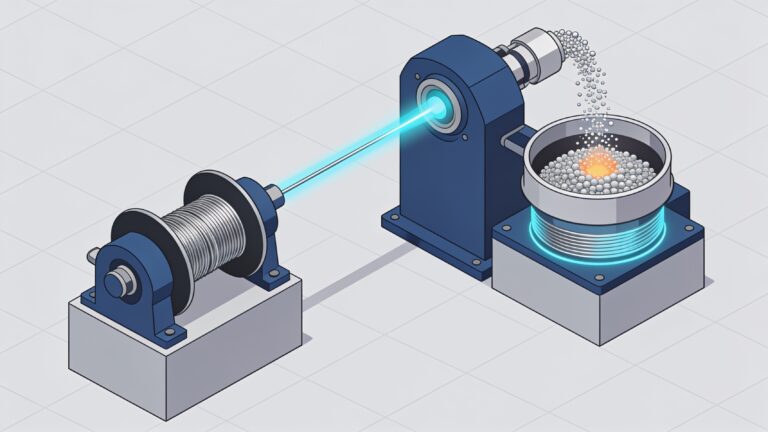
Large-scale Directed Energy Deposition utilizes real-time melt pool monitoring, targeted deposition, and dynamic modeling to ensure precision, metallurgical quality, and thermal control during the production and repair of large metal components.

How In-Process Metrology Works in Metal Additive Manufacturing

How In-Process Metrology Works in Metal Additive Manufacturing

In-process metrology in metal additive manufacturing enables precise measurement during production, ensuring repeatable and scalable quality. Unlike traditional monitoring, it provides quantitative and traceable data, reducing the reliance on costly post-process inspections. Technologies such as optical fringes allow for real-time 3D measurements, improving affi

Industrial Build Preparation Automation: The Concrete Plan to Reduce Errors and Times

Industrial Build Preparation Automation: The Concrete Plan to Reduce Errors and Times

Automation of build preparation in additive manufacturing reduces errors and time through standardized and repeatable processes. Solutions like AMIS Runtime enable intelligent nesting and continuous optimization, increasing density and production flexibility. Benefits include fewer human errors, greater machine efficiency, and cost reduction. Integration requires val

Post-Processing and Debinding: How Key Additive Manufacturing Technologies Work

Post-Processing and Debinding: How Key Additive Manufacturing Technologies Work

Post-processing and debinding are crucial stages in additive manufacturing that determine the quality, strength, and finish of components. Technologies such as vapor smoothing and chemical debinding improve surface and structural properties, making parts ready for industrial use.

/