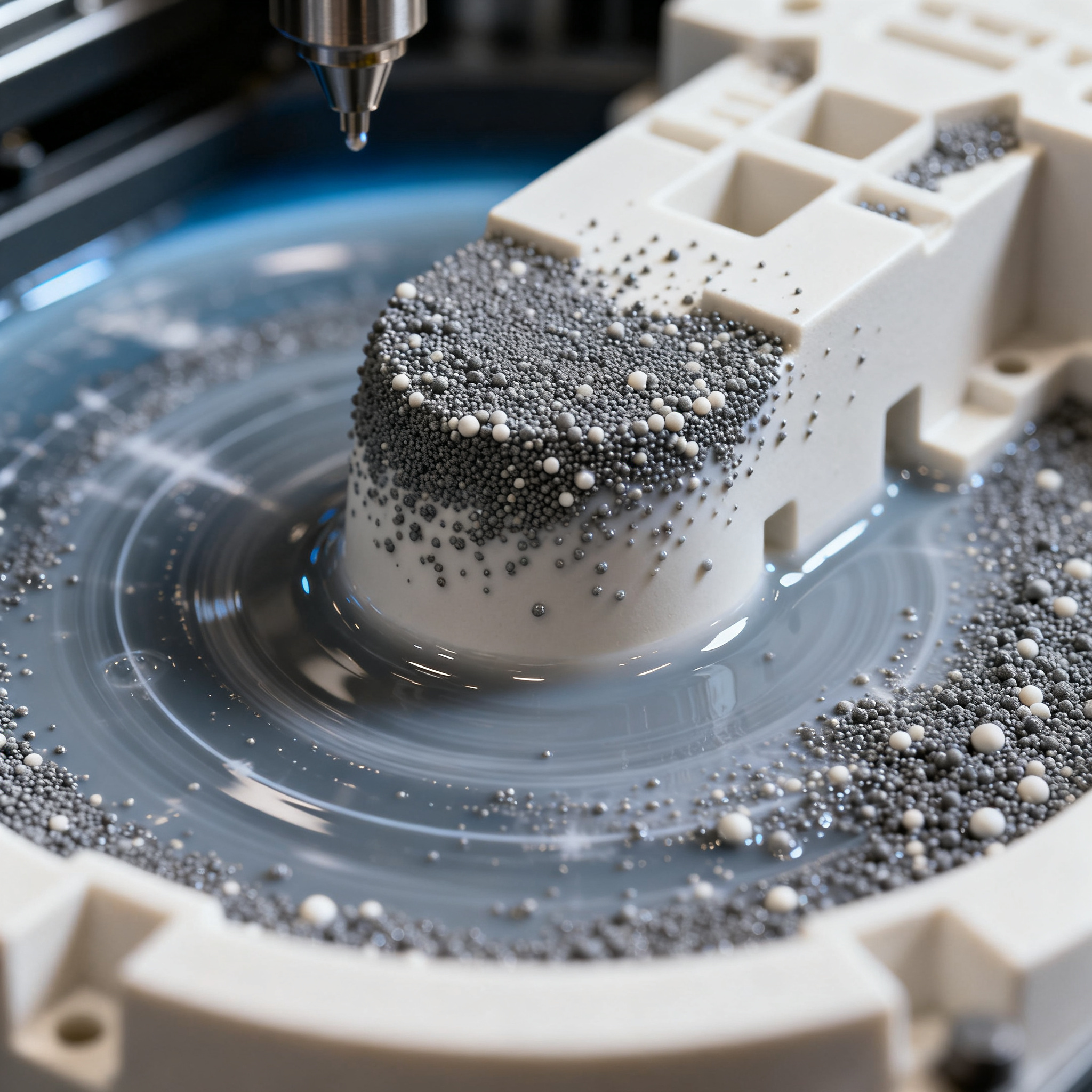
Does 3D printing in space produce better ceramics?
3D printing in microgravity not only works, but improves the quality of ceramic components thanks to the uniform distribution of materials. Tests conducted on parabolic flights show that materials like silicon carbide and alumina perform better without gravity.
The British company Photocentric has created CosmicMaker, a division dedicated to space manufacturing, after successfully testing three 3D printers aboard Novespace’s Airbus A310 Zero G. During the April flights, the machines produced components through cycles of 22 seconds of microgravity alternating with phases of variable gravity between 0g and 2g.
- Tutte e tre le stampanti hanno funzionato durante l’intero volo
- Production of components with four different materials: silicon carbide, alumina, and two thermosetting polymers
- Dimensional accuracy confirmed on all pieces produced
Why microgravity changes everything
In the absence of gravity, ceramic materials distribute more evenly, eliminating separation problems that afflict terrestrial production.
The most surprising result concerns ceramics themselves. Silicon carbide and alumina provided better results during microgravity phases than during normal or increased gravity phases. Without the force that pulls heavier particles downward, ceramic mixtures maintain a homogeneous distribution throughout the process.
During higher gravity phases, the particles tended to separate from the surrounding liquid suspension. This phenomenon compromises the final quality of the piece. Microgravity naturally eliminates this physical problem.
CosmicMaker: the process that uses no supports
The system keeps components immersed in liquid material during construction, using microgravity to eliminate support structures.
Unlike many 3D printing systems, CosmicMaker surrounds parts with liquid material as they are built. This means that the printed object remains naturally supported throughout the entire process. In microgravity, no additional structures are needed.
This feature represents a decisive advantage for future space applications. While most additive systems must be adapted to work in space, CosmicMaker could work better in microgravity than on Earth.
The platform is based on LCD systems already used by Photocentric to produce tens of millions of components on Earth, ensuring reliability and process traceability.
Materials that work better in space
Silicon carbide and alumina show superior properties when processed in orbit, opening new possibilities for advanced components.
The system is designed to work with a wide range of materials: plastics, ceramics, metals and composites. Weight and energy consumption remain low, two critical factors when equipment must be launched into space.
Tests have confirmed that ceramic materials directly benefit from the microgravity environment. Heavy particles do not settle at the bottom of the tank as happens on Earth. The result is superior structural quality and greater uniformity of mechanical properties.
The technology is based on an LCD photopolymerization process. A light projected through a mask selectively solidifies the resin. This method consumes less energy than thermal processes and does not require handling of loose powders, an important advantage in enclosed environments such as space stations or lunar habitats.
3D printing in microgravity is not just a technological curiosity, but a real evolution for the production of advanced components in space. The results obtained with ceramic materials demonstrate that some manufacturing technologies can work better off Earth than on our planet.
Discover how ceramic materials are redefining the orbital industry and production possibilities for long-duration missions.
article written with the help of artificial intelligence systems
Q&A
What is CosmicMaker and which company developed it?
CosmicMaker is the space division created by the British company Photocentric to focus on in-orbit manufacturing. It was born after the success of 3D printing tests conducted aboard Novespace's Airbus A310 Zero G.
How does microgravity improve the quality of ceramic components?
In the absence of gravity, ceramic materials such as silicon carbide and alumina distribute more uniformly because heavier particles are not dragged downward. This eliminates the separation issues typical of terrestrial production and ensures superior structural quality.
Which materials were tested during the parabolic flights and what results were obtained?
Four materials were tested: silicon carbide, alumina, and two thermosetting polymers. All three printers operated throughout the flight and dimensional precision was confirmed on all parts, with better results for ceramics in microgravity.
What is the main advantage of the CosmicMaker process regarding support structures?
The process keeps components immersed in the liquid material during construction, eliminating the need for additional support structures. In microgravity the object remains naturally supported, which represents a decisive advantage for future space applications.
Why is the LCD photopolymerization process particularly suitable for space environments?
This technology consumes less energy compared to thermal processes and does not require management of loose powders. These characteristics make it ideal for enclosed environments such as space stations or lunar habitats, where weight and energy consumption are critical.
What are the practical implications of these results for future space missions?
3D printing in microgravity proves to be a real evolution for the production of advanced components directly in orbit. It opens new possibilities for the manufacturing of ceramics, metals, and composites during long-duration missions, without depending on supplies from Earth.