3 concrete ways to accelerate PBF?
Metal 3D printing is emerging from the pioneering phase: today the real battlefield is on powder bed uniformity, density of finished parts, and setup time. Two recent patents focus precisely on these bottlenecks.
The innovations described do not overhaul the architecture of PBF machines. Instead, they address two critical points: the quality of the fresh powder layer and the speed at which the right parameters are found for each material.
Controlled vibration for a perfect layer
A system that applies targeted vibrations to the powder distributor promises to improve layer uniformity and reduce surface defects.
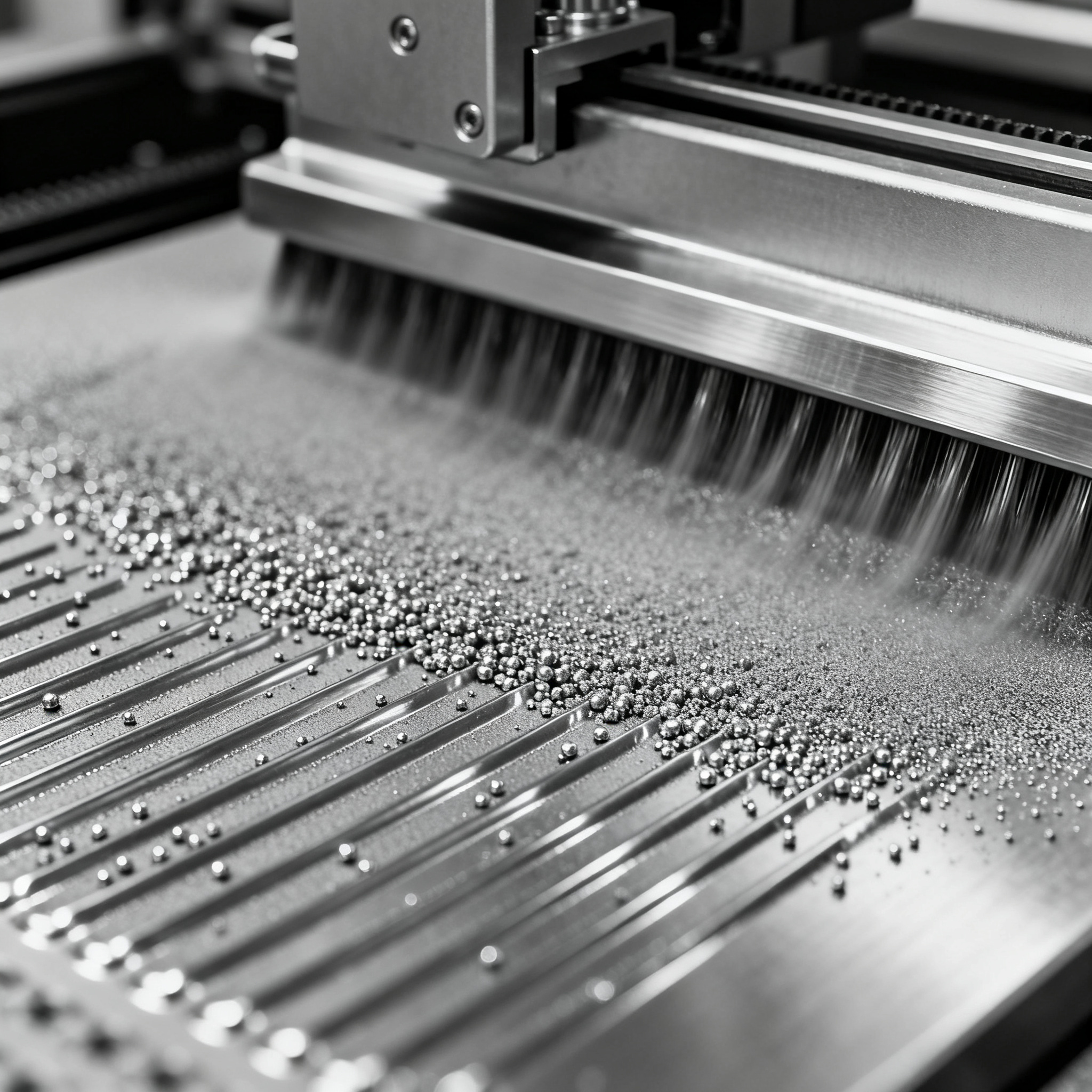
The patent “IMPROVING FLOWABILITY OF AM POWDERS” proposes to vibrate the powder distributor at a predetermined frequency during spreading. The goal is to improve material flowability and obtain more leveled and homogeneous layers.
The logic is simple: many metal powders have poor flowability. This generates areas with irregular thickness, which in turn cause fusion defects or geometric distortions. Vibrations help to better arrange the particles, reducing voids and accumulations.
- Greater uniformity of the powder layer
- Reduction of surface defects related to irregularities in spreading
- Possible increase in cycle speed due to more reliable layers
The patent does not specify frequency or amplitude values. This suggests that calibration will have to be done on a case-by-case basis, depending on the type of powder and the geometry of the distributor.
The use of controlled vibrations is already established in sectors such as industrial dosing and the handling of granules. Their integration into existing PBF systems therefore appears technically feasible, although it will require attention to the mechanical wear of the distributor.
Rapid optimization of process parameters
A systematic methodology allows achieving densities above 99.95% in reduced times, cutting the number of experimental trials.
The patent “METALLIC RETICULAR STRUCTURE AND METHOD FOR ESTABLISHING PARAMETERS” describes a structured approach to identify the combinations of parameters that maximize density and productivity.
The tables reported in the patent show concrete results. In the first series, 15 experiments explored combinations of laser power, scan speed, hatch distance, and layer thickness. Several sets achieved relative density of 99.95% or higher.
| Series | No. of experiments | Max density (%) | Optimized parameters |
|---|---|---|---|
| Series 1 | 15 | 99,99 | Main infill |
| Series 2 | 12 | 99,99 | Infill with greater spacing |
| Series 3 | 16 | Not specified | Edge parameters |
The second series tested wider bead distances (from 110 to 160 µm) while maintaining densities above 99.93%. This indicates that it is possible to reduce the number of laser passes without compromising quality, increasing the production rate.
The method proposed in the patent does not require complex predictive models or advanced simulations. It is based on direct experimental data, which makes it replicable even in production environments without advanced modeling skills.
The third series focuses on edge parameters, keeping infill parameters constant. This modular approach allows optimizing the different zones of the part separately, reducing the overall setup time.
Trade-off and operational limits
The new technologies are not free from critical issues: mechanical wear, specific calibrations, and limits of applicability condition their adoption.
The vibration system described in the patent “IMPROVING FLOWABILITY OF AM POWDERS” introduces an additional mechanical variable. This could accelerate wear of the distributor, especially with abrasive powders such as those based on titanium or hard alloys.
The patent does not provide indications on expected lifespan or maintenance. This is a critical point for industrial adoption, where machine downtime costs weigh heavily on the TCO.
The need for specific calibrations for each type of powder could lengthen initial qualification times, especially in multi-material contexts.
Regarding the parameter optimization method, the patent “METALLIC RETICULAR STRUCTURE AND METHOD” shows results on simple geometries (cubic samples). It is not clear how extendable the methodology is to complex geometries or to reticular structures with local density variations.
The patent reports that some parameter sets were not produced (indicated as “Not manufactured” in the tables). This suggests that there are non-viable combinations, but the exclusion criteria are not explained.
Both solutions require operational know-how to be implemented effectively. They are not “plug-and-play”, but tools that need to be integrated into a broader qualification process.
Reality check: when and where they really apply
Despite the advantages, the effectiveness depends on the production context, materials, and operational know-how.
The vibration system makes sense especially where the layer quality is already a known problem. For example, with irregular morphology powders or in machines with rigid distributors that tend to leave lines.
In contexts where the powder already flows well, the benefit may be marginal. The patent “IMPROVING FLOWABILITY OF AM POWDERS” does not provide direct comparative data, so the extent of improvement must be verified case by case.
Application of the optimization method
- Series 1: tests on main infill parameters with cubic samples.
- Series 2: exploration of larger spacings to increase the production rate.
- Series 3: optimization of border parameters while keeping infill parameters constant.
- Validation: verifica su geometrie rappresentative del caso d’uso reale.
The optimization method described in the patent “METALLIC RETICULAR STRUCTURE AND METHOD” is more universal. It can be applied to any material and machine, provided one has the time and resources to conduct the experimental series.
The main advantage is the reduction in the number of trials compared to a trial-and-error approach. However, the patent does not quantify this saving in absolute terms.
The adoption in production also requires validation on pilot batches. Relative density data is a good indicator, but does not cover other critical properties such as fatigue resistance, surface roughness, or dimensional stability.
Conclusion
These innovations do not change the heart of PBF, but refine its critical margins. The vibration system acts on the quality of the layer, a known weak point. The parameter optimization method reduces setup time, a hidden but significant cost.
Both solutions are technically plausible and based on established principles. The real impact will depend on how quickly they are integrated into commercial machines and how effective the practical implementations are.
Evaluate whether your processes can benefit from these solutions already today, or within the next 24 months. If layer quality or material qualification time are bottlenecks, it is worth following the evolution of these patents.
article written with the help of artificial intelligence systems
Q&A
What does the patent "IMPROVING FLOWABILITY OF AM POWDERS" consist of and what problem does it solve?
The patent proposes applying targeted vibrations to the powder dispenser during spreading to improve its flowability. This enables more uniform and homogeneous layers to be obtained, reducing fusion defects and geometric distortions caused by irregular thicknesses.
What are the expected advantages of the vibration system for metal PBF printing?
The main benefits are greater uniformity of the powder bed, reduction of surface defects linked to spreading irregularities, and a possible increase in cycle speed thanks to more reliable layers. However, calibration must be defined on a case-by-case basis depending on the powder type and dispenser geometry.
How does the method described in the patent "METALLIC RETICULAR STRUCTURE AND METHOD" work to optimize process parameters?
It is based on progressive experimental series conducted on cubic samples to identify the parameter combinations that maximize density and productivity. The modular approach allows infill and border parameters to be optimized separately, reducing overall setup time compared to a trial-and-error method.
What concrete results has the patent on parameter optimization achieved?
The tables report that various combinations of laser power, scanning speed, and spacing achieved relative densities of 99.95% or higher, up to 99.99%. Furthermore, by using wider bead distances, high density was maintained, allowing laser passes to be reduced and the production rate to be increased.
What are the limitations and operational criticalities of these two innovations?
The vibration system could accelerate dispenser wear, especially with abrasive powders, and requires specific calibrations for each material. The parameter optimization method is tested on simple geometries and it is unclear how extendable it is to complex shapes; both solutions require operational know-how and are not plug-and-play.
When is it advisable to apply these technologies in a real production context?
The vibration system is indicated where layer quality is already critical, for example with powders having irregular morphology. The parameter optimization method is more universal and can be applied to different materials, provided that resources are available for experimental series and validation on pilot batches.