Perché i nuovi distributori liquidi potrebbero ridisegnare l’efficienza industriale?
Thanks to additive manufacturing, new liquid distributors with complex geometries promise to make industrial evaporators more efficient and sustainable. 3D printing is opening up unprecedented scenarios for components that, until today, were constrained by the limits of traditional production.
Distributori liquidi: l’evoluzione geometrica
3D printing enables geometries impossible with traditional methods, improving flow uniformity.
Liquid distributors for evaporators are crucial components in many industrial processes. Until today, the most common solutions were based on perforated plates or spray nozzles, with evident limitations: clogging, uneven distribution, rapid wear.
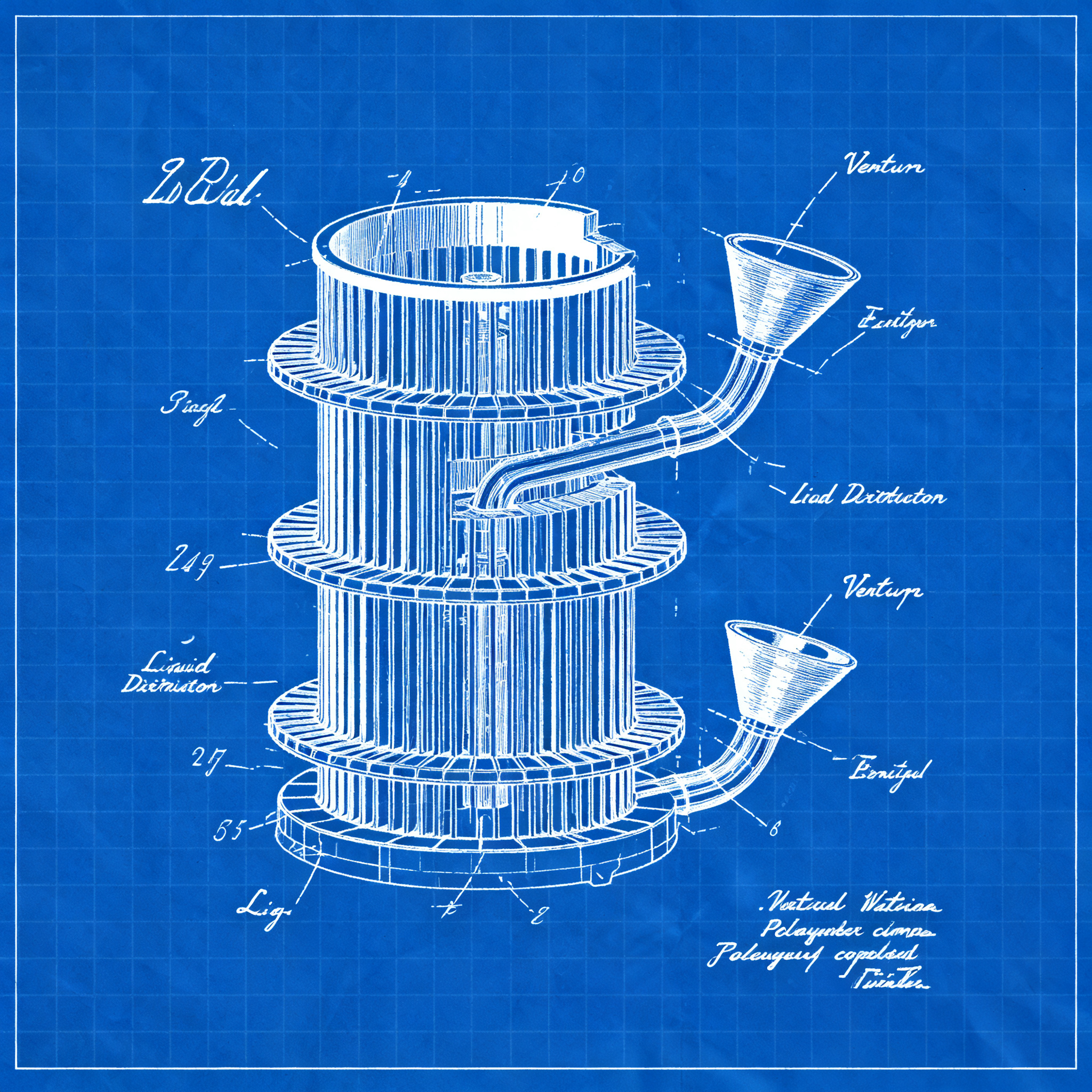
The patent “Multi-Cylinder Liquid Distributor for Evaporator Devices” proposes a system of three coaxial cylinders printed in 3D. The liquid enters the inner cylinder, passes through the intermediate one, and exits from the outer cylinder through longitudinal slots of variable width.
The width of the slots changes along the axis of the distributor. Near the inlet, where the pressure is higher, the slot is narrower; at the opposite end, where the pressure drops, it widens. This ensures a uniform flow along the entire length of the distributor.
- Three coaxial cylinders with variable-width slots to compensate for pressure differences
- Production in composite polymer material via additive manufacturing
- Creation of a uniform “liquid curtain” that falls vertically onto the heated tubes
The design described in the patent uses gravity and pressure to create a vertical and uniform liquid curtain. The cylinders are positioned horizontally, with the outlet slots strategically placed: the inner cylinder's slot at the bottom, the intermediate one at the top, the outer one again at the bottom.
Thermal efficiency within geometry's reach
I distributori a più cilindri e slot variabili riducono hot spot e aumentano l’efficacia degli scambiatori termici.
The uniformity of the liquid film is crucial for the efficiency of evaporators. Areas with too little liquid risk overheating; areas with too much liquid waste thermal energy.
The patent “Multi-Cylinder Liquid Distributor for Evaporator Devices” aims precisely at this: ensuring that each section of the heated tubes receives the same amount of liquid. The three-stage system automatically compensates for pressure variations along the distributor.
The composite polymer materials used allow complex internal geometries, which include directional fins to guide the flow and prevent unwanted turbulence.
Liquid flow in the three-cylinder system
- Inlet: the liquid enters the inner cylinder through a dedicated opening.
- First stage: exits from the variable slot of the inner cylinder and fills the space around it.
- Second stage: passes through the slot of the intermediate cylinder, positioned at the top.
- Final outlet: exits from the lower slot of the outer cylinder, forming a uniform curtain.
The second patent, “Distribution Device for a Liquid-Vapor Two-Phase Fluid and Related Method”, addresses a different but complementary problem. In refrigeration systems, the refrigerant arrives at the distributor as a liquid-vapor mixture. If this mixture is not homogeneous, some tubes of the evaporator receive more liquid, others more vapor.
The patent describes a distributor with integrated turbulent elements. These elements — angled deflectors, spirals, spring shapes — are printed directly inside the inlet duct. Their function is to create controlled turbulence that mixes the two phases.
After the turbulent elements, the duct has a Venturi-shaped section: it narrows and then widens. This creates an additional mixing effect, ensuring that each outlet duct receives the same liquid-vapor proportion.
| Feature | Traditional distributors | AM distributors |
|---|---|---|
| Flow uniformity | Variable, depends on mechanical tolerances | Controlled via optimized geometries |
| Internal elements | Absent or simple | Complex integrated turbulators |
| Pressure compensation | Limited | Variable width slots |
Concrete applications: from cooling to desalination
In sectors such as HVAC and desalination, the advantages translate into lower consumption and longer plant life.
The patent “Multi-Cylinder Liquid Distributor for Evaporator Devices” explicitly cites desalination as a target application. In falling film desalination plants, brackish water is uniformly distributed over heated tubes. Evaporation separates pure water from salt.
An irregular film causes problems. Zones that are too thin overheat and promote the formation of salt deposits. Zones that are too thick reduce thermal efficiency. The three-cylinder distributor aims to eliminate both problems.
The patent “Distribution Device for a Liquid-Vapor Two-Phase Fluid and Related Method” focuses on HVAC and refrigeration systems. In a heat pump or refrigeration system, the refrigerant enters the evaporator as a two-phase mixture after passing through an expansion valve.
If the distribution is uneven, some tubes work with excess liquid (reducing efficiency), others with excess vapor (reducing cooling capacity). The distributor with turbulent elements ensures that each tube receives the same mixture.
- Desalination: film d’acqua salmastra uniforme riduce incrostazioni e migliora la resa termica
- Heat pumps: distribuzione omogenea liquido-vapore aumenta l’efficienza dell’evaporatore
- Industrial refrigeration: fewer hot spots and longer life of thermal components
The claimed benefits are measurable. The patent “Multi-Cylinder Liquid Distributor for Evaporator Devices” mentions improvement of evaporation efficiency and reduction of localized overheating. The patent “Distribution Device for a Liquid-Vapor Two-Phase Fluid and Related Method” aims at complete and homogeneous mixing of the phases.
No precise quantitative data on efficiency gains are provided. The patents describe the technical solutions but do not report experimental results or detailed simulations.
Trade-offs and limitations
The promises are concrete, but the durability of materials and maintenance remain critical issues to be resolved.
Both patents indicate additive manufacturing as the fabrication method. The patent “Multi-Cylinder Liquid Distributor for Evaporator Devices” specifies the use of composite polymer materials. The patent “Distribution Device for a Liquid-Vapor Two-Phase Fluid and Related Method” emphasizes that complex turbulent elements are achievable only with 3D printing.
This technological choice brings advantages and critical issues. Composite polymers allow geometries impossible with casting or machining. But their durability in aggressive environments — high temperature, corrosive fluids, high pressures — must be verified in the field.
The patents do not provide data on the chemical and thermal resistance of the proposed polymer materials. The operational lifespan in environments such as desalination (with hot brackish water) or refrigeration (with aggressive refrigerants) remains to be demonstrated.
Maintenance is another unknown. The complex internal geometries — variable slots, turbulent elements, intertwined channels — are difficult to inspect and clean. In applications subject to fouling or deposits, this could become a serious problem.
The patent “Multi-Cylinder Liquid Distributor for Evaporator Devices” mentions that the end caps hermetically seal the cylinders. This suggests that the system is designed to be closed, but it is not clear whether and how it can be disassembled for maintenance.
Reproducibility in series is another challenge. 3D printing allows for prototypes and small series, but mass production requires stable and repeatable processes. The patent “Distribution Device for a Liquid-Vapor Two-Phase Fluid and Related Method” does not address this aspect.
| Appearance | Advantage | Critical issues |
|---|---|---|
| Complex geometries | Flow optimization | Difficulty of cleaning and inspection |
| Polymeric materials | Lightness and design flexibility | Durability in aggressive environments to be verified |
| AM production | Customization and rapid prototyping | Series reproducibility and still uncertain costs |
Production costs are not discussed in the patents. 3D printing of large components in composite materials can be expensive. For large-scale industrial applications, the cost-benefit ratio will need to be carefully evaluated.
Conclusions
3D printed liquid distributors represent a tangible innovation for the efficiency of industrial evaporators. The solutions described in the patents “Multi-Cylinder Liquid Distributor for Evaporator Devices” and “Distribution Device for a Liquid-Vapor Two-Phase Fluid and Related Method” address real problems with concrete technical approaches.
The promised advantages — flow uniformity, reduction of hot spots, improvement of thermal efficiency — are plausible and measurable. Applications in desalination, refrigeration and HVAC could significantly benefit from these technologies.
But the challenges are equally concrete. Durability of materials, maintenance of complex geometries, industrial reproducibility and costs are aspects that will have to be resolved before large-scale adoption.
If you operate in sectors that use evaporators or heat exchangers, it is worth monitoring the evolution of these technologies. The geometries made possible by 3D printing could offer significant margins for improvement, provided that the current limitations are addressed realistically.
article written with the help of artificial intelligence systems
Q&A
How does the three coaxial cylinder distributor described in the patent "Multi-Cylinder Liquid Distributor for Evaporator Devices" work?
The liquid enters the inner cylinder, passes through the intermediate one and exits the outer cylinder through longitudinal slots of variable width. The slot width changes along the distributor axis to compensate for pressure differences, ensuring uniform flow. The cylinders are arranged horizontally with strategically positioned slots to create a vertical liquid curtain over the heated tubes.
What is the technical problem addressed by the patent "Distribution Device for a Liquid-Vapor Two-Phase Fluid and Related Method"?
In refrigeration systems, the refrigerant reaches the distributor as an often non-homogeneous liquid-vapor mixture. This causes uneven distribution in the evaporator tubes, with some receiving more liquid and others more vapor. The patent solves the problem by integrating turbulent elements and a Venturi section in the inlet duct to mix the two phases in a controlled manner.
What advantages do liquid distributors made with additive manufacturing offer compared to traditional ones?
3D printing allows the creation of complex internal geometries such as variable-width slots and integrated turbulators, impossible with traditional production. This significantly improves flow uniformity, reduces hot spots and increases the thermal efficiency of evaporators. Furthermore, it allows automatic compensation of pressure variations along the component.
In which industrial sectors do these new distributors find concrete application?
Distributors find employment in desalination, where a uniform film reduces salt scaling and improves thermal yield, and in HVAC and industrial refrigeration systems. Heat pumps also benefit from the homogeneous distribution of the liquid-vapor mixture, which increases evaporator efficiency and the lifetime of thermal components.
What are the main critical issues and limitations of 3D printed liquid distributors?
The main critical issues concern the durability of composite polymeric materials in aggressive environments, still to be verified in the field. Complex internal geometries make inspection and cleaning difficult, raising maintenance problems in case of scaling. Finally, production costs and mass reproducibility for large-scale applications remain uncertain.