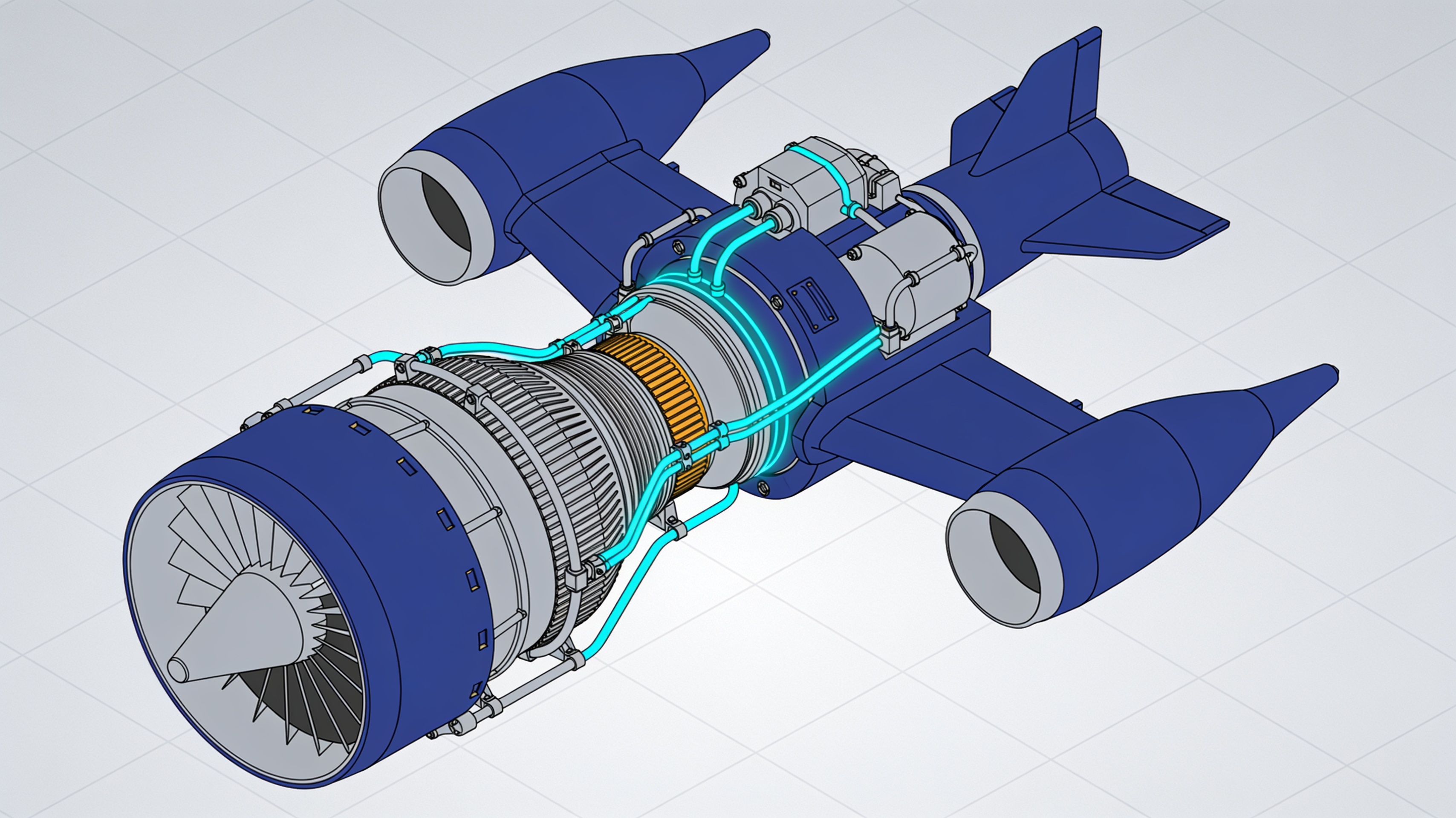
UK: 3D-printed turbojet ready to fly in seven months
The UK Ministry of Defence and Alloyed have developed a 1,100 N turbojet, taking it from initial design to “flight-ready” status in less than seven months. The programme, announced on 15 September 2026, aims to create a national capability in compact propulsion systems through digital design, metal alloy development and additive manufacturing.
Meanwhile, the smaller 300 N A300 has already completed flight tests and entered serial production in the UK.
- 1,100 N A1100 turbojet: from design to flight-ready in less than 7 months
- 300 N A300 turbojet: already in serial production after flight tests
- Family of propulsion systems from 30 to 2,000 N for uncrewed aerial platforms
- Integrated approach: materials, geometry, printing and simulation developed together
A modular family for drones and aeronautical applications
The Strategic Capabilities Office programme covers a range of propulsion systems from 30 to 2,000 N, intended primarily for uncrewed aircraft.
The programme led by the Strategic Capabilities Office of the British Ministry of Defence concerns a family of turbojets ranging from 30 to 2,000 N of thrust. The range covers micropropulsors for small aircraft up to significantly larger units.
Modularity should allow Alloyed and the Argive division to adapt the architecture to different requirements without starting from scratch each time. Two engines have reached the most advanced stages of development.
| Model | Thrust | Development status |
|---|---|---|
| A300 | 300 N | Series production |
| A1100 | 1,100 N | Flight-ready |
Beyond replacement: native design for additive
The distinctive element is the integrated approach where material, geometry, printing strategy, and simulation are developed together from the outset.
Alloyed is building a production platform in which material, component geometry, printing strategy, simulation, and production control are developed together. It is not about using 3D printing as a mere replacement for conventional machining.
Components are designed from the outset by considering what additive production allows in terms of internal geometry, part consolidation, and high-temperature materials. This approach differs radically from using additive manufacturing as a mere technological alternative.
The A300 turbojet uses the ABD-900AM superalloy developed by Aubert & Duval and Alloyed, and is compatible with diesel, kerosene, and Jet A-1.
Serial production and national capability
The A300 has already entered serial production through Argive, Alloyed's division dedicated to microturbines.
The A300 turbojet represents the first concrete result of the program. After completing flight tests, it entered serial production in the United Kingdom through Argive.
The UK Ministry of Defence aims to create an autonomous national capability in the field of compact propulsion systems. The goal is to reduce development times and increase production flexibility for advanced aeronautical applications.
The program also involves the research ecosystem of the University of Oxford, from which Alloyed's technology platform originated. Collaboration between government body, industry, and academic research accelerates technology transfer from research to production.
article written with the help of artificial intelligence systems
Q&A
How long did the development of the A1100 turbojet take?
The 1,100 N A1100 turbojet progressed from initial design to flight-ready status in under seven months. This achievement resulted from collaboration between the UK Ministry of Defence and Alloyed.
What is the current status of the A300 model?
The 300 N A300 turbojet has already successfully completed flight tests. This model has now entered serial production in the UK.
What is the thrust range of the developed engine family?
The programme covers a modular family of turbojets with thrust ranging from 30 to 2,000 Newtons. These engines are primarily intended for unmanned aerial platforms of various sizes.
What does Alloyed's integrated approach involve?
The approach involves the simultaneous development of materials, geometry, printing strategy, and simulation from the project's outset. It is not about replacing conventional manufacturing but designing natively for additive manufacturing.
Which entities lead the turbojet development programme?
The programme is led by the UK Ministry of Defence's Strategic Capabilities Office in partnership with Alloyed. The goal is to establish national capability for compact propulsion systems.