IMTS 2026: industrial robotics embraces 3D printing
The IMTS 2026 trade show in Chicago showed a massive presence of industrial robots, with growing integration between automation and additive manufacturing. The numbers speak for themselves: 1,788 exhibiting companies, over 90,000 visitors from 113 countries, and robots practically everywhere.
The event highlighted how robots are evolving from simple handling tools into true flexible production platforms. This transformation makes them natural partners for 3D printing.
FANUC dominates the additive automation scene
The Japanese manufacturer was present not only with its own booth, but integrated into the systems of dozens of other exhibitors, confirming its central role in manufacturing automation.
The distinctive yellow FANUC robots appeared throughout the trade show, often as components of systems built by third-party integrators such as Weldon. This ubiquity reveals a winning strategy: you don't need to control the entire production cell to be essential to the process.
FANUC demonstrated concrete applications in additive manufacturing. ARC Mate welding robots support additive processes that convert digital paths into physical structures.
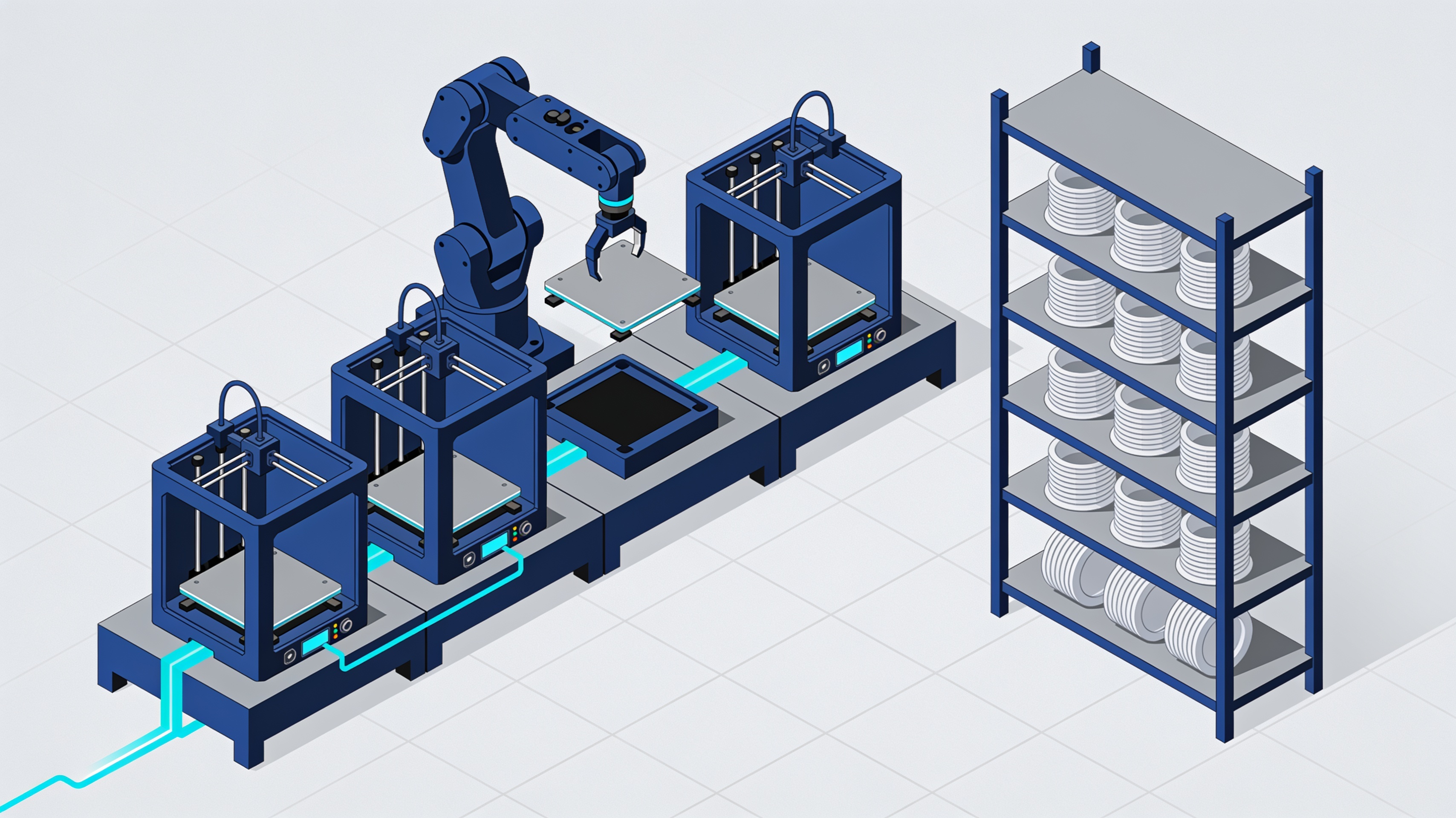
- FANUC's CRX collaborative robot automates print plan changes
- System manages multiple 3D printers simultaneously
- Part production nearly doubled
- Machine utilization significantly increased
The Athena 3D Manufacturing project represents a concrete example of how robotic automation can multiply the efficiency of 3D printing.
Boston Dynamics and Spot: mobility at the service of scanning
The quadruped robot Spot attracted attention by demonstrating how robotic mobility can integrate with data acquisition processes for additive manufacturing.
Boston Dynamics' Spot demonstrated the versatility of modern robotic systems. The robot uses a vibration-resistant mounting system that makes it suitable for automated 3D surveys in industrial environments.
Mobility represents a key advantage. While traditional robots remain anchored to fixed positions, Spot can move freely to acquire geometric data needed for additive design.
Standard Bots: American production and additive manufacturing
The Long Island company promotes robots manufactured in the United States and integrates 3D printing into its production processes.
Standard Bots represents the trend toward reshoring production. The company uses 3D printing internally, demonstrating how robot manufacturers themselves are adopting additive technologies.
This choice is not random. Additive manufacturing makes it possible to produce custom components and prototypes quickly, accelerating the development of new robotic systems.
KUKA and Yaskawa: global giants bet on additive
The two giants of industrial robotics have shown growing interest in integration with 3D printing technologies, expanding applications in the aerospace, automotive, and naval sectors.
KUKA, acquired by Midea Group, continues to develop applications that integrate robotics and 3D printing. The German company focuses on high-complexity sectors such as aerospace and shipbuilding.
Yaskawa, with the Motoman brand, represents another global player present at IMTS 2026. Motoman robots are used in additive processes that require high precision and repeatability.
Industrial robotics integrated with 3D printing is increasingly used in aerospace, automotive, and shipbuilding, where the production of complex and customized components is essential.
The future is in integration
IMTS 2026 showed that the convergence between robotics and additive manufacturing is no longer a future prospect, but an operational reality. Robots do not simply move 3D-printed parts: they manage the entire production flow, from preparation to post-processing.
The presence of 400 exhibitors at the first participation suggests a rapidly expanding market. Robotic automation of 3D printing is no longer the preserve of a few pioneers, but is becoming an industrial standard.
The authors Charles R. Goulding and Preeti Sulibhavi emphasize how robots are becoming increasingly versatile production platforms. This versatility makes them complementary to the intrinsic flexibility of additive manufacturing.
article written with the help of artificial intelligence systems
Q&A
How many visitors and exhibitors did IMTS 2026 record?
The 2026 IMTS trade show in Chicago hosted 1,788 exhibiting companies and over 90,000 visitors from 113 countries. These figures confirm a massive presence of industrial robots at the event.
What is the role of FANUC robots in additive manufacturing?
FANUC robots, particularly the ARC Mate welding models, support additive processes by converting digital paths into physical structures. They are present both at their own booth and integrated into systems by other exhibitors like Weldon.
What results did Athena 3D Manufacturing achieve with collaborative robots?
By using a FANUC CRX collaborative robot to automate bed changes, Athena 3D Manufacturing managed multiple printers simultaneously. This nearly doubled part production and significantly increased machine utilization.
How is Boston Dynamics' Spot robot used at the trade show?
The Spot quadruped robot demonstrates mobility for scanning services, utilizing a vibration-resistant mounting system. It is ideal for performing automatic 3D surveys and acquiring geometric data in industrial environments.
How does Standard Bots integrate 3D printing?
Standard Bots, an American company from Long Island, uses 3D printing internally in its own production processes. This approach highlights the trend toward production reshoring and the adoption of additive technologies by robot manufacturers themselves.