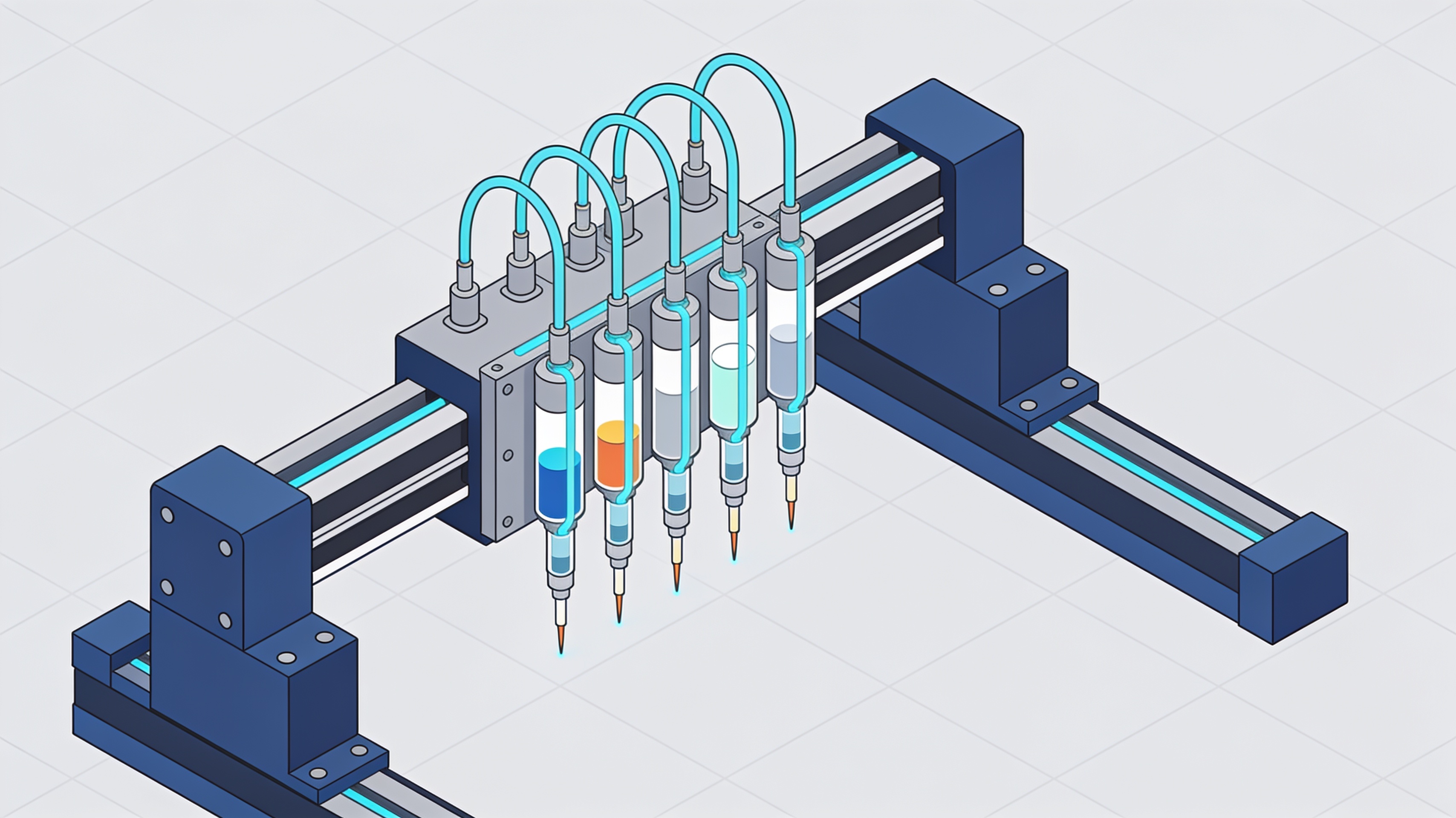
ATLANT 3D patents multi-fluid printhead for atomic deposition: nanometric precision without magic
The Danish company files a new international patent for a printhead capable of handling multiple fluids and micro-nozzles dedicated to atomic layer manufacturing. The technology promises thickness control at the atomic level, but lateral resolution depends on other factors.
ATLANT 3D has filed an international patent application (WO2026180515) describing a multi-fluid printhead for processes of deposition and controlled removal of material at the nanoscale. The system is based on surface chemical reactions rather than traditional melting or extrusion.
The technology moves away from conventional 3D printing. Instead of melting metal powders or polymerizing resins, it uses processes derived from the semiconductor industry such as Atomic Layer Deposition (ALD) and Atomic Layer Etching.
- Patent WO2026180515 for printhead with multi-fluid management and micro-nozzles
- Atomic thickness control, nanometric in-plane resolution
- Applications: semiconductors, MEMS, selective microfabrication
- DALP (Direct Atomic Layer Processing) technology already protected by US patents
How atomic layer deposition works
ALD is not traditional 3D printing: it is based on cycles of self-limiting surface reactions that build thin films with atomic precision in thickness.
The ALD process introduces a first chemical precursor that reacts with the available sites on the surface until it saturates them. Once all sites are occupied, the reaction stops naturally. Excess material is removed by evacuation and inert gas.
Next, a second reactant is introduced that reacts with the previous layer, followed by a new purge cycle. By repeating hundreds or thousands of these cycles, the desired film is obtained with atomic-level thickness control.
Atomic precision does not mean atomic resolution
The distinction is fundamental: atomic control of thickness is not equivalent to freely positioning atoms in three-dimensional space.
Speaking of “atomic 3D printing” can generate misunderstandings. The machine cannot build any object by placing individual atoms as desired. ALD guarantees atomic precision only in the thickness of the deposited film.
The lateral resolution of the pattern depends on completely different factors: nozzle size, distance from the substrate, gas diffusion, flows, and platform movement. Surface chemistry also plays a decisive role.
Atomic precision in thickness and nanometric resolution in the plane are two independent parameters that should not be confused.
The multi-fluid printhead: from wafer to selective processing
The main innovation consists of bringing processes from a closed chamber to a mobile printhead system that acts only where necessary.
Traditionally, ALD treats the entire wafer uniformly inside a chamber. The printhead patented by ATLANT 3D reverses this approach: it is directed only to the areas where material needs to be deposited or removed.
The system handles multiple fluids through dedicated micro-nozzles. It can work with materials such as alumina, silicon carbide, silicon nitride, quartz, and silicon dioxide. It uses inert gases such as argon for purge phases.
ATLANT 3D's patent portfolio
The Danish company has already obtained U.S. patents for the DALP platform and continues to expand its intellectual property protection.
ATLANT 3D has developed the DALP (Direct Atomic Layer Processing) technology implemented in the NANOFABRICATOR system. The portfolio includes patent US 12,049,700 B2 for ‘Atomic layer process printer’, with inventors Maksym Plakhotnyuk, Ole Hansen, and Anja Boisen.
A second U.S. patent, US 12,515,403 B1, protects a multifunctional deposition nozzle. International application WO2026180515 represents the latest development in this protection strategy.
| Patent | Type | Subject |
|---|---|---|
| US 12,049,700 B2 | Granted | Printer for atomic layer processes |
| US 12,515,403 B1 | Granted | Multifunctional deposition nozzle |
| WO2026180515 | Application | Multi-fluid printhead with micro-nozzles |
Industrial applications: semiconductors and MEMS
The target sectors are those requiring selective microfabrication and thin films with controlled properties.
ATLANT 3D's ES-200 platform is aimed at semiconductor packaging. DALP technology also finds application in MEMS (Micro-Electro-Mechanical Systems), where selective deposition reduces waste and process times.
The selective approach represents an advantage over traditional chamber processes. Depositing material only where needed reduces the consumption of expensive precursors and eliminates masking steps.
The multi-fluid printhead could accelerate the adoption of ALD processes in contexts where flexibility and prototyping speed are prioritized over the massive production volumes typical of the semiconductor industry.
article written with the help of artificial intelligence systems
Q&A
What is the patent number filed by Atlant 3D?
The Danish company has filed international patent application WO2026180515. This document describes a printhead capable of handling multiple fluids for atomic layer fabrication.
How does this technology differ from traditional 3D printing?
Unlike conventional 3D printing that melts powders or polymerizes resins, this system uses surface chemical reactions. It relies on processes such as Atomic Layer Deposition (ALD) derived from the semiconductor industry.
What is meant by atomic precision in this context?
Atomic precision refers exclusively to controlling the thickness of the deposited film through self-limiting reaction cycles. It does not imply the ability to freely position individual atoms in three-dimensional space.
On which factors does the lateral resolution of the process depend?
In-plane resolution depends on nozzle dimensions, distance from the substrate, gas diffusion, and flow rates. Surface chemistry and platform movement also influence the final result.
What are the main intended applications for this printhead?
Target applications include semiconductor manufacturing, MEMS devices, and selective microfabrication. The technology enables controlled deposition and removal of material at the nanoscale.