
Oerlikon installs the first ATLIX xBUILD 5000: automated production with four lasers
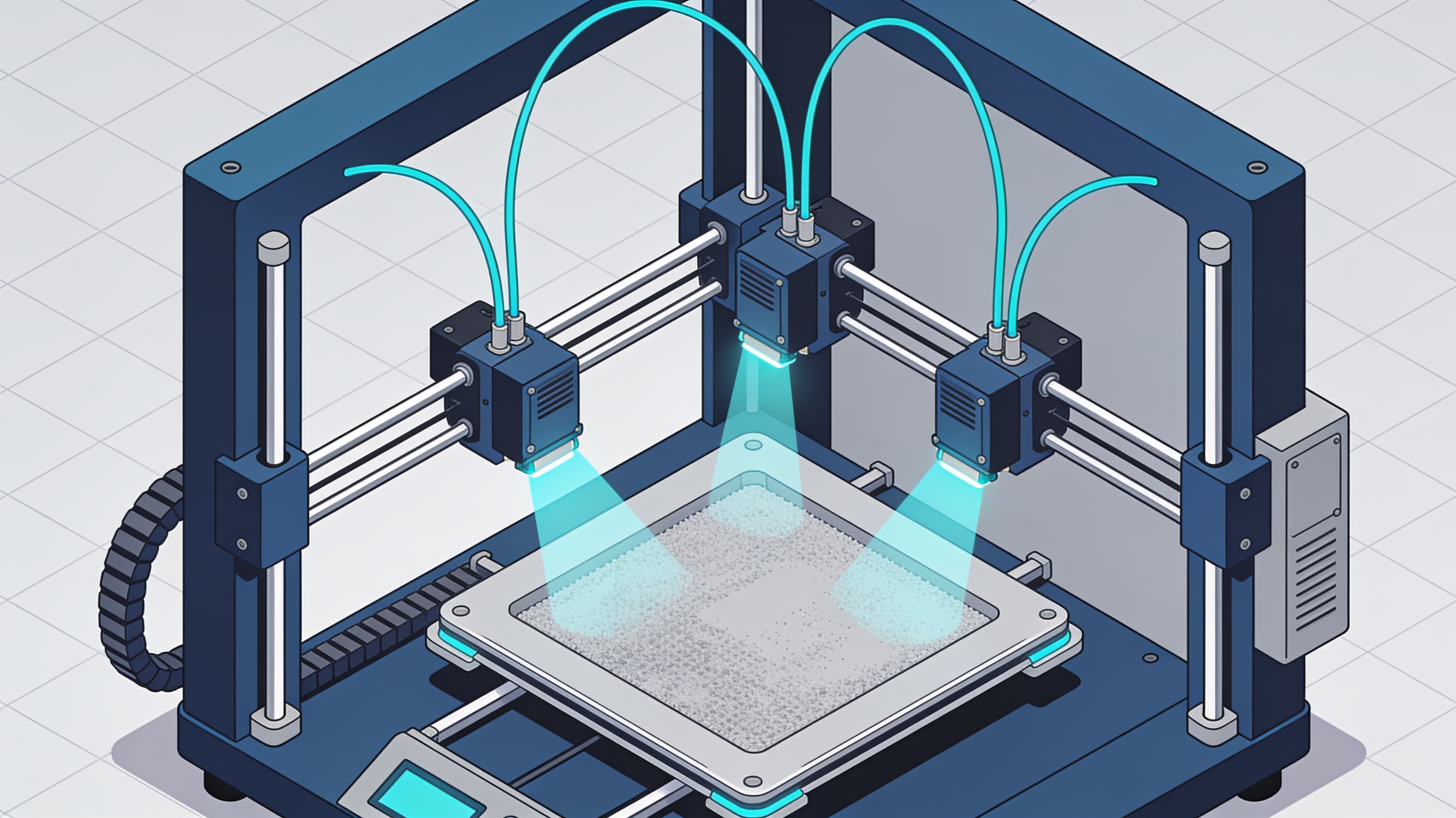
Oerlikon has commissioned the world's first ATLIX xBUILD 5000 metal 3D printer at its Huntersville, North Carolina plant. The system integrates four 1 kW lasers and an automated system for changing build modules, designed to reduce downtime between one production run and the next.
The official announcement was published by Oerlikon AM on October 8, 2026, and picked up by the U.S. trade press on October 13.
- Build volume: 500 × 500 × 400 mm
- Four 1 kW lasers (4 kW total)
- Technology: Laser Powder Bed Fusion
- Automated module changing system
Automation to reduce downtime
The xBUILD 5000 addresses one of the limitations of metal additive manufacturing: the time required between one job and the next, when the machine remains idle for auxiliary operations.
The complete production cycle of an LPBF system is not limited to powder melting. It includes cooling, build module management, powder removal, and preparation of the new job.
These operations require prolonged interventions on the machine. A portion of the production capacity remains unused even after completion of the laser process.
ATLIX proposes a solution through automated alternation of production modules. The system is designed to minimize the times during which the machine remains idle between one job and the next.
Four lasers: power and complexity
The multi-laser configuration increases the theoretical processing capacity, but introduces specific challenges in process management.
The xBUILD 5000 integrates four laser sources of 1,000 watts each, for a nominal installed power of 4 kW. The use of multiple sources can increase processing capacity when scanning strategies effectively distribute the component zones.
Actual productivity does not depend only on the sum of the powers. Material, layer thickness, required energy density, part geometry, and management of overlap zones between different lasers also have an influence.
A multi-laser configuration requires particular attention to process uniformity. Components built in different areas of the volume must meet the same dimensional and metallurgical specifications.
Build volume for large-format components
The volume of 500 × 500 × 400 millimeters makes it possible to accommodate significantly sized components or to consolidate multiple parts in a single print session.
This capability proves strategic for industrial applications that require large-format components or batch production of smaller items.
World's first production installation
According to Oerlikon, this is the world's first production installation of an xBUILD 5000. The decision to implement the system at the Huntersville facility indicates the intention to use the machine in a real production environment, not only for tests or demonstrations.
The installation at a company like Oerlikon, active in the supply of additive manufacturing components and services, represents a significant test bed for ATLIX technology in an industrial context.
article written with the help of artificial intelligence systems
Q&A
Where was the world's first ATLIX xBUILD 5000 installed?
The first ATLIX xBUILD 5000 was commissioned by Oerlikon at its facility in Huntersville, North Carolina. The official announcement was published by Oerlikon AM on October 8, 2026.
What are the main technical specifications of the xBUILD 5000?
The machine has a build volume of 500 × 500 × 400 mm and integrates four 1 kW lasers each, for a total rated power of 4 kW. It uses Laser Powder Bed Fusion technology and is equipped with an automated module change system.
How does the automated module change system work?
The system is designed to automatically rotate production modules, reducing the time the machine remains idle between one job and the next. This addresses the auxiliary operations of the LPBF cycle such as cooling, module handling, powder removal, and preparation of the new job.
Does productivity depend only on the power of the four lasers?
No, actual productivity is not simply the sum of the powers. Material, layer thickness, required energy density, part geometry, and management of overlap zones between different lasers also play a role.
What challenges does a multi-laser configuration introduce?
A multi-laser configuration requires particular attention to process uniformity. Components built in different areas of the volume must meet the same dimensional and metallurgical specifications.


