
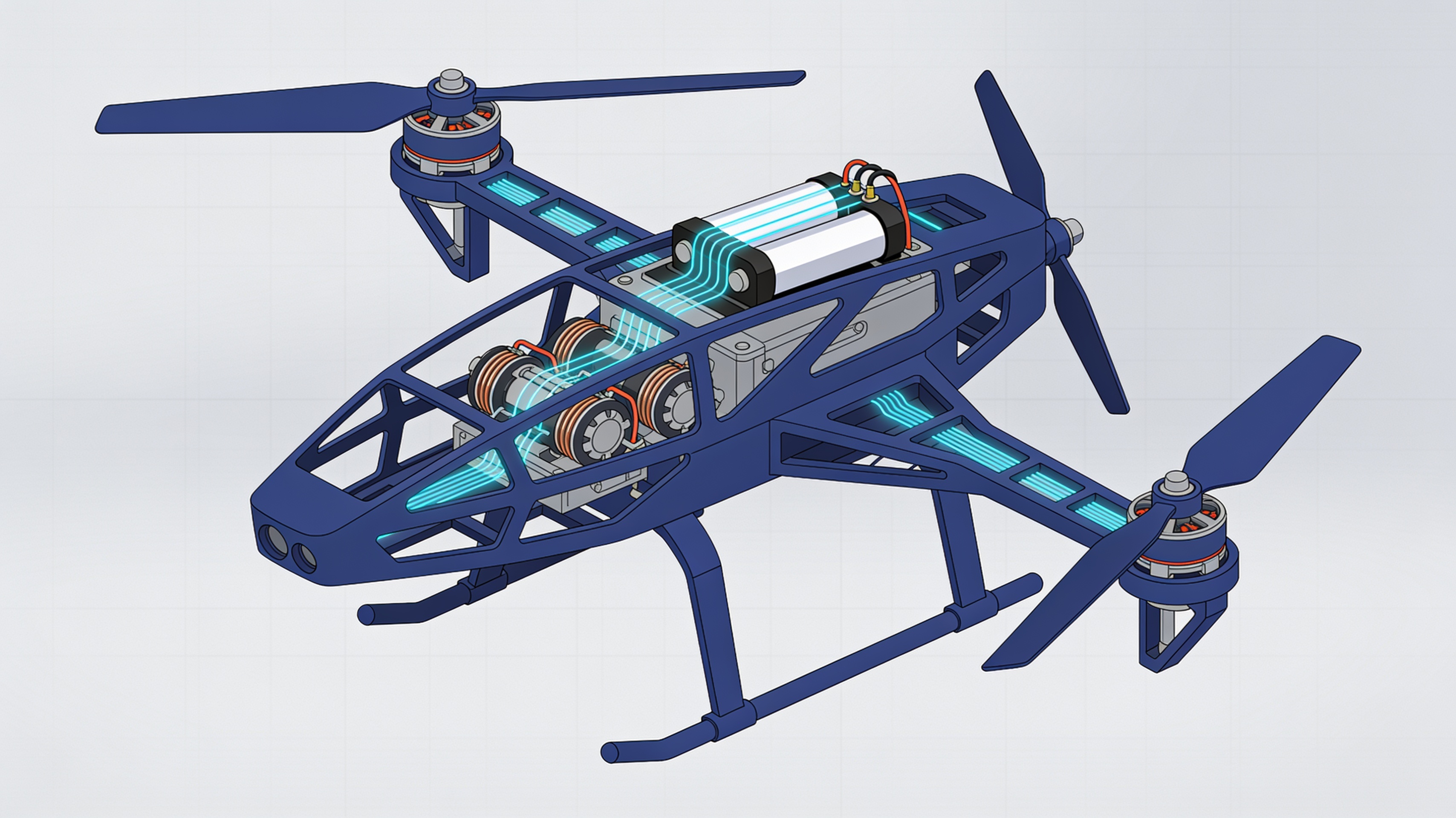
250-gram FDM drone at 413 km/h: 3D printing accelerates the iterative development of propellers
An ultralight drone with an FDM-printed structure and propulsion units reached, according to its designer, 413 kilometers per hour. The figure has not been certified by independent bodies, but the project demonstrates how additive manufacturing enables rapid development cycles by combining aerodynamic simulation, parametric design, and field testing.
The vehicle weighs about 250 grams and was developed by engineer Luis from Munich, author of the luisengineering channel. The case was described on October 14, 2026 by 3Druck.
From speed to the development method
The main interest is not the claimed record, but the iterative process made possible by additive manufacturing.
The previous prototype had reached about 320 km/h according to the same designer. To surpass that result, Luis did not limit himself to increasing power. He redesigned the outer shape to reduce aerodynamic drag, repositioned the electronics and battery, and developed new propulsion units.
At high speeds, the energy required to overcome air resistance grows rapidly. Drag force increases approximately with the square of speed; the required power grows even more rapidly. A significant increase in speed therefore requires substantial work on shapes, even on vehicles of limited mass.
- Mass: approximately 250 grams
- Declared speed: 413 km/h (not certified)
- Dimensions: slightly larger than a banana
- Structure and propellers: FDM 3D printing
Extreme compactness and technical compromises
The new drone concentrates all the components in a very thin casing. The overall thickness is now close to that of the battery.
Such a compact arrangement helps limit the surfaces exposed to airflow. However, it complicates access to components, heat dissipation, and cable routing. These are typical compromises of extreme designs, where every millimeter of frontal area counts.
FDM for structure and propellers: iterative advantages
Fused filament deposition 3D printing makes it possible to modify and manufacture new versions without molds or specialized machining.
The most relevant aspect for additive manufacturing is the use of FDM technology for both structural elements and propellers. This allows the designer to modify the geometry and produce new versions without having to make molds or turn to specialized manufacturing chains for each test.
Cost-effectiveness does not necessarily stem from the unit cost of a single printed component compared with an equivalent product made using traditional methods. The advantage lies in the speed of the cycle: design, print, test, analyze the data, redesign.
Iterative development sequence
- Aerodynamic simulation: Analysis of airflow behavior around the drone.
- Parametric design: Modifying geometries based on simulation results.
- FDM printing: Rapid fabrication of the frame and propellers.
- Field testing: Speed testing and data collection.
- Iteration: Return to the analysis phase for further optimizations.
Certification limits
The 413 km/h figure is not accompanied by independent certification or measurement conducted by sports organizations. It should be presented as a result declared by the manufacturer, not as a homologated record.
The absence of certification does not detract from the project's value from a technical point of view. It demonstrates how additive manufacturing is becoming a mature development tool for high-performance applications, where the ability to iterate rapidly matters as much as the final production technology.
Luis's drone case shows that FDM 3D printing, often considered suitable only for prototypes or low-load components, can also be used in contexts where speed, vibrations, and mechanical stresses are extreme. The key is the ability to test, fail quickly, and improve without tooling constraints.
article written with the help of artificial intelligence systems
Q&A
What speed did the 250-gram FDM drone reach?
According to designer Luis from Munich, the drone reached 413 km/h. The figure is not certified by independent bodies. The previous prototype topped out at around 320 km/h.
Which 3D printing technologies were used for the drone?
The project uses FDM (Fused Deposition Modeling) technology for both the structural elements and the propellers. This made it possible to modify geometries and produce new versions without molds.
Why did the speed increase so much compared to the previous prototype?
Luis didn't just increase power: he redesigned the outer shape to reduce aerodynamic drag, repositioned the electronics and battery, and developed new propulsion systems. At high speeds, air drag grows with the square of the speed, so shapes matter a lot.
What are the technical trade-offs of such a compact drone?
The drone concentrates all components into a thin shell, close to the thickness of the battery. This compactness reduces the surfaces exposed to airflow, but complicates access to components, heat dissipation, and cable routing.
What is the real advantage of FDM 3D printing in this project?
The main advantage is not the unit cost of a single part, but the ability to modify geometries and produce new versions without molds or specialized dies. This enables rapid iterative development cycles by combining aerodynamic simulation, parametric design, and field testing.


