Category: Manufacturing

Implementing Mass Customization with Additive Manufacturing: A Technical Playbook for Consumer Products

Implementing Mass Customization with Additive Manufacturing: A Technical Playbook for Consumer Products

Mass customization is now possible thanks to additive manufacturing, artificial intelligence, and parametric design. These technologies allow for the production of thousands of customized variants while maintaining efficiency and margins, overcoming the limits of traditional production. The integration of software toolchains and automated processes enables the management of variability without au

Additive Manufacturing Certification for Medical Devices: An Operational Framework for Effective Qualification

Additive Manufacturing Certification for Medical Devices: An Operational Framework for Effective Qualification

The certification of medical devices produced with additive manufacturing requires an operational framework that integrates regulatory requirements from the design phase. This approach, called “design for certification”, reduces delays and late reviews, turning compliance into a competitive advantage. It is fundamental to qualify the 3D printing process with documented proof of rep

Bio-Based SLS Printing: When Sustainability Meets Technological Limits

Bio-Based SLS Printing: When Sustainability Meets Technological Limits

Bio-based materials for SLS 3D printing, such as PHB and PA11, offer more sustainable solutions but still present technological limitations compared to traditional polymers like PA12. Although they improve stiffness and thermal stability, they suffer from lower ductility, high porosity, and a narrow process window. Research continues to optimize composition and parameters, aiming for a balance between sust

How Lignosulfonate-Based Industrial Ink Works for Recycled 3D Printing

How Lignosulfonate-Based Industrial Ink Works for Recycled 3D Printing

New 3D printing ink based on lignosulfonate, a by-product of the paper industry, enables room-temperature processes without solvents or post-treatments. Composed of 70% waste material, it is recyclable up to nine times while maintaining high performance, promoting a circular economy in industrial additive production.

Sustainable materials in action: how the industry is implementing bio-based solutions on a large scale

Sustainable materials in action: how the industry is implementing bio-based solutions on a large scale

The industry is implementing bio-based sustainable materials on a large scale, integrating responsible agricultural supply chains, technological innovation and circular economy. Projects such as Pragati, Bio.3DGREEN and Virtucycle demonstrate how sustainability and industrial performance can coexist, thanks to strategic partnerships and standardization.

Part Identification via CAD without ML Model Retraining

Part Identification via CAD without ML Model Retraining

A new innovative method enables the automatic identification of 3D printed parts directly using CAD models, without the need to retrain machine learning models. Developed by KU Leuven, Materialise, and Iristick, the system leverages geometric representations and few-shot learning techniques to classify new parts quickly and efficiently, reducing times and

How Chemical Vapor is Revolutionizing the Post-Processing of 3D Parts

How Chemical Vapor is Revolutionizing the Post-Processing of 3D Parts

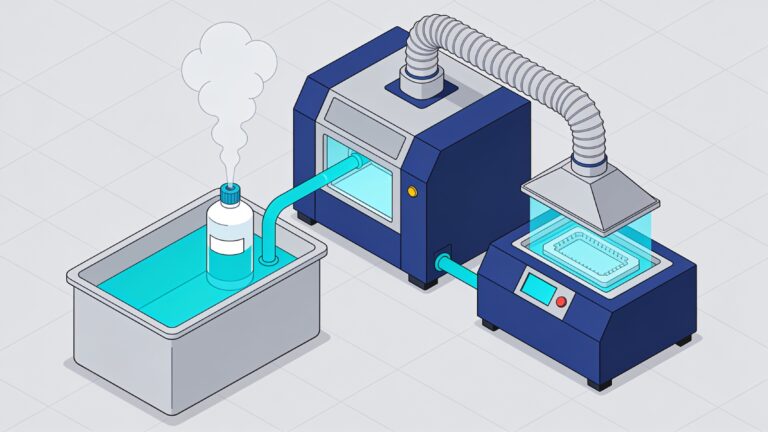
Chemical vapor is revolutionizing the post-processing of 3D parts, offering smooth, waterproof, and repeatable finishes without material removal. Automated technologies like AMT PostPro eliminate production bottlenecks, reduce costs, and improve mechanical properties, making additive production scalable and certifiable for demanding industries.

New Era of Governance: The Evolution of Leadership in the Additive Manufacturing Industry

New Era of Governance: The Evolution of Leadership in the Additive Manufacturing Industry

The Additive Manufacturing Alliance, born from the union of Leading Minds and AM I Navigator, promotes the industrial integration of additive manufacturing through structured governance, standardization, and operational support.

Additive Manufacturing in Production: How Industrial Companies Build Reliable Processes

Additive Manufacturing in Production: How Industrial Companies Build Reliable Processes

The adoption of additive manufacturing in industry requires operational discipline, focus on defined part families, and rigorous process control. Technology alone is not enough: organizational management is needed to ensure reliability and repeatability. Winning applications are born where performance advantages outweigh complexity, such as in aerospace, medical, and tooling. Integration

Implementing the Digital Thread in Additive Manufacturing: An Operational Playbook for Multi-CAD Integration

Implementing the Digital Thread in Additive Manufacturing: An Operational Playbook for Multi-CAD Integration

Implementing the digital thread in additive manufacturing is now an operational necessity, no longer a futuristic vision. Multi-CAD integration requires reliable solutions to overcome interoperability barriers, ensure traceability, and maintain data consistency throughout the entire production cycle. Case studies and best practices show how middleware, clear governance, and hybrid toolchains can

Designing “Lights-Out” Factories: The Software Architecture That Makes the Difference

Designing “Lights-Out” Factories: The Software Architecture That Makes the Difference

Designing lights-out factories requires an advanced software architecture that integrates machines, data, and processes in real time. Software-defined automation makes it possible to overcome the limitations of proprietary solutions, ensuring interoperability, security, and scalability. Only in this way can artificial intelligence be fully leveraged to optimize production and maintain control of the p

Superelastic Metamaterials: How the Combination of Reticulated Structures and NiTi Works for Advanced Mechanical Properties

Superelastic Metamaterials: How the Combination of Reticulated Structures and NiTi Works for Advanced Mechanical Properties

Researchers have developed superelastic metamaterials in Nitinol with interwoven 3D-printed structures, combining superelasticity and lattice architectures to achieve advanced mechanical properties without altering the chemical composition. These materials, which behave more like fabrics than metals, open new possibilities for biomedical implants, protective devices, and stru

/