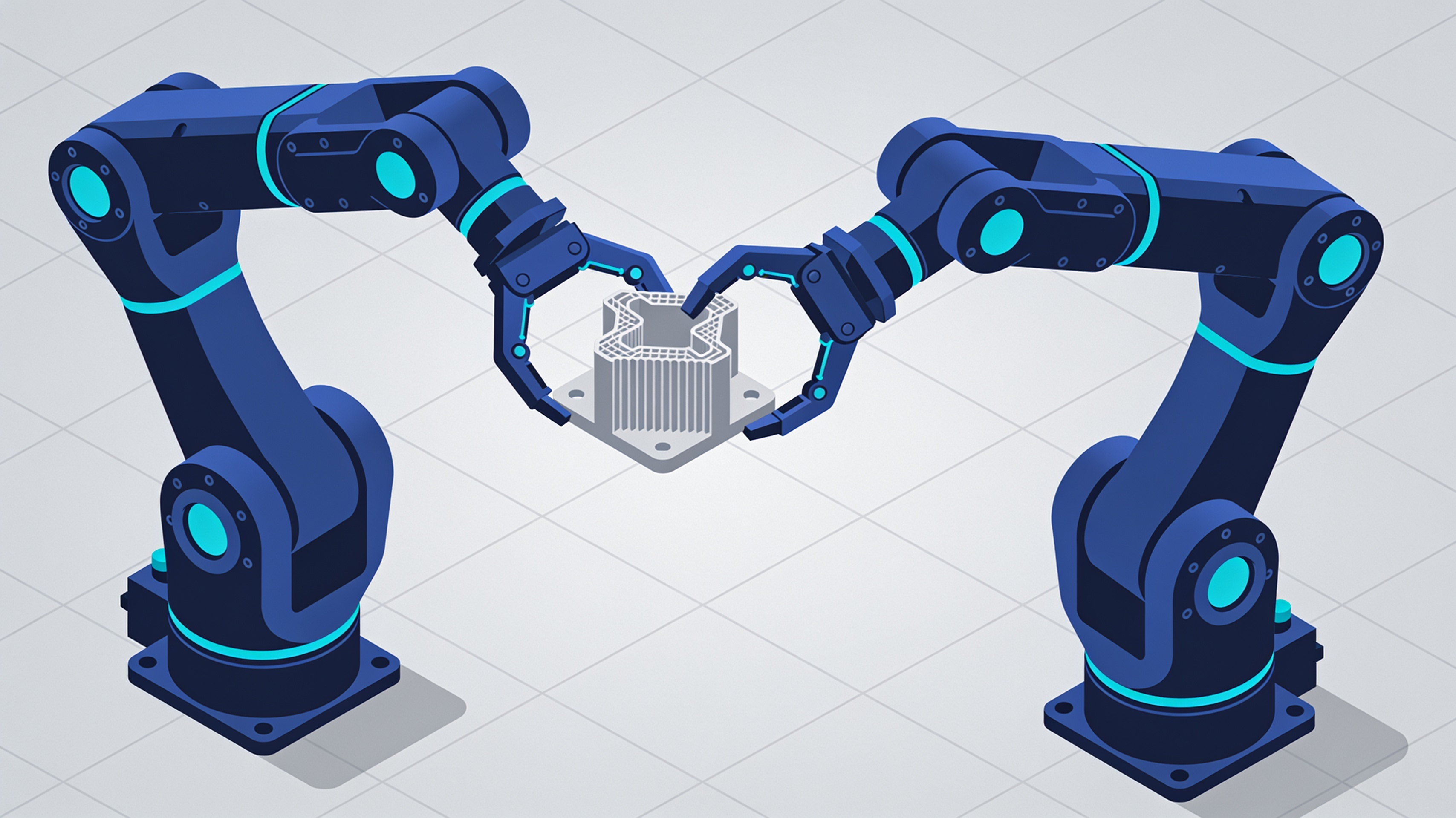
Devonics integrates 3D printing and collaborative robotics for industrial automation
The California-based company Devonics is building an automation ecosystem that combines collaborative robots, vision systems, and 3D printing for customized components. Additive manufacturing becomes a development tool for grippers, brackets, and equipment adapted to each specific application.
A model beyond robot sales
Devonics does not just resell robotic arms: it offers design, integration, and production of customized components via 3D printing.
The San Diego-based company has developed a comprehensive offering that includes collaborative robots, grippers, vision systems, simulation software, autonomous mobile robots, and cells configured for specific production processes. The model includes component selection, application design, end-of-arm tooling development, mechanical and electronic integration, programming, and operator training.
3D printing is used as a tool to develop components that must adapt to the part, the robot, or the cell layout. Customized grippers, gripping fingers, sensor brackets, adapters, cable guides, jigs, and supports are digitally designed, produced, and tested without waiting for dedicated tooling.
- Customized grippers and gripping fingers
- Sensor and adapter brackets
- Cable guides and supports
- Jigs and validation equipment
When additive manufacturing becomes strategic
3D printing takes on particular relevance in low-volume applications with many formats or non-standard geometries.
In these situations, a universal solution can be too heavy, bulky, or unreliable. Production by molding or machining can require time and costs that are hard to justify during the early stages of the project.
Additive manufacturing allows rapid iteration during the development phase. A component can be modified and reproduced in a short time, accelerating the validation of the robotic application.
Undisclosed technical details
Devonics has not published information on the printers used, the materials adopted, or the share of components produced with additive manufacturing.
No declared collaborations with system manufacturers such as Stratasys, 3D Systems, EOS, HP, Desktop Metal, or Markforged are reported. The role of 3D printing must be interpreted mainly in the context of prototyping, validation, and development of custom equipment.
The absence of specific data suggests an internal use focused on the engineering phase rather than on serial production of components.
Devonics' approach favors rapid customization over standardization. 3D printing becomes an enabler of tailor-made solutions without investments in permanent equipment.
Devonics' robotic ecosystem
The robotic base consists of Fairino cobots, for which Devonics is the exclusive partner in North America.
Fairino (Suzhou) Robot Technology develops the FR series of collaborative robots, which includes models with different load capacities, from the compact FR3 to more powerful versions. Fairino lists Devonics among its authorized channels in the United States, while Devonics presents the collaboration as an exclusive partnership for the North American market.
The offering also includes the Gentle Pro gripper, a 4-finger soft gripping system developed internally by Devonics. The company is also a channel partner of DH Robotics for end effectors and collaborates with Schmalz for vacuum systems and Vention for automation platforms in machine tending solutions.
For simulation and offline programming, RoboDK is used, a software platform that allows validating applications before physical installation.
Applications in regulated sectors
The combination of collaborative robotics and customized components finds application in the food and pharmaceutical sectors.
These areas require solutions compliant with specific regulations and often need adaptations to handle variable formats or particular processes. 3D printing allows the development of components that meet regulatory constraints such as ISO 10218 and ISO/TS 15066 for the safety of collaborative robots.
The modular approach allows configuring cells for specific processes while maintaining flexibility for subsequent modifications. The ability to quickly produce new components reduces downtime for adaptations or format changes.
Perspectives for additive integration
The Devonics model represents an example of integrating 3D printing into industrial automation without necessarily positioning itself as a supplier of additive technologies. Additive manufacturing becomes an internal tool to accelerate development and reduce engineering costs.
This strategy could spread among robotic system integrators, especially where customization represents added value compared to standardization. 3D printing does not replace traditional production methods but complements them in the development and validation phase.
article written with the help of artificial intelligence systems
Q&A
What services does Devonics offer besides selling robots?
Devonics offers design, integration, and production of custom components via 3D printing. The service includes component selection, end-of-arm tooling development, programming, and operator training.
Which specific components are manufactured using 3D printing?
Custom grippers, gripping fingers, sensor brackets, adapters, cable guides, jigs, and supports are produced. These elements are digitally designed to fit every specific application.
In which scenarios does additive manufacturing become strategic for Devonics?
3D printing is crucial in low-volume applications with numerous formats or non-standard geometries. It allows rapid iteration during development, accelerating robotic application validation.
What technical information has Devonics published about the printers used?
Devonics has not published details on the printers used, materials adopted, or the share of components produced via additive manufacturing. No declared collaborations with major system manufacturers are reported either.
What is the primary role of 3D printing in the Devonics ecosystem?
The role of 3D printing is primarily interpreted in the context of prototyping, validation, and development of custom equipment. Its use appears focused on the engineering phase rather than serial production.