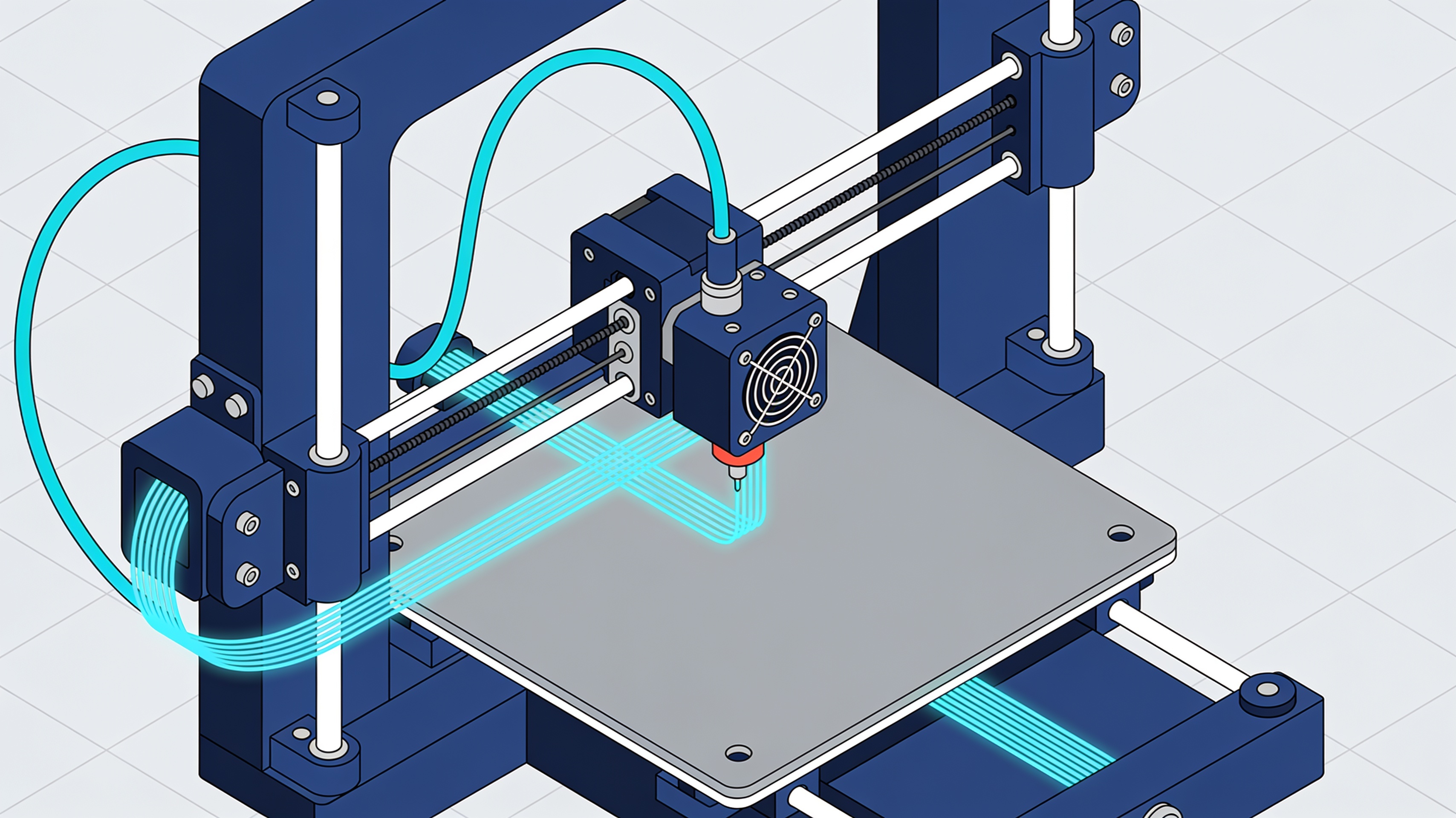
Controlled vibrations improve strength and adhesion of PLA in FFF printing
A group of researchers has developed an FFF 3D printing system that integrates controlled mechanical vibrations during material deposition. The goal is to solve one of the main limitations of extrusion technology: the poor quality of the bond between successive layers.
The study, published on July 20, 2026 in the scientific journal Polymers, documents significant improvements in the mechanical properties of PLA samples. The results show increases of 8-15% in strength compared to conventional printing and a reduction of 60% in the average size of internal pores.
- Moderate vibrations increase strength and yield limit of PLA by 8-15%
- Reduction of 60% in the average size of internal pores
- System tested on modified Creality Ender-3 Pro printer
- Research funded by the University of Ha'il
The problem of interlayer adhesion
FFF printing produces anisotropic components due to the layered nature of the process. The interface between layers represents the structural weak point.
In FFF printing, the thermoplastic filament is heated and extruded through a nozzle in the form of adjacent beads. Once a layer is completed, the machine moves vertically and deposits the next one.
The final component is not a uniform mass. Its structure is formed by numerous filaments joined laterally and vertically. Strength depends on the quality of the individual beads and the diffusion of polymer chains between layers.
When the newly extruded material touches the underlying layer, the temperature begins to decrease. The molecular chains lose mobility and the interface solidifies. Too rapid cooling or incomplete contact leave voids and weak adhesion zones.
The result is an anisotropic material: a printed part can show good strength along the direction of the filaments, but fragility between layers.
The experimental system
The researchers modified a commercial printer by installing a vibrating motor under the print bed. The device generates controlled mechanical stresses during deposition.
A modified Creality Ender-3 Pro was used for the experiments. The tested material is a 1.75 millimeter EasyFil PLA filament produced by FormFutura.
The team installed under the print bed a vibrating motor with eccentric mass, powered and adjusted to generate different levels of mechanical stress.
An eccentric mass motor generates vibrations through the rotation of an unbalanced weight. The frequency and amplitude depend on the rotation speed and the eccentric mass.
Results and microscopic analysis
Mechanical and microscopic analyses document significant improvements in the properties of material printed with moderate vibrations.
The study analyzed the effects of vibration on tensile strength, yield strength, flexural behavior, surface roughness, and internal structure. Samples subjected to moderate vibration show increases of 8-15% in mechanical properties compared to conventional printing.
Electron microscope images reveal a reduction of about 60% in the average size of internal pores. This indicates better material compaction and more effective adhesion between extruded strands.
Mechanical vibration probably maintains the mobility of polymer chains at the interface between layers for longer. This promotes molecular diffusion and reduces voids before complete solidification.
The research team
The work is signed by seven researchers affiliated with academic institutions in Saudi Arabia and Tunisia.
The authors of the study are Lotfi Ben Said, Fouzi Alhadar, Hamdi Hentati, Mondher Wali, Badreddine Ayadi, Sattam Alharbi and Muapper Alhadri. The research received funding from the University of Ha’il and was conducted with the contribution of researchers also affiliated with Tunisian institutions.
The work was published in Polymers, a peer-reviewed scientific journal dedicated to polymer science and technology.
Application prospects
The technique could be implemented on existing printers with relatively simple modifications.
The approach based on controlled vibrations offers practical advantages. It does not require complex modifications to the extruder or heating system. A vibrating motor can be installed on existing commercial printers with limited interventions.
Documented improvements in mechanical properties could make FFF printing more competitive for structural applications. The reduction of internal pores also improves fatigue resistance and long-term durability.
The effects on other thermoplastic materials and optimizations of vibration parameters for different geometries and printing speeds remain to be explored.
article written with the help of artificial intelligence systems
Q&A
How much does PLA strength improve with controlled vibrations?
Applying moderate vibrations during FFF printing increases the strength and yield limit of PLA by 8% to 15% compared to conventional methods.
What is the impact of vibrations on internal porosity?
The study documents a 60% reduction in average internal pore size, significantly improving the density and homogeneity of the printed material.
Which printer was used for the experiments?
Researchers modified a commercial Creality Ender-3 Pro printer by installing an eccentric mass vibrating motor under the print bed.
Why do vibrations improve interlayer adhesion?
Mechanical stresses promote the diffusion of polymer chains between layers before the material solidifies, reducing voids and anisotropy.
Where was this scientific study published?
The research, funded by the University of Ha'il, was published on July 20, 2026, in the scientific journal Polymers.