Stratasys and General Motors: how to scale additive manufacturing into production
Stratasys launched the F870, a new large-format FDM platform for industrial production, at the International Manufacturing Technology Show (IMTS) 2026 in Chicago. The system is already operational at companies such as Rivian Automotive in Michigan and Toyota Production Engineering in Kentucky.
The F870 represents a concrete response to the growing demand for larger machines that can integrate directly into production environments. The goal is to manufacture tooling, tools, and end-use components with the speed and dimensions required by large-scale production.
F870 technical specifications
The new system stands out for its size and thermal capacity, focusing on high-performance materials for industrial applications.
The F870 offers a build volume of a full meter (1000 x 610 x 610 mm) with a heated chamber. According to Stratasys, it boasts the longest heated build capacity in its class of large-format industrial printers.
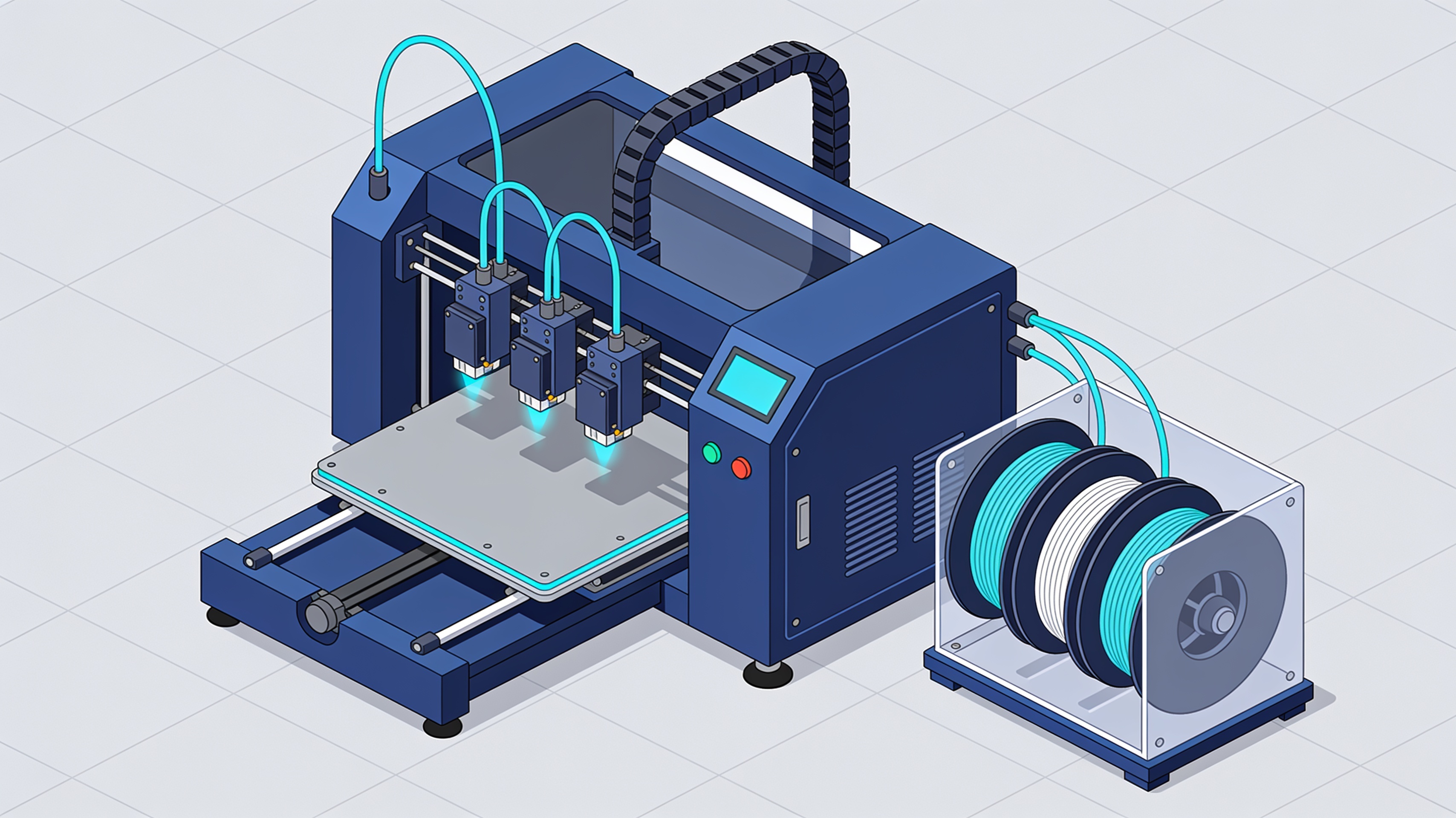
Thomas Whiting, Application Engineer at Stratasys, confirmed that the F870 is the company's longest printer on the X-axis. The system integrates three different print heads with variable nozzle sizes for different materials or to increase production speed.
- Build volume: 1000 x 610 x 610 mm
- Heated chamber for dimensional stability
- Three interchangeable print heads
- Materials: Nylon 12CF, ASA, ABS
- Integrated material drying system (6-10 hours)
Material management and innovations
The F870's material management system includes active drying functionality, eliminating moisture issues during production.
The machine has two material bays beneath the print chamber. Each bay can hold two 250-cubic-inch spools of build or support material.
The bays are heated and can actively dry the material. “You can insert a wet spool, let it sit for 6 to 10 hours, so basically overnight, and you'll have a dry spool,” Whiting explained.
Automotive applications: the primary use case
Automotive emerges as the leading sector for the F870, with components that utilize the entire available print volume.
Whiting showed a robotic end-of-arm tool (EOAT) 42 inches wide, printed in Nylon 12CF. The component, intended for an exhaust heat shield, had to be printed diagonally in the machine to fit the dimensions.
The EOAT integrates internal air channels and mounting features, as well as suction cups for gripping. This application demonstrates the F870's ability to produce complex tooling in a single piece.
Nylon 12 Carbon Fiber is Stratasys' strongest material, now available on the company's largest platform. This combination makes it possible to produce large structural components with high mechanical properties.
Strategic partnerships and industrial deployment
Leading automotive companies are already using the F870 to accelerate production processes.
Fadi Abro, Sr. Global Director – Automotive & Mobility for Stratasys, emphasized the uniqueness of the combination of the company's strongest material and its largest platform. The F870 has already been implemented by Rivian Automotive and Toyota Production Engineering to speed up production at the plant level.
In addition to large-scale prototypes, the F870 is used for jigs, fixtures, and other production aids. The ability to produce these components in-house reduces procurement times and enables rapid iterations.
Prospects for industrial production
The F870 is part of a broader trend toward integrating additive manufacturing directly into production lines. The automotive, aerospace, and defense sectors increasingly require reliable machines that can operate continuously in industrial environments.
The availability of high-performance materials such as Nylon 12CF on large-format platforms opens up new possibilities for functional components and tooling that previously required traditional machining or assembly of multiple parts.
article written with the help of artificial intelligence systems
Q&A
What is the build volume of the Stratasys F870?
The F870 offers a build volume of 1000 x 610 x 610 mm, equal to a full meter on the X axis. According to Stratasys, it boasts the longest heated build capacity in its class of large-format industrial printers.
What materials does the Stratasys F870 support?
The F870 works with high-performance materials such as Nylon 12CF, ASA, and ABS. The system integrates three print heads with variable-size nozzles to handle different materials or increase production speed.
How does the F870's material drying system work?
The machine has two heated material bays beneath the build chamber, each capable of holding two 250-cubic-inch spools. By inserting a wet spool and letting it rest for 6 to 10 hours, a dry spool is obtained.
Which companies already use the Stratasys F870?
The system is already operational at Rivian Automotive in Michigan and Toyota Production Engineering in Kentucky. The F870 was launched at the International Manufacturing Technology Show (IMTS) 2026 in Chicago.
What automotive applications have been demonstrated with the F870?
A 42-inch-wide robotic end-of-arm tool (EOAT) printed in Nylon 12CF was shown, intended for an exhaust heat shield. The component, printed diagonally to fit the machine's dimensions, integrates internal air channels, mounting features, and vacuum grippers.