KraussMaffei: LFAM 3D printing as a product and internal advantage
Large-format additive manufacturing is not only a new business line for the German manufacturer of plastics processing machinery, but also a strategic resource to optimize internal production processes.
KraussMaffei, a German company founded in 1838 and specialized in plastics processing technologies, has integrated large-format 3D printing (LFAM) into its product portfolio. The addition represents a natural extension of the company's expertise in injection molding, extrusion, and reactive processing.
The real peculiarity lies in the dual-use approach: the PowerPrint systems are not only sold to customers but also used intensively at the Brighton, Michigan plant to produce equipment and components for the machinery that the company itself manufactures.
Dual function: sales and self-production
KraussMaffei internally uses the LFAM technology it commercializes, creating a concrete use case that demonstrates the value of the solution to potential customers.
“We would have a use case for this technology even if we didn’t sell the machines,” says Dan Rozelman, technical sales and applications manager. The Brighton plant simultaneously functions as a machinery assembly factory, technology showroom, test bench for new machines, and production facility for equipment.
- KraussMaffei produces prototype molds, cutting jigs, router tools, and 3D-printed risers.
- LFAM technology was developed internally over 6 years
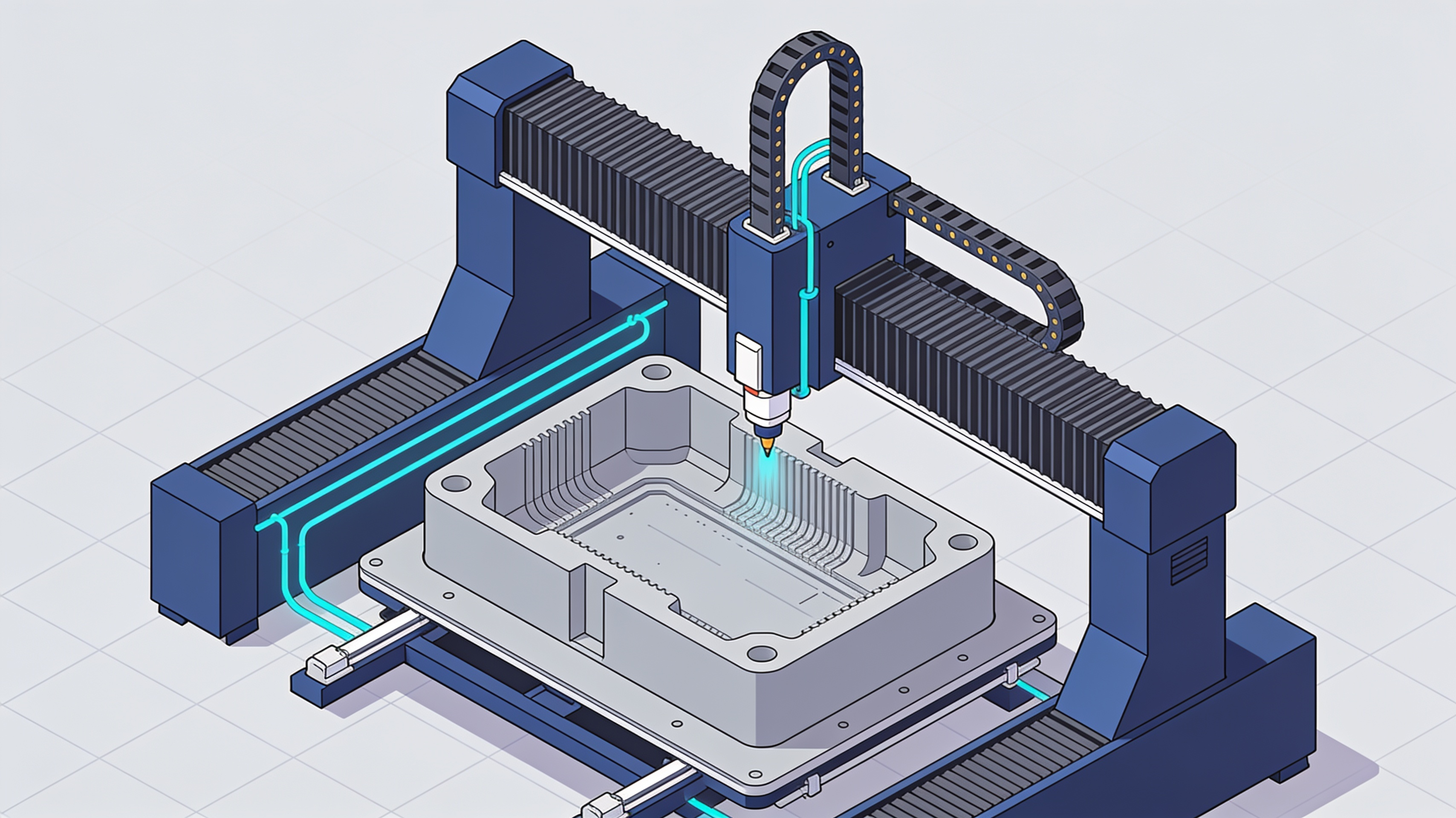
- The company offers two configurations: PowerPrint Flex (6-axis robot) and PowerPrint Plus (gantry)
The PowerPrint range
KraussMaffei's LFAM systems share the same extrusion technology, but differ in configuration and flexibility.
The PowerPrint Plus is a gantry system with a print volume of 2x2x2.5 meters. The PowerPrint Flex instead uses a six-axis robot for greater versatility. Both machines use the same single-screw extruder, capable of depositing up to 70 kg of material per hour.
Application case: composite riser vs aluminum
Replacing aluminum risers with 3D printed components demonstrates concrete advantages in time, cost, and thermal performance.
Risers are structures at least 20 cm high that support mold tools and secure them to the press. Traditionally made of cast aluminum and then machined, they required up to 10 weeks for delivery and final processing.
With LFAM 3D printing, the same component is produced internally in about 8 hours of printing and completed within a week.
| Parameter | Aluminum casting | LFAM 3D Printing |
|---|---|---|
| Production time | 10 weeks | 1 week |
| Printing/fusion time | N/A + machining | 8 hours |
| Weight | Greater | Reduced |
| Thermal performance | Standard | Improved |
Advantages beyond speed
Weight reduction and improved thermal performance have significant impacts on the tool's life cycle.
In addition to the drastic reduction in times, 3D printed risers offer lower costs and reduced weight compared to aluminum counterparts. The improved thermal performance plays a significant role in the overall energy consumption of the tool throughout its entire life cycle.
3D printed risers are used in foam-in-place tools, where thermal management is critical for process quality and energy efficiency.
An integrated ecosystem
The Brighton plant represents a complete hub where production, testing and demonstration coexist, strengthening the commercial proposition.
The Michigan facility supports the sale of machinery for foam-in-place, lamination, edge bending, cutting and engraving, all common processes in automotive development and production. 3D printing fits into this ecosystem not only as a new product line, but as a transversal capability that improves the efficiency of the entire operation.
This approach allows KraussMaffei to internally test applications, collect real data and demonstrate to customers the concrete benefits of LFAM technology in real production contexts.
article written with the help of artificial intelligence systems
Q&A
What are the two configurations of KraussMaffei's PowerPrint systems?
KraussMaffei offers PowerPrint Flex, which uses a six-axis robot for greater versatility, and PowerPrint Plus, a gantry system with a print volume of 2x2x2.5 meters.
How is LFAM technology used internally at the Brighton facility?
The Brighton facility uses LFAM systems to produce internal equipment such as prototype molds, cutting jigs, and risers, also serving as a showroom and testbed.
What advantages does 3D printing offer over aluminum for riser production?
LFAM 3D printing drastically reduces production times from 10 weeks to about 8 hours of printing plus finishing, while also cutting costs and improving thermal performance.
How much material can the extruder of PowerPrint machines deposit?
Both configurations employ the same single-screw extruder capable of depositing up to 70 kg of material per hour, ensuring high productivity for large formats.
How long has KraussMaffei been developing LFAM technology?
LFAM technology was developed internally by the company over more than 6 years of research, representing a natural extension of its expertise in extrusion.