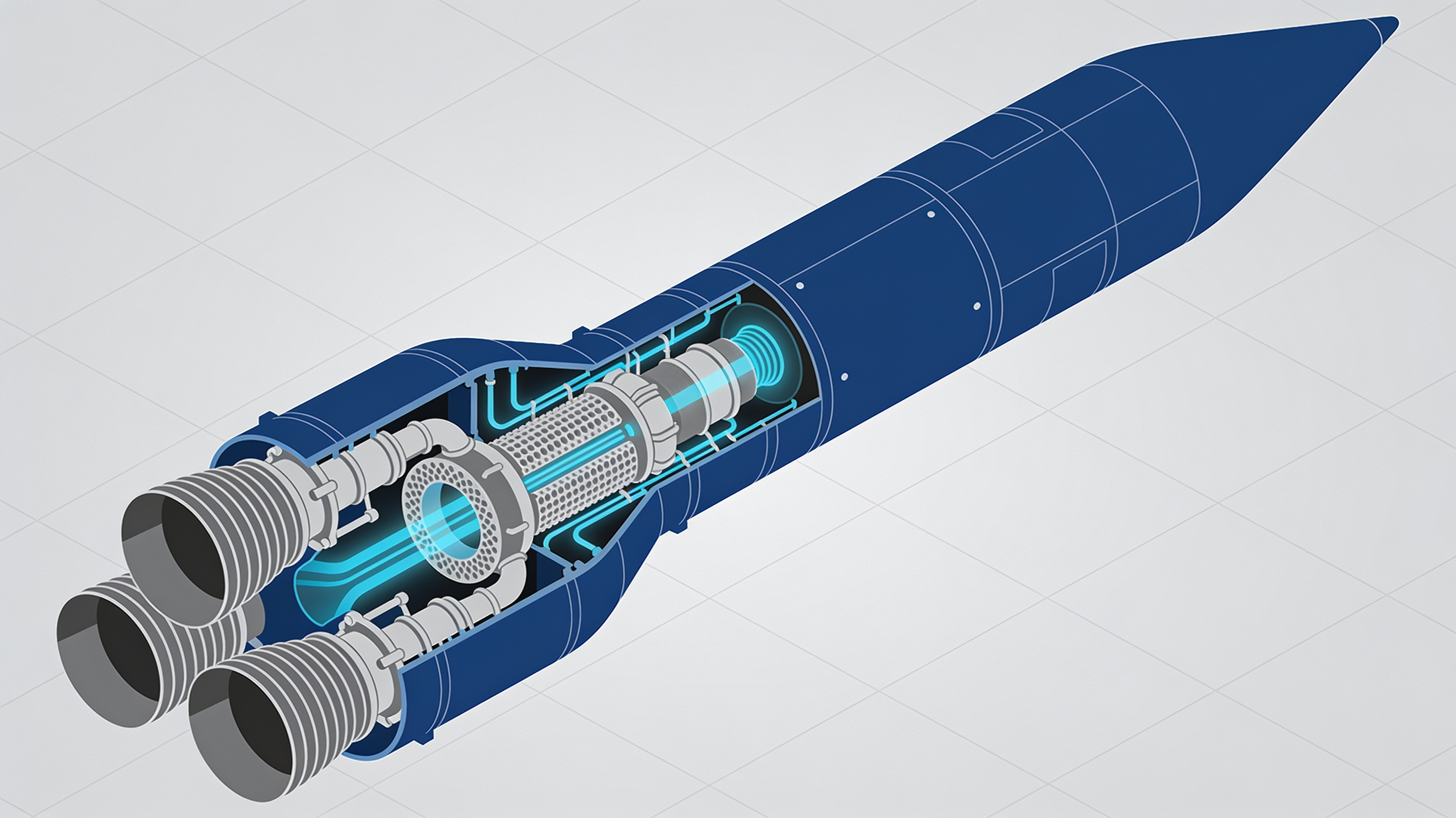
Ursa Major: innovation in aerospace propulsion through additive manufacturing
The American company is revolutionizing both propulsion systems and 3D printing itself, digitalizing production processes and developing solutions for flexible manufacturing of rocket engines.
Ursa Major, founded in 2015 with headquarters in Ohio and Colorado, has made additive manufacturing the heart of its production strategy. The company, which employs over 300 people, develops critical components for space launch, hypersonic, solid propellant motors, and in-space movement.
The Hadley engine represents a significant milestone: 80% of its mass is made up of metal 3D printed parts. Most of the company’s other products substantially integrate additive components.
- Ursa Major produces engines with 80% 3D printed components by mass
- The company is digitalizing additive manufacturing to reduce its complexity
- The Lynx process combines AM, composites, and robotics for flexible production of solid rocket motors
From rapid prototyping to series production
Additive manufacturing has gone from a rapid iteration tool to a complete production solution for complex propulsion components.
“We are experts in propulsion,” says Nick Doucette, vice president of operations at Ursa Major.
The company’s initial approach involved using 3D printing primarily to accelerate development.
“The only way to attract investors was to demonstrate that we could build an advanced combustion rocket engine”, explains Doucette. “In 12-18 months we had to go from zero to a working system. We printed as much as possible because it was the fastest way to obtain complex components”.
This need transformed additive manufacturing from an auxiliary tool to a central production technology.
Digitizing additive manufacturing
Ursa Major is addressing the limitations of 3D printing by treating it as a digital technology to be optimized with algorithms rather than human expertise.
The company has identified structural problems in current additive manufacturing. Too much capacity is tied to proprietary and opaque machine functionalities. Too much specialized expertise is required to effectively implement additive.
To scale production, Ursa Major is investing in reducing the intrinsic complexity of AM. The approach is based on extensive data acquisition, algorithm development, and collaborations.
Ursa Major treats additive manufacturing as a digital technology that can be optimized through code rather than relying exclusively on human expertise.
Lynx: flexible production for solid propellant engines
The Lynx process responds to the growing demand for solid rocket motors by combining additive manufacturing, composites, and robotics for versatile production.
Solid propellant rocket motors (SRMs) are in demand for military applications such as missiles and some categories of space launch vehicles. They are easily storable long-term and less complex to build than liquid propellant motors.
“Solid rocket motors are interesting because you don't really develop a motor. You build a manufacturing process”, explains Doucette.
The challenge of variety
The United States uses 35-40 different types of missiles, with about twelve more considering allies. Demand has increased dramatically with the war in Ukraine and subsequent conflicts.
Before this increase, solid rocket motor manufacturers had decommissioned production lines or closed. This leaves the defense sector with a shortage of inventory and suppliers.
Robotic solution
The Lynx process developed by Ursa Major combines additive manufacturing and composites with robotics to flexibly produce any type of solid motor required.
“Everyone immediately thinks: ‘Print the explosive part’”, says Doucette. “But that's not the problem. The real bottleneck that the supply chain and customers ask to solve is the manufacturing process for the casing geometry”.
Conventional production lines are specialized for specific motor diameters. Reconfiguring them for different products requires considerable time and resources.
Impact on defense and aerospace
Production flexibility becomes a strategic advantage in a context of variable demand and the need for rapid response.
Ursa Major’s approach directly addresses the limitations of traditional production lines. The ability to quickly switch between different engine configurations meets the needs of the defense sector.
The combination of digitalization of additive manufacturing and flexible production processes positions the company as an innovator in both propulsion and production technologies themselves.
article written with the help of artificial intelligence systems
Q&A
How much of the Hadley engine is 3D printed?
80% of the Hadley engine's mass consists of metal 3D-printed components. This represents a significant milestone for Ursa Major in the use of additive manufacturing.
What is Ursa Major's goal in digitizing AM?
The company aims to reduce the intrinsic complexity of additive manufacturing by treating it as a digital technology optimizable via algorithms. The goal is to overcome dependence on specialized human expertise and opaque proprietary features.
Why did Ursa Major initially choose 3D printing?
3D printing was chosen to accelerate development and go from zero to a functioning system in 12-18 months. It was the fastest method to obtain the complex components needed to attract investors.
What does the Lynx process developed by Ursa Major include?
The Lynx process combines additive manufacturing, composites, and robotics. This integration enables flexible production of solid-propellant rocket engines.
Where is Ursa Major headquartered?
Ursa Major is an American company founded in 2015 with operational facilities in Ohio and Colorado. The company employs over 300 people specializing in propulsion.