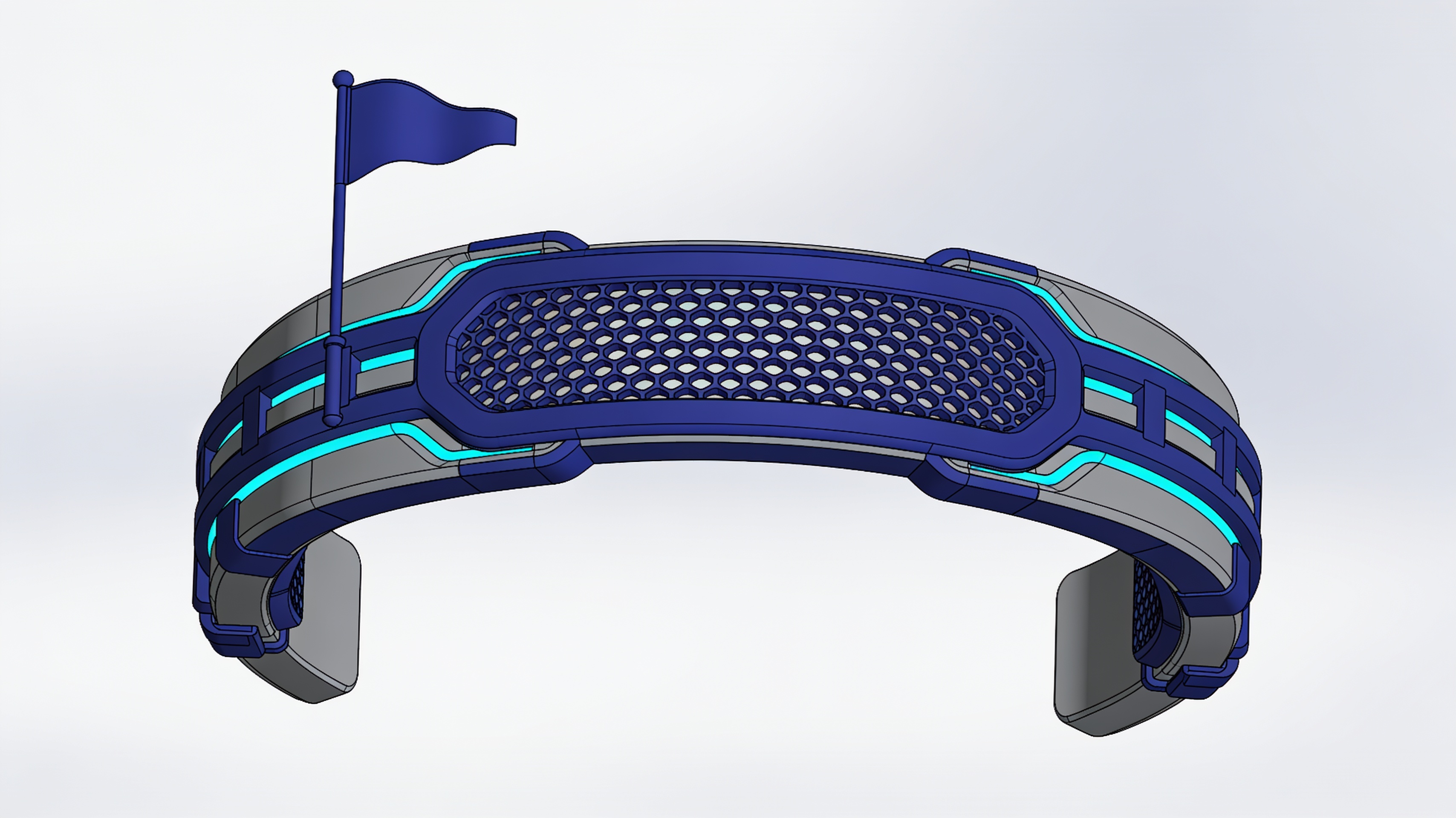
Flag football: Carbon and SYZMIK develop protection with a 3D-printed lattice
SYZMIK Sports and Carbon have presented X7c+, a protective band for flag football that replaces traditional padding with a 3D-printed lattice structure. The device uses controllable geometries to dissipate impact energy, reducing acceleration peaks during tests.
- X7c+ protective band for flag football with a 3D-printed polymer lattice
- Production using Carbon's Digital Light Synthesis in EPU 45 elastomer
- Reduction in acceleration from 140 g to 102 g in tests (-27%)
- Designable geometry to control the mechanical response to impacts
A device for an evolving sport
Flag football reduces contact compared with traditional football, but does not completely eliminate collisions and falls that require protection.
Flag football avoids many of the tackles characteristic of American football, but unintentional collisions, falls, and head-to-head contacts remain possible. SYZMIK Sports and Carbon have developed X7c+, a protective band that integrates a polymer network made via additive manufacturing.
The main innovation does not lie in the use of 3D printing itself. The value lies in the introduction of a controllable geometry as a dissipative element: the mechanical response is modified by acting on the topology of the cells, their thickness and their spatial distribution.
Designable geometry versus traditional foams
Digitally printed lattices make it possible to design differentiated deformation paths, overcoming the limitations of conventional foams.
A traditional foam contains cells produced by chemical and physical processes, with properties linked to the formulation and the resulting microstructure. A digitally printed lattice, on the other hand, makes it possible to design different deformation paths and densities in different areas of a protection.
During an impact, the struts or walls deform and dissipate energy through viscoelastic behavior, internal friction and, in some cases, controlled instability. The response does not depend solely on the material: force orientation, loading speed, cell shape, connections and thickness influence acceleration peaks.
A good result in a single test does not demonstrate identical performance in every accident. Geometric and dynamic variables significantly influence the lattice's response.
Carbon DLS technology and EPU 45 material
Production uses Digital Light Synthesis with polyurethane elastomer, a combination that offers geometric freedom but requires attention to durability.
Carbon produces the components with Digital Light Synthesis, a photopolymerization process that creates three-dimensional geometries and requires a controlled sequence of polymerization and post-treatment. The specified material is EPU 45, a polyurethane elastomer designed to deform and recover its shape.
The choice of an elastomeric photopolymer makes it possible to print a relatively complex open network. However, aging, sweat, UV, cleaning, repeated impacts and variability of properties between batches must be considered.
Without fatigue and environmental conditioning data, it is not possible to quantify the useful life of the device.
The numerical results and the limits of interpretation
The tests show a reduction of 27% in acceleration, but this value does not automatically equate to a proportional reduction in neurological risk.
According to information circulated about the project, the partners reportedly reduced a measured acceleration value from 140 g to 102 g during the design iteration, without increasing the thickness of the protection. This is a reduction of approximately 27% for that specific value.
This datum should not be interpreted as an equivalent reduction in neurological risk. A complete assessment would require additional information on test protocols, measurement repeatability, and the correlation between linear accelerations and injury risk.
| Parameter | Traditional foam | Printed lattice |
|---|---|---|
| Geometric control | Limited | Designable |
| Variable density | Difficult | Possible |
| Production process | Chemical-physical | Digital |
| Durability data | Consolidated | To be validated |
Prospects for additive manufacturing in sports protective equipment
The approach opens possibilities for customized protective equipment, but requires thorough validation on durability and long-term performance.
The interest of the news lies in the introduction of a controllable geometry as a dissipative element. This approach could extend to other personal protective equipment, where customization of the mechanical response represents a competitive advantage.
Questions remain open about production scalability, costs compared with conventional solutions, and standardization of test protocols for lattice structures. Additive manufacturing offers design freedom, but requires rigorous validation for applications where safety is a priority.
article written with the help of artificial intelligence systems
Q&A
What is the X7c+ protective band for flag football?
It is a device developed by SYZMIK Sports and Carbon that replaces traditional padding with a 3D-printed polymeric lattice structure. It serves to protect against collisions, falls, and head-to-head contact in flag football.
What technology and material does the X7c+ use?
Production takes place via Carbon's Digital Light Synthesis, using the EPU 45 polyurethane elastomer. This combination offers geometric freedom in lattice design.
How much does it reduce acceleration during impacts?
In tests, acceleration dropped from 140 g to 102 g, a 27% reduction. The lattice dissipates impact energy by reducing acceleration peaks.
Why is a 3D-printed lattice better than traditional foams?
Conventional foams have properties tied to their chemical formulation and resulting microstructure. A digitally printed lattice allows designing different deformation paths and densities in different zones of the protection.
What does the lattice's response to impacts depend on?
The response does not depend only on the material: force orientation, loading speed, cell shape, connections, and thickness all play a role. Struts deform by dissipating energy through viscoelastic behavior, internal friction, and controlled instability.