ACMER GE1: dual laser source for versatile desktop marking
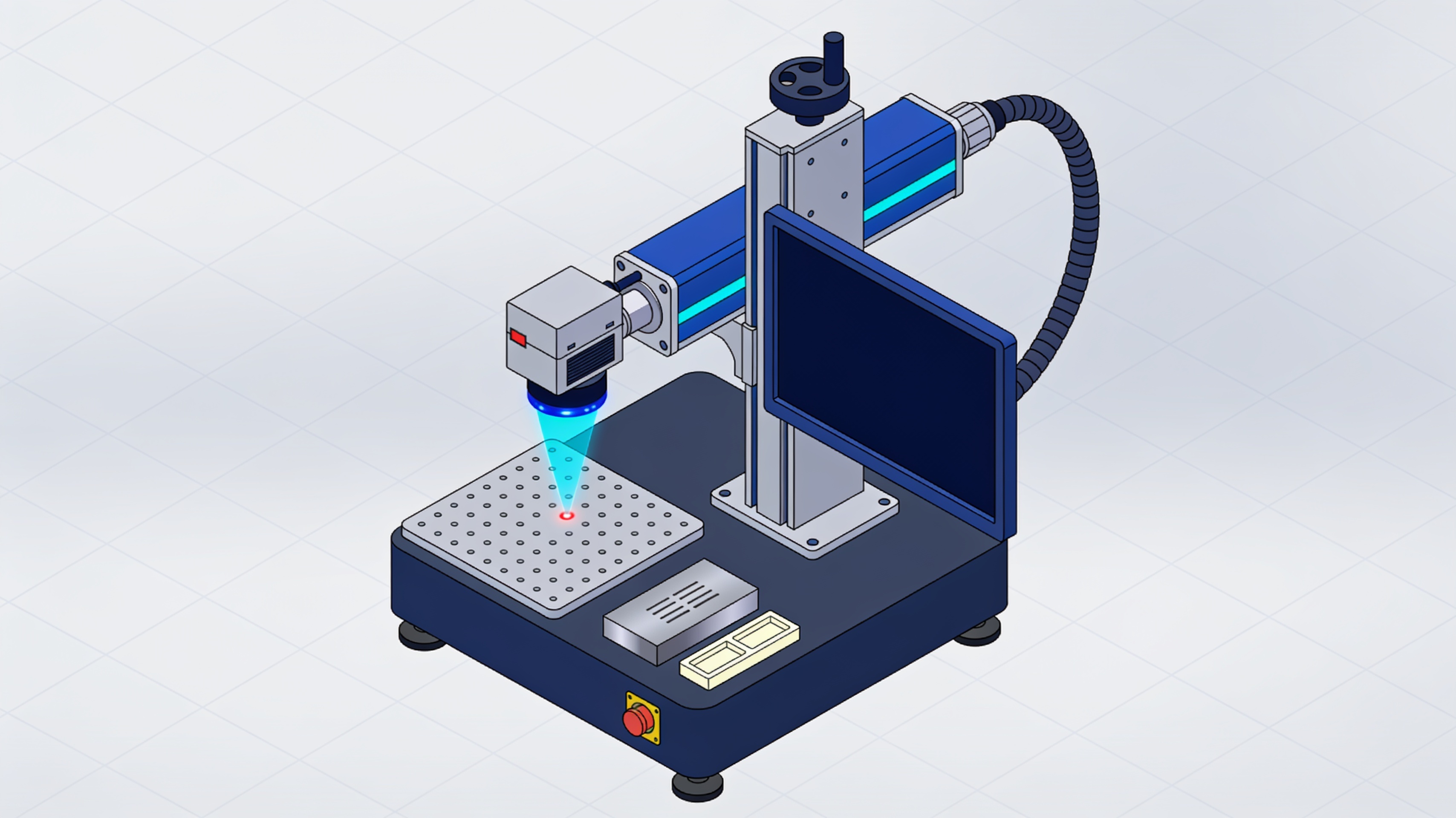
The ACMER GE1 desktop engraver integrates two distinct laser technologies: a 10 W blue diode and a 2 W infrared. The combination aims to cover organic materials, plastics and metals with a compact galvanometric system.
ACMER has introduced the GE1, a desktop laser engraver that brings together two laser sources in a single machine. The device combines a 10 W blue diode for organic and opaque materials with a 2 W infrared laser aimed at marking metals and certain plastics.
The choice to integrate both sources responds to physical limits that cannot be solved simply by increasing power. Wavelength and material absorption determine the coupling of energy to the surface.
- 10 W blue diode for marking and cutting organic and opaque materials
- 2 W infrared laser for marking metals and selected plastics
- Galvanometric system with speeds up to 5,000 mm/s
- Working field 105 × 105 mm, extendable to 105 × 370 mm
- Motorized Z-axis with automated focusing
Two wavelengths, two applications
The blue diode and the infrared are not interchangeable: each source responds to specific needs related to material absorption.
A reflective metal sheet may respond poorly to a visible diode and react differently to infrared. The behavior depends on alloy, finish, any treatments, and process parameters.
The 10 W blue diode is intended for marking and, within material-dependent limits, for cutting organic and opaque substrates. The 2 W infrared focuses on marking metals and certain plastics.
Galvanometric scanning: speed without moving masses
The galvo system deflects the beam through steerable mirrors, eliminating the inertia of Cartesian carriages.
Unlike Cartesian engravers that move a head along two axes, the galvanometric system deflects the beam through steerable mirrors. The movement of the mirrors can be very fast because it does not require accelerating the mass of a carriage.
ACMER declares a maximum engraving speed of up to 5,000 mm/s. The value does not represent a constant speed in every design, material, or quality setting.
The nominal working field is 105 × 105 mm, extendable with an accessory to 105 × 370 mm. A long object may require repositioning or coordinated advancement and verification of pass registration.
Focus management and preview
The motorized Z axis automates focal height adjustment after the workpiece thickness is indicated.
The GE1 integrates a motorized Z axis for focal height. The manufacturer advertises an automated focusing procedure after the workpiece thickness is indicated.
It is important to distinguish height adjustment from real-time measurement of the profile of a complex object. No three-dimensional surface scanning system is documented.
The contour preview function helps center the job and check the overall dimensions before exposing the material to the beam. On curved or non-planar elements, the depth of focus and any use of the rotary accessory become decisive.
A dark marking on metal does not necessarily demonstrate material removal. Some processes produce oxidation or surface changes; others cause actual ablation. These are different phenomena, with different wear resistance, contrast, and repeatability.
Limits of the 2 W infrared source
A 2 W IR does not replace higher-power fiber or MOPA systems for deep engraving or intensive industrial processing.
The power of the GE1's infrared source is intended for surface marking. A 2 W IR laser should not be presented as a direct replacement for higher-power fiber or MOPA systems for deep engraving or intensive industrial processing.
The difference between marking and deep engraving is substantial. Some processes produce oxidation, surface variations or optical changes. Others cause actual ablation, with different wear resistance, contrast and repeatability.
Market positioning
The GE1 targets maker labs and additive service providers looking for benchtop versatility without investing in dedicated industrial laser systems.
The integration of two sources in a benchtop device represents a compromise between versatility and specialization. The machine aims to cover marking needs on different materials without requiring the purchase of separate laser systems.
The limited work area and the contained power of the infrared source define a positioning aimed at prototyping, customization and small batches rather than high-intensity industrial production.
article written with the help of artificial intelligence systems
Q&A
What laser sources does the ACMER GE1 integrate?
The GE1 integrates two distinct sources: a 10 W blue diode for organic and opaque materials and a 2 W infrared laser aimed at marking metals and certain plastics. The two sources are not interchangeable and respond to needs related to material absorption.
Why are two wavelengths needed instead of increasing power?
Physical limits are not simply solved by increasing power: wavelength and material absorption determine how energy couples to the surface. A reflective metal sheet may respond poorly to a visible diode and react differently to infrared, depending on alloy, finish, treatments and process parameters.
What is the declared maximum speed and what does it mean?
ACMER declares a maximum engraving speed of up to 5,000 mm/s thanks to the galvanometric system, which deflects the beam via steerable mirrors without moving carriages. The value does not represent a constant speed in every design, material or quality setting.
What is the GE1's work area and is it extendable?
The nominal work area is 105 × 105 mm and can be extended with an accessory to 105 × 370 mm. A long object may require repositioning or coordinated advancement, with verification of pass registration.
How does the GE1 handle focusing?
The GE1 integrates a motorized Z axis that automates focal height adjustment after indicating the thickness of the piece. This simplifies focusing compared to manual adjustment.