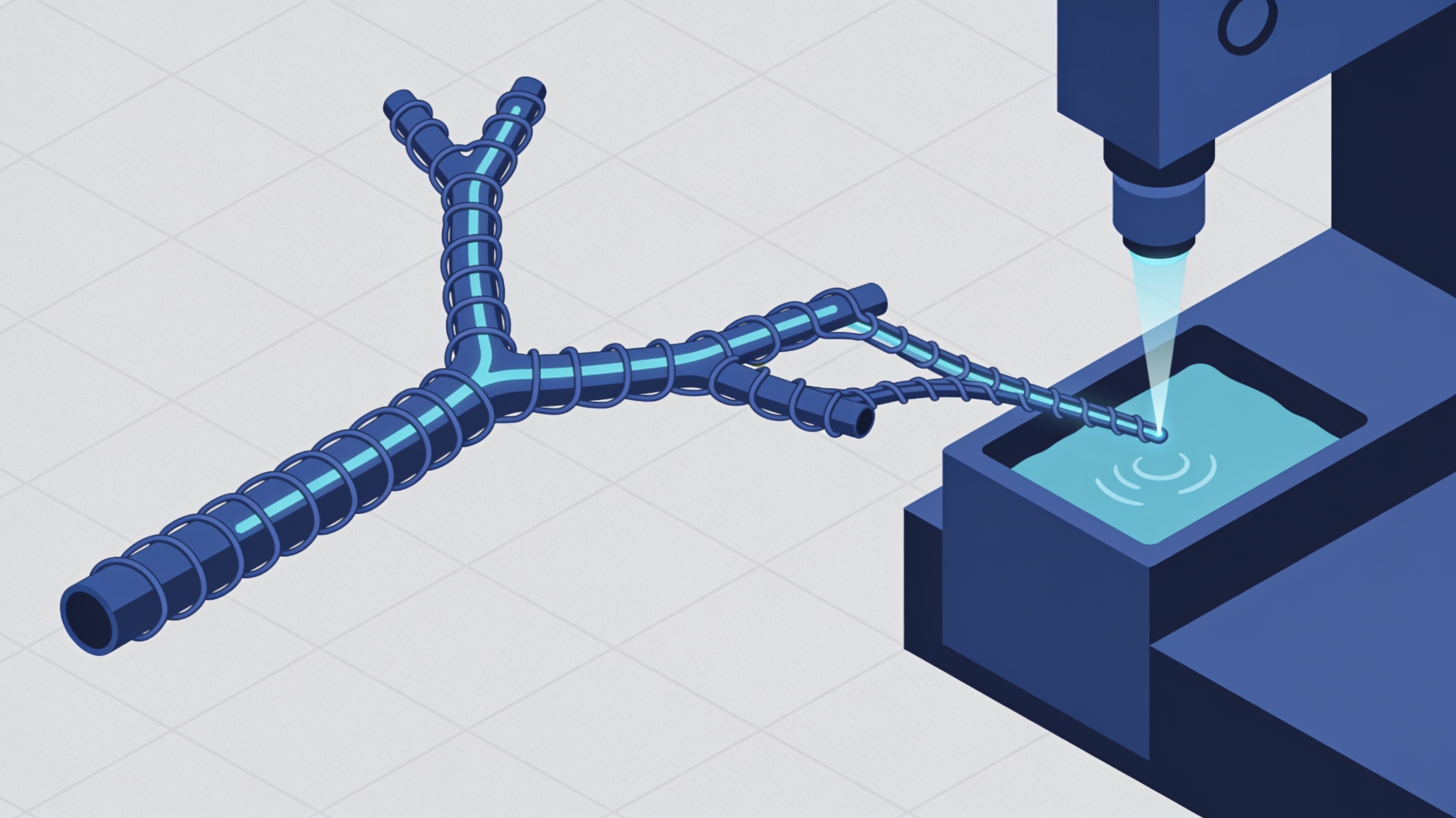
Vital3D and Cleveland Clinic develop custom Y-shaped brain stents with laser microprinting
Lithuanian company Vital3D Technologies and Cleveland Clinic have signed a licensing agreement to study custom Y-shaped brain stents manufactured via laser microprinting. The project aims to treat complex aneurysms at cerebral arterial bifurcations with devices designed based on the individual patient's geometry.
The announcement dates back to 29 September 2026 and concerns an exploratory phase: this is not a clinical authorization nor a device already implanted. The program must still establish whether the stent can be designed, manufactured reproducibly, and inserted through a catheter.
- Licensing agreement between Vital3D Technologies and Cleveland Clinic for custom brain stents
- Technology based on laser microfabrication with the FemtoBrush platform
- Indication: complex aneurysms at cerebral arterial bifurcations
- Exploratory phase, not yet clinically validated
The problem of aneurysms at bifurcations
Aneurysms that form where a cerebral artery divides into two branches present specific anatomical challenges that standard devices struggle to address.
A cerebral aneurysm is a localized dilation of the wall of a blood vessel. When it forms at a bifurcation, the neck of the sac may be located near the two branches continuing downstream.
Treatment must preserve flow in both vessels originating from the bifurcation. Complex bifurcations and wide-necked aneurysms require elaborate procedural strategies.
The standard geometry of existing devices does not always match the individual patient's anatomy. This is especially true when the angles and diameters of the two branches differ significantly.
The solution: a custom-made Y-stent
The proposed approach involves a Y-shaped structure as a single component, designed from the outset around the individual vascular geometry.
The idea of Vital3D and Cleveland Clinic is to study customized devices for selected cases, not to universally replace existing endovascular devices. Each stent would be designed for the patient's specific bifurcation.
Laser microfabrication makes it possible to create complex geometries on a millimeter scale. Vital3D's FemtoBrush platform represents the technological basis of the program.
The clinical know-how behind the project
The content of the license derives from the work of neurosurgeons Mark Bain and Sean Nagel of Cleveland Clinic.
The licensed know-how includes elements relating to device design and clinical and procedural planning. Bain and Nagel developed these contents at the Cleveland Clinic.
The stent must be compressible to pass through a neurovascular catheter and reach the treatment area. Repeatable manufacturability and insertability are requirements still to be validated.
For Vital3D, the agreement opens the possibility of developing a technology based on this knowledge. The path requires completing research activities and subsequent regulatory requirements.
Prospects and limitations
The program is at an early stage, focused on technical feasibility before any clinical application.
The communication does not concern a marketed product but a technological path. Open questions include the repeatability of the manufacturing process, the biocompatibility of materials, and the navigability of the device through vascular anatomy.
The target is complex anatomies where standard solutions show limitations. The personalized approach could offer advantages in selected cases, but requires extensive clinical validation.
Laser microfabrication applied to implantable medical devices represents an evolving field. The project between Vital3D and Cleveland Clinic adds a specific use case in endovascular neurosurgery.
article written with the help of artificial intelligence systems
Q&A
Who signed the agreement for the custom Y-shaped brain stents?
The license agreement is between the Lithuanian company Vital3D Technologies and the Cleveland Clinic, announced on September 29, 2026. The program concerns custom Y-shaped brain stents manufactured via laser microprinting.
Which aneurysms are these custom stents intended to treat?
The project is intended for complex aneurysms that form at cerebral artery bifurcations, where the neck of the sac may be located near the two downstream branches. These geometries require preserving flow in both vessels and often do not match standard devices.
What technology is the stent microfabrication based on?
The technological basis of the program is Vital3D's FemtoBrush platform, based on laser microfabrication. This enables the creation of complex geometries on a millimeter scale, such as the Y-shaped structure as a single component.
Is the project already in the clinical validation phase?
No, this is an exploratory phase and not a clinical authorization nor a device already implanted. The program must still establish whether the stent can be designed, manufactured reproducibly, and inserted through a catheter.
From whom does the licensed clinical know-how derive?
The know-how derives from the work of neurosurgeons Mark Bain and Sean Nagel of the Cleveland Clinic. The license includes elements relating to device design and clinical and procedural planning.