Habitat for Humanity tests two concrete 3D printing methods on five homes in Virginia
Five affordable homes in Virginia will become a testing ground to compare warehouse prefabrication and direct on-site deposition. The project measures the advantages, limitations, and real costs of additive construction applied to social housing.
Richmond Metropolitan Habitat for Humanity has launched a pilot project in the Carter Place I area, in Henrico County near Richmond. The initiative involves Virginia Housing, Virginia Tech, and other partners to build five single-family homes with 3D-printed concrete walls.
The original press release dates to September 29, 2026. The news was covered by 3DPrint.com's American roundup on October 17.
Two construction approaches compared
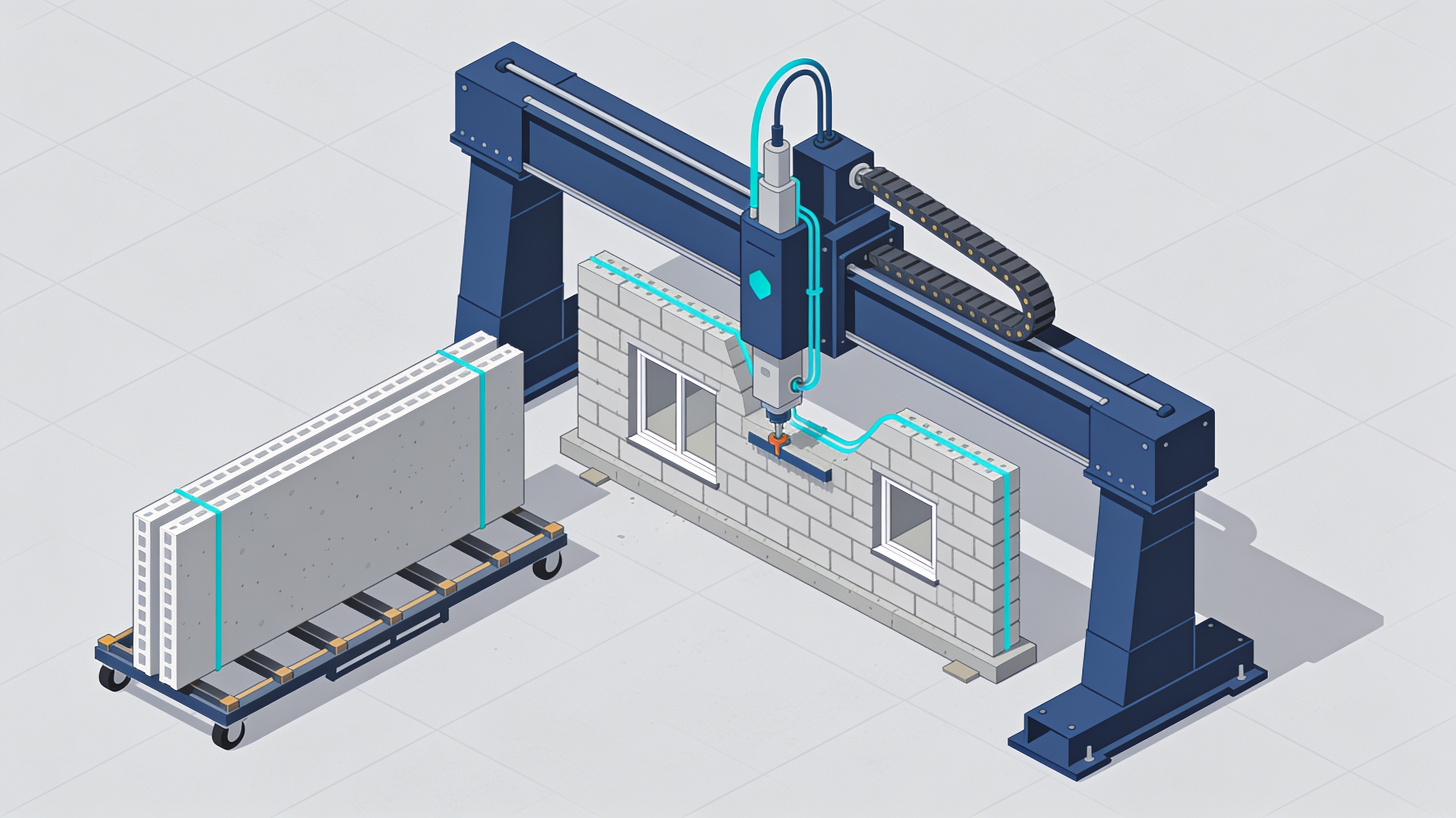
The project compares two additive manufacturing methodologies: manufacturing walls in a controlled environment and printing directly on the building site.
The first method involves prefabricating the walls in a warehouse, followed by transport and assembly on site. The second deposits concrete directly in the building area.
This field comparison answers a concrete industry question: which approach offers the best balance between costs, time, and construction quality in affordable housing?
- Five single-family homes with 3D-printed walls at Carter Place I, Virginia
- Comparison between warehouse prefabrication and direct on-site printing
- Investment of $1.1 million in technology and demonstration program
- Partnership between Habitat for Humanity, Virginia Tech, Virginia Housing and other organizations
Printed walls, not complete houses
Only the perimeter walls are produced through additive deposition. Foundations, roofs, systems and finishes follow traditional processes.
The five homes are intended for affordable housing. Only the concrete walls are 3D printed.
Foundations, roofs, systems, windows and doors, and finishes remain necessary as in conventional construction. The construction sequence can be coordinated differently, but the masonry constitutes one part of the building process, not the whole.
This distinction is essential to correctly interpret the economic and timing data of the additive construction sector.
Investment in technology and research
The Virginia Center for Housing Research purchased a mobile printer through a $1.1 million grant from Virginia Housing.
The funding is tied to the technology and the demonstration program, not to the unit cost of individual homes. The equipment comes from Tvasta, an Indian company specializing in additive construction systems.
The Virginia Center for Housing Research at Virginia Tech coordinates the technical and research aspects. Williamsburg Builder Consultants contributes to the construction, structural, and permitting aspects.
Tvasta's mobile SIRA RC printer uses a robotic arm to deposit concrete. This system allows both prefabrication and in-situ printing, making direct comparison between the two methods possible.
Habitat for Humanity and affordable housing
The organization combines local collaboration, volunteering, dedicated funding, and family participation in housing programs.
Richmond Metropolitan Habitat for Humanity coordinates the project in the Darbytown Road area. The initiative is part of the housing programs that the organization develops to make homeownership accessible.
The involvement of HiveASMBLD, an automated additive construction company, completes the technical partnership. This collaboration among public entities, universities, nonprofit organizations, and private companies represents a model of applied experimentation.
Measuring in the field, beyond demonstrators
The goal is to quantify the real advantages, limitations, and costs of a process often presented only through prototypes.
The Carter Place I project stands out for its comparative approach. It does not limit itself to demonstrating technical feasibility, but measures the economic and operational effectiveness of two construction methodologies.
Data collected during the construction and delivery of the five homes will provide concrete guidance for future affordable housing initiatives. Field experimentation makes it possible to evaluate aspects that demonstrators cannot capture: logistics, coordination among work processes, actual timelines, and final quality.
This evidence-based approach represents a necessary step for the maturation of 3D printing in the construction sector.
article written with the help of artificial intelligence systems
Q&A
How many homes are being built in Habitat for Humanity's pilot project in Virginia?
The project includes five accessible single-family homes in the Carter Place I area, in Henrico County near Richmond. The houses serve as a testing ground to compare two concrete 3D printing methods.
What are the two 3D printing methods compared in the project?
The first method involves prefabricating the walls in a warehouse, then transporting and assembling them on site. The second deposits the concrete directly in the build area. The comparison measures the advantages, limitations, and real costs of the two approaches.
What is 3D printed in the project's homes?
Only the concrete walls are produced through additive deposition. Foundations, roofs, systems, windows, and finishes follow traditional processes as in conventional construction.
Who participates in the project and who funds it?
The project involves Richmond Metropolitan Habitat for Humanity, Virginia Housing, Virginia Tech, and other partners. The Virginia Center for Housing Research purchased a mobile printer thanks to a $1.1 million grant from Virginia Housing.
Does the $1.1 million funding cover the cost of the homes?
No, the funding is tied to the technology and the demonstration program, not to the unit cost of the individual homes. The equipment comes from Tvasta, an Indian company specializing in 3D printing systems.