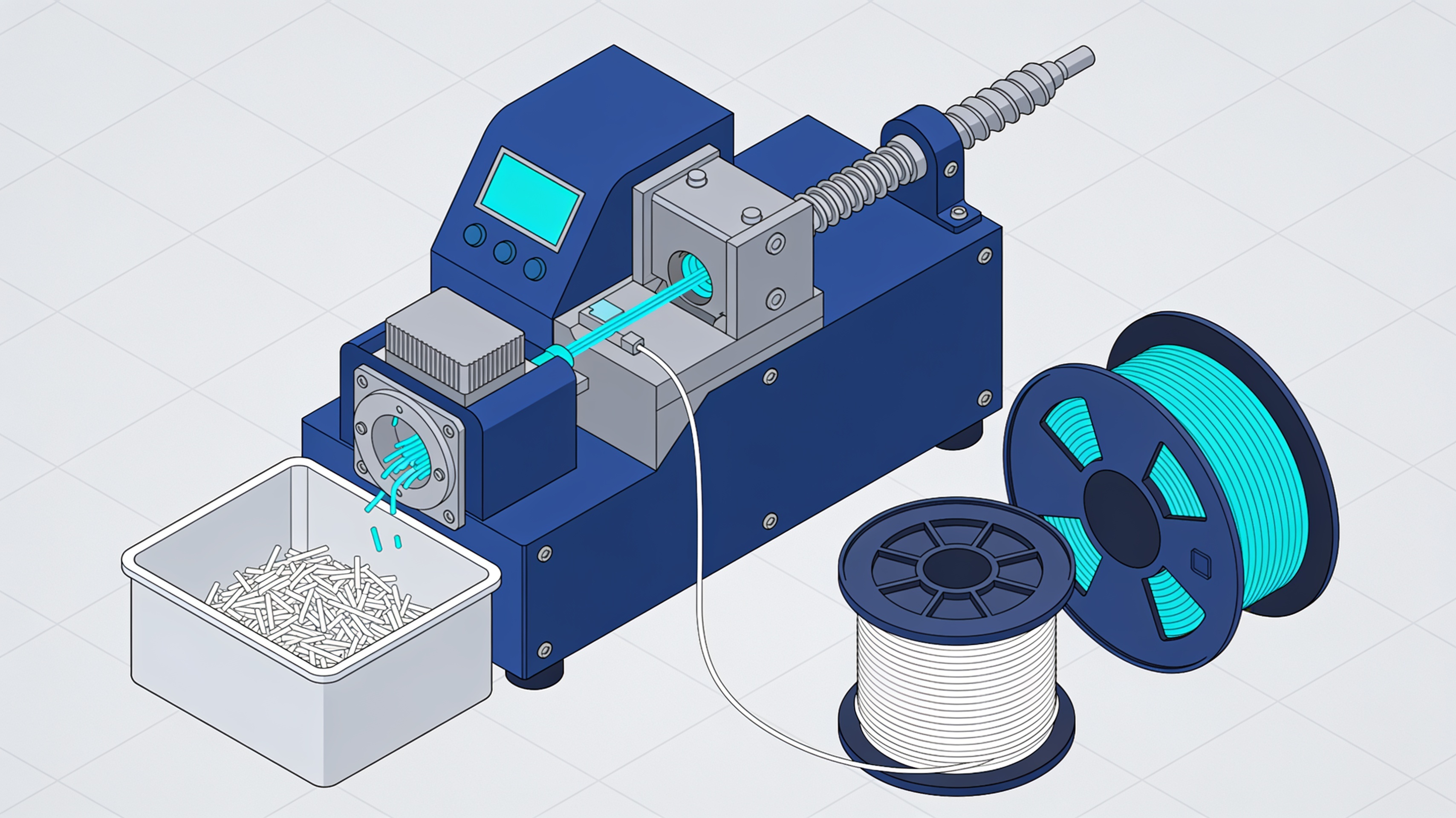
FilUM: the University of Montreal recycles 3D printing waste into new filament
A pilot project turns PLA waste into reusable spools. Over 40 kg recovered through a network connecting campus laboratories and libraries.
Université de Montréal has launched FilUM, an initiative that recovers 3D printing waste and transforms it into new filament. The project has already collected over 40 kilograms of PLA from supports, discarded prototypes and spool remnants accumulated in the university's laboratories and libraries.
The announcement came on 13 October 2026. These are not industrial volumes, but a scale sufficient to verify the feasibility of a mechanical recycling circuit at university campus level.
- Over 40 kg of PLA recovered from 3D printing waste
- Collection network across campus laboratories and libraries
- Complete process: shredding, extrusion and reuse
- Funded by university funds and the Royal Society of Chemistry
A distributed collection network
FilUM works thanks to a coordinated system that aggregates small quantities of scraps from different points across the campus.
The project started in 2025 with the support of a university fund dedicated to the environmental responsibility of research. At the beginning of 2026 it also received a contribution from the Sustainability Fund of the Royal Society of Chemistry.
The Hubert-Reeves library on the MIL campus serves as the central point. The chemistry laboratory led by Professor Audrey Laventure handles the processing of the material.
The system collects scraps from libraries with fabrication spaces and from research groups. Laboratories can deliver the material to dedicated points or through internal mail.
Each individual laboratory produces modest quantities, but aggregation makes it possible to fill usable spools and to justify the investment in an extruder.
From waste to filament: the process
The material goes through shredding, drying and extrusion before becoming usable again.
Recovery stages
- Collection: The scraps are delivered to collection points distributed across the campus.
- Shredding: The material is reduced into uniform flakes.
- Drying: Moisture is removed to ensure print quality.
- Extrusion: The flakes are transformed into new filament and wound onto reused spools.
Coordination is as crucial as technology. Without continuous collection, an extruder remains unused and the investment becomes disproportionate to the kilograms processed.
PLA is not compostable everywhere
Many filaments are sold as compostable, but the real disposal conditions are more complex.
PLA can derive from renewable raw materials. This does not mean that a printed part will decompose quickly in soil or in a standard organic waste bin.
Industrial composting processes require controlled temperatures, humidity, and conditions. The local availability of facilities capable of processing the material varies greatly.
In the case of the Université de Montréal, there was no accessible supply chain for printer waste. Mechanical recovery offers an alternative: keeping the polymer in circulation for new prints.
Mechanical recycling of PLA keeps the material usable without requiring complex chemical processes or hard-to-access industrial composting infrastructure.
Beyond the single laboratory
The FilUM model addresses a problem typical of universities: fragmentation of resources and widespread accumulation of waste.
Each laboratory produces modest quantities when considered individually, but together they can fill usable spools.
The presence of a cross-cutting structure makes it possible to measure waste instead of considering it anonymous refuse. The project also offers concrete data on the feasibility of recycling at campus scale.
The 40 kilograms recovered represent a starting point. The concrete question is: when can filament recycling truly work at campus scale?
FilUM provides a practical answer based on existing infrastructure and real material flows.
article written with the help of artificial intelligence systems
Q&A
How many kilograms of waste did FilUM recover?
FilUM collected over 40 kilograms of PLA from supports, discarded prototypes and spool remnants. This is a sufficient scale to verify the feasibility of a mechanical recycling circuit at the university campus level.
When was the FilUM project announced?
The announcement came on October 13, 2026. However, the project had started in 2025 with the support of a university fund dedicated to the environmental responsibility of research.
What stages does the PLA recycling process in FilUM involve?
The material goes through four stages: collection at dedicated points on campus, grinding into homogeneous flakes, drying to remove moisture, and finally extrusion into new filament wound onto reused spools.
How does the campus waste collection network work?
The Hubert-Reeves library on the MIL campus serves as the central point, while Professor Audrey Laventure's chemistry laboratory handles the processing. Laboratories can deliver the material to dedicated points or via internal mail.
Who funds the FilUM project?
FilUM is supported by a university fund dedicated to the environmental responsibility of research and, since the beginning of 2026, also by the Sustainability Fund of the Royal Society of Chemistry.