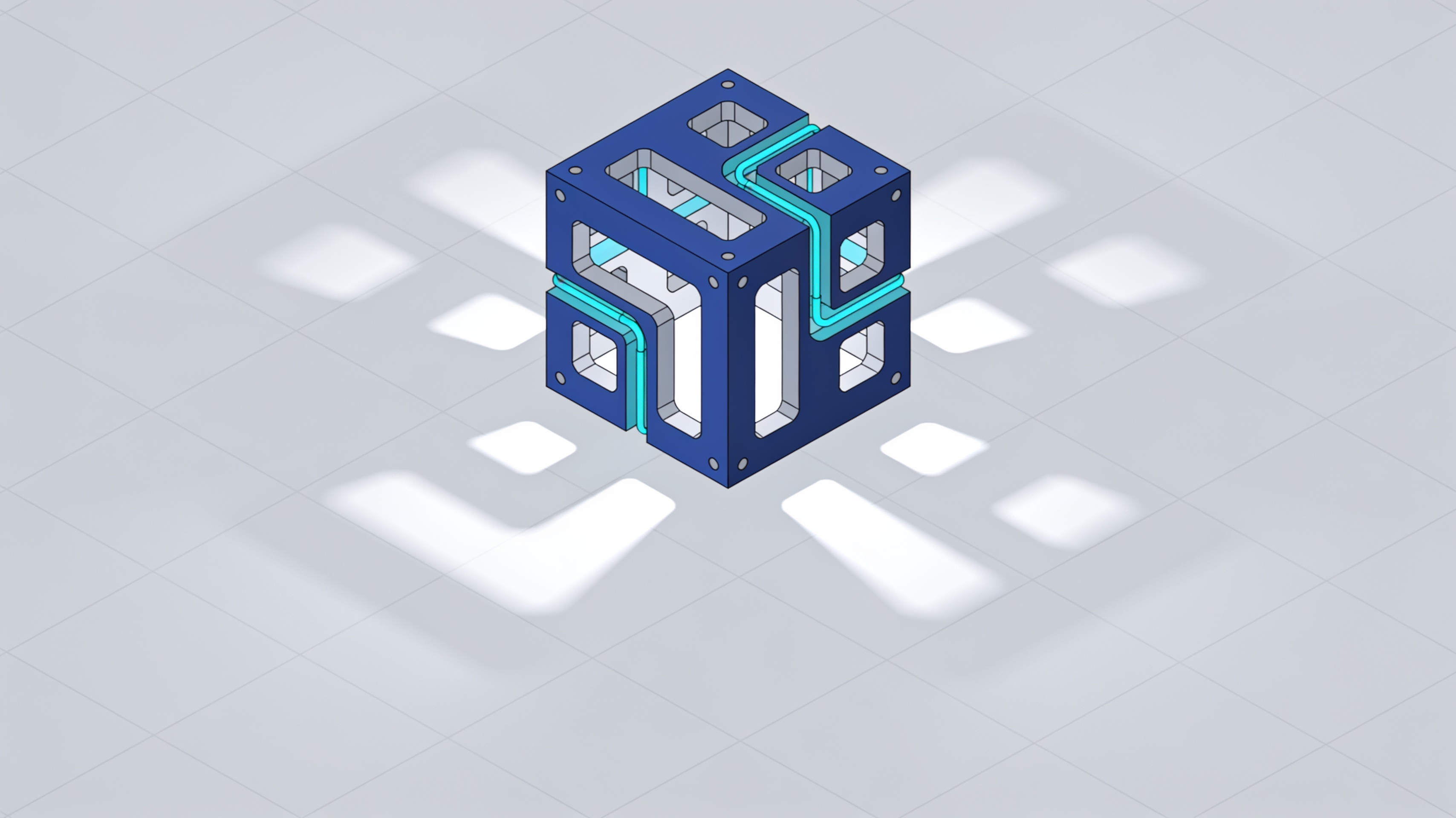
Shattie Cubes: 3D-printed cubes that hide three projected images
An apparently abstract cube can contain three different images, recognizable only when light passes through it along specific directions. The Swiss studio Drzach&Suchy developed Shattie Cubes, now accessible through an online configurator that allows you to customize the images and automatically generate the necessary three-dimensional geometry.
The distinctive point is not printing visible figures on the surface, but building a volume that controls the projected shadow. Digital model and light source become two parts of the same project.
Encoded geometry, not surface decoration
Visual information is embedded in the three-dimensional structure, not in color or images applied afterward.
A normal bas-relief reveals the design by observing the surface. In Shattie Cubes, however, the figure may not be immediately legible from the external geometry.
Recognizability emerges when light passes through the structure, creating shadow zones and openings that compose a design on the projection plane. The same solid contains three visual configurations, associated with different directions.
- Three images hidden in a single 3D-printed cube
- The figures emerge only through directional light projections
- Online configurator for customization and automatic generation
- Information encoded in the geometry, not in color or surface
The geometry may appear confusing up close because every detail contributes to a specific projection. When the object is illuminated from the intended side and the receiving surface is in the correct position, the combination comes together.
The result depends on the interaction between shape, light position, distance, and background contrast. Without adequate lighting, the effect may be much less evident than in the demonstration photographs.
From panel to cube: evolution of the research
Drzach&Suchy has been working for years on the relationship between three-dimensional forms and images generated by shadows, developing various related technologies.
Shadow casting panels are structures that can produce different images under different lighting conditions. Shadow clouds extend the principle to three-dimensional assemblies that do not correspond to a simple sculpted surface.
The new customizable cube is part of this design research, transforming a method developed in the artistic field into an application accessible to a wider audience.
| Technology | Hidden images | Type |
|---|---|---|
| Relief Shattie | 2 | Sculpted surface |
| Shattie Cube | 3 | Three-dimensional volume |
The studio itself distinguishes on its website the Relief Shattie, capable of hiding two images, from the Shattie Cube, presented as an object that hides three. The distinction is important so as not to attribute the same functioning to both.
Implications for additive manufacturing
The project demonstrates how 3D printing can encode complex information in the geometry itself, opening perspectives beyond the simple replication of shapes.
The user chooses the images, the system generates the three-dimensional geometry, and the result can be obtained as an object or through the service provided by the platform. This represents an example of inverse design: one starts from the desired image and calculates the necessary geometry.
The term “online configurator” refers to the tool through which users can customize their Shattie Cubes, selecting the three images to hide in the three-dimensional volume.
The technology is based on principles of geometric optics applied to additive manufacturing. It is not about printing a visible image, but about building a three-dimensional filter that modulates light in a controlled way.
This approach opens up application possibilities that go beyond the artistic field: from encoding multiple pieces of information into physical objects to the creation of architectural elements with variable light effects, and even potential applications in security or identification.
The availability of an online configurator makes the technology accessible without requiring specific skills in 3D modeling or optics. The system automates the complex geometric calculation required to translate three two-dimensional images into a single functional three-dimensional structure.
article written with the help of artificial intelligence systems
Q&A
What are Drzach&Suchy's Shattie Cubes?
They are 3D-printed cubes that contain three hidden images, recognizable only when light passes through them along specific directions. The visual information is encoded in the geometry of the volume, not in color or surface decorations.
How are the hidden images revealed in Shattie Cubes?
The figures emerge when light passes through the structure, creating shadow zones and apertures that compose a drawing on the projection plane. Directional lighting, distance, and adequate background contrast are required.
How many images can a single cube contain?
A single cube contains three visual configurations, each associated with a different direction of light. The geometry may appear confusing up close because every detail contributes to a specific projection.
Is it possible to customize Shattie Cubes?
Yes, an online configurator is available that allows you to customize the images and automatically generate the necessary three-dimensional geometry. The project transforms an artistic method into an application accessible to a broader audience.
What is the difference between Shattie Cubes and a normal bas-relief?
A bas-relief reveals the design by observing the surface, whereas in Shattie Cubes the figure is not legible from the external geometry. The image appears only through light projection, controlling shadow instead of surface.