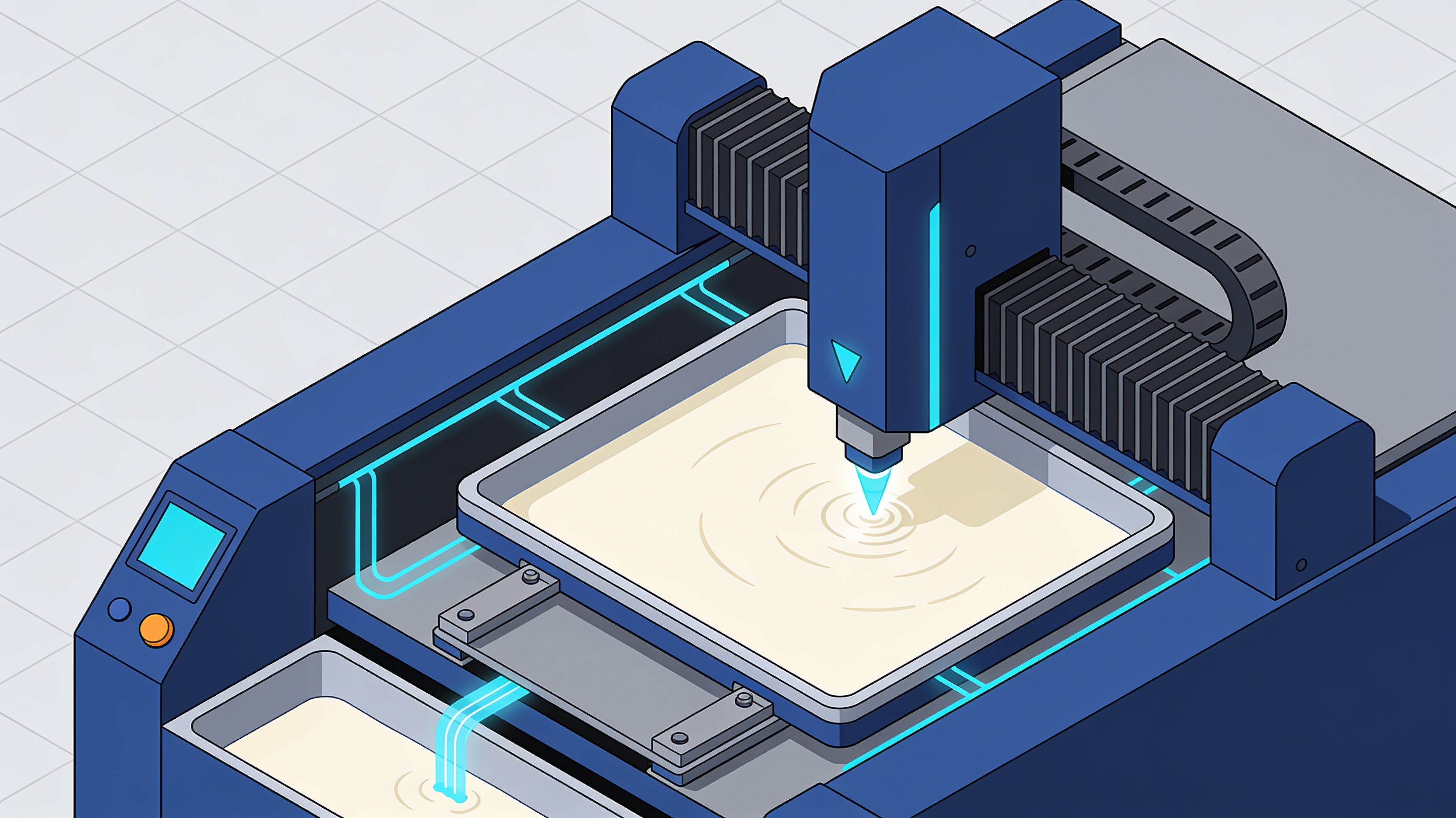
Prodways launches CERAM PRO 365 MAX: high UV intensity for complex technical ceramics
Prodways has presented CERAM PRO 365 MAX, a new configuration for the photopolymerization of ceramic suspensions with high powder loading. The system focuses on irradiance up to 200 mW/cm² and is aimed primarily at material development and the fine-tuning of processes requiring high light doses.
The machine uses the French company's MOVINGLight technology at 365 nm. Its distinctive feature lies not only in the size of the build plate, but in the intensity of the source and the flexibility of exposure.
- Declared irradiance: up to 200 mW/cm²
- Print area: up to 264 × 328 mm
- Print height: 350 mm
- Native pixel: 31 micrometers
- Technology: MOVINGLight DLP at 365 nm
Intensity versus dose: a fundamental distinction
Irradiance measures luminous power per unit area, but the effective dose depends on exposure time and the characteristics of the suspension.
Prodways states up to 200 mW/cm² of irradiance. This quantity measures luminous power per unit area. The dose that actually reaches the resin also depends on exposure time.
Cure depth is influenced by multiple factors. Light absorption and scattering by ceramic particles, photoinitiator, particle size distribution, and solids content all play a role.
An increase in irradiance can widen the process window for difficult formulations. However, it does not automatically mean halving times or increasing productivity.
Configuration and nominal resolution
The machine adopts a modular top-down structure with print areas selectable according to the configuration.
The system is described as having a native pixel size of 31 micrometers. The selectable areas vary, depending on the configuration, up to 264 × 328 mm, with a print height of 350 mm.
Pixel size does not coincide with the final accuracy of the part. The optical response, light scattering, and especially shrinkage during thermal treatments modify the dimensions.
When comparing sintered components, the compensation system and batch-to-batch variability must be reported.
From green body to dense ceramic: the complete process
The printed component requires debinding and sintering to become a functional ceramic object, stages that can introduce defects and deformation.
The freshly printed component contains organic binder and powder. To obtain a functional ceramic object, debinding and sintering are normally required.
These stages can cause loss of shape, cracks, residual porosity, and differential deformation. Alumina, silica, and other compositions require distinct thermal cycles.
A research platform must therefore also be evaluated for repeatability of final density. Thickness homogeneity, defect distribution, and post-treatment properties are critical parameters.
What is missing for a complete evaluation
To understand the actual advantage of the MAX variant, comparative data on different suspensions and dimensional tolerances after sintering would be needed.
To understand how much the MAX variant outperforms previous configurations, working curves for different suspensions would be needed. Dimensional tolerances after sintering and a comparison of overall times would be required.
The manufacturer states source performance and machine configuration. However, it does not provide an independent comparative demonstration of the productivity increase.
The greatest interest concerns materials development. The CERAM PRO 365 MAX system positions itself as a tool for research on complex ceramic suspensions, where high UV intensity can make a difference in the polymerization of formulations with high powder loading.
article written with the help of artificial intelligence systems
Q&A
What is the maximum irradiance declared by Prodways for the CERAM PRO 365 MAX?
Prodways declares an irradiance of up to 200 mW/cm². This quantity measures the light power per unit area, but the effective dose also depends on the exposure time and the characteristics of the ceramic suspension.
What are the build area dimensions and the maximum height of the CERAM PRO 365 MAX?
The build area is selectable according to the configuration and reaches up to 264 × 328 mm, with a build height of 350 mm. The declared native pixel is 31 micrometers.
What photopolymerization technology does the CERAM PRO 365 MAX use?
The machine uses the 365 nm MOVINGLight DLP technology developed by Prodways. The distinctive feature is not only the plate size, but the intensity of the source and the exposure flexibility.
Does increasing irradiance automatically reduce printing times?
No. An increase in irradiance can widen the process window for difficult formulations, but it does not automatically mean halving times or increasing productivity. The dose also depends on the exposure time and the properties of the suspension.
What stages are needed to obtain a dense ceramic component after printing?
The freshly printed component contains organic binder and ceramic powder. To obtain a functional ceramic object, debinding and sintering are normally required, stages that can introduce defects and deformations.