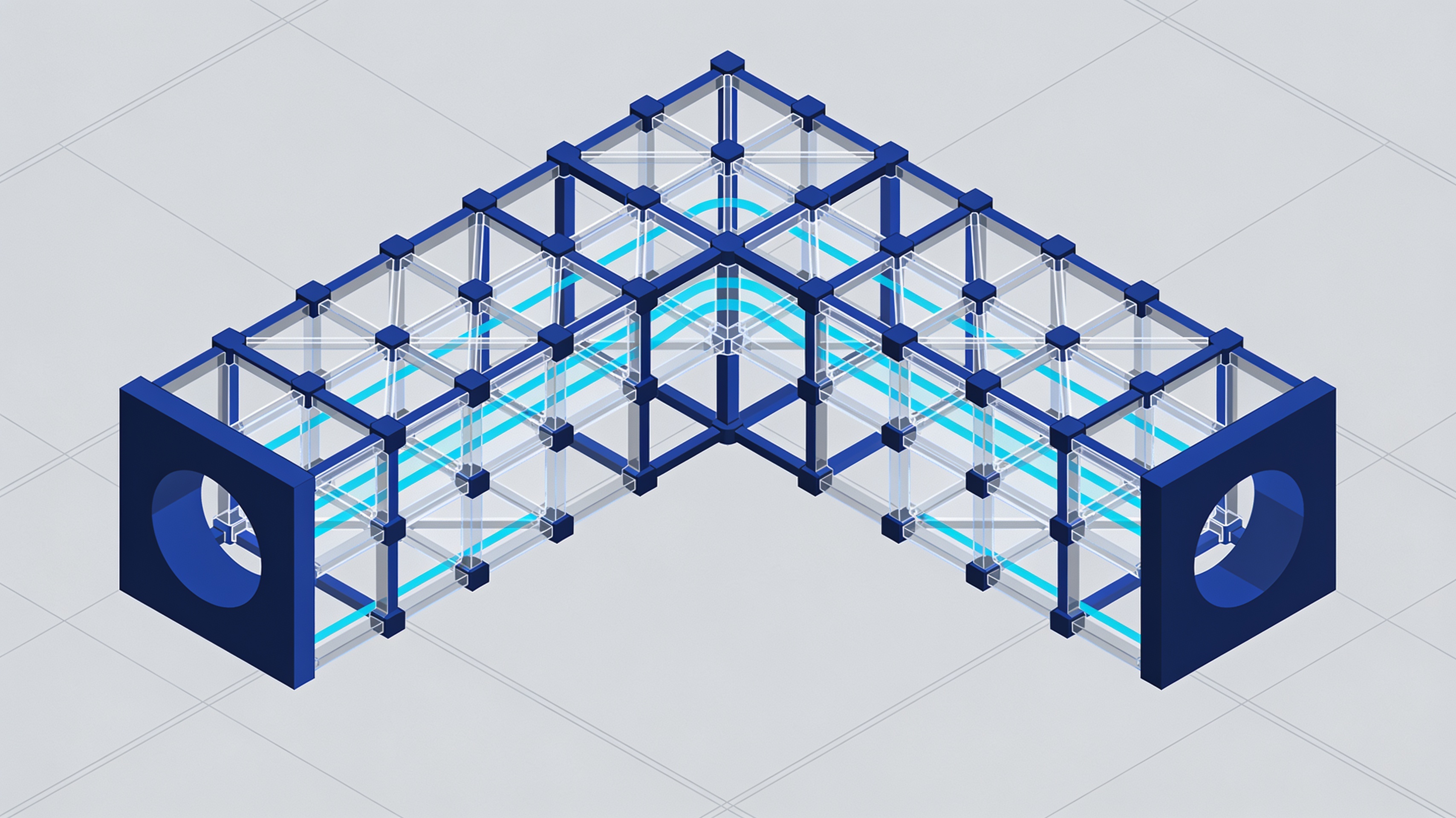
From polymer to silica: at KIT, 3D-printed glass nanostructures with strength up to 6 GPa
Researchers at the Karlsruhe Institute of Technology have developed a process to convert 3D-printed polymer microstructures into silica glass through thermal treatment. The technique achieves tensile strength values up to 6 GPa, opening prospects for micro-optics and miniaturized devices.
The method is based on two-photon polymerization (2PP), which enables drawing volumes at the micrometric and submicrometric scale using a focused laser beam. In this case, the polymer is not the final material but serves as a precursor for an inorganic structure.
The role of POSS as a precursor
The resin contains special silicon- and oxygen-based molecules that enable conversion into glass after thermal removal of the organic components.
The studied formulation incorporates polyhedral oligomeric silsesquioxane (POSS), cage-structured molecules composed of silicon, oxygen, and reactive organic groups. The resin also includes acrylates and a photoinitiator.
The samples were fabricated with the Nanoscribe Photonic Professional GT2 platform. After laser writing, the structures appear as polymer elements with rubber-like behavior, very different from the final glass.
- Thermal conversion of 2PP microstructures into silica glass
- POSS precursor with Si-O cage molecular structure
- Tensile strength up to 6 GPa under experimental conditions
- Geometric shrinkage up to 60% of the original dimensions
Thermal transformation: temperatures and shrinkage
The conversion process requires careful control of temperature, mass loss and geometric contraction across several critical stages.
During observation of printed disks about 100 micrometers thick, researchers documented the thermal evolution. At around 300 °C, yellowing and initial shrinkage begin. Around 440 °C, further significant contraction occurs.
The samples reach about 70% of their initial size at 440 °C. After complete conversion they reach about 60% of the original dimensions and become transparent again.
Above 600 °C, mass and heat flow signals stabilize. The residual mass, close to 32%, corresponds to the theoretical silica fraction. The high shrinkage requires geometric compensation and carries risks of distortion.
Stages of thermal conversion
- 300 °C: Yellowing and onset of geometric shrinkage.
- 440 °C: Greater contraction, reduction to 70% of dimensions.
- 600 °C: Stabilization, transparency restored, final dimensions at 60%.
Mechanical strength: interpreting the 6 GPa
The declared strength value refers to specific experimental conditions on microstructures and must not be confused with other mechanical properties or with the performance of macroscopic components.
The figure of approximately 6 GPa refers to tensile strength obtained for microstructures under the experimental conditions of the study. It does not correspond to fracture toughness, compressive strength, or the performance of macroscopic pieces.
At very small scales, defect size and distribution strongly influence the results. Comparison with conventional industrial glasses therefore requires specifying geometry, sample preparation, and measurement method.
The work offers an interesting laboratory proof, not a qualification of commercial optical or mechanical components. The strength values are specific to the microstructures tested.
Application prospects
Potential applications range from micro-optics to microfluidics, leveraging the unique properties of silica glass at the micrometric scale.
Potential applications include micro-optics, microfluidics and miniaturized devices. The technology combines the geometric freedom of 3D printing with the optical and chemical properties of silica glass.
The main challenge remains controlling geometric shrinkage during thermal conversion. The process requires design compensations and optimization of thermal parameters to maintain dimensional precision.
article written with the help of artificial intelligence systems
Q&A
Which 3D printing technology does the KIT use for silica glass microstructures?
The process is based on two-photon polymerization (2PP), which allows micrometric and submicrometric volumes to be written with a focused laser beam. The samples were produced with the Nanoscribe Photonic Professional GT2 platform.
What is POSS and why is it essential in the resin?
POSS (polyhedral oligomeric silsesquioxane) is a cage molecule composed of silicon, oxygen, and reactive organic groups. In the resin it acts as a precursor: after thermal removal of the organic components, it enables conversion into silica glass.
Which temperatures characterize the thermal conversion?
Around 300 °C yellowing and initial shrinkage begin; around 440 °C the greatest contraction occurs, with a reduction to 70% of the dimensions. Above 600 °C mass and heat flow stabilize, with residual mass close to 32%, corresponding to the theoretical silica fraction.
How much do the structures shrink after conversion into glass?
After complete conversion the structures reach about 60% of their original dimensions and become transparent again. This high shrinkage requires geometric compensation and entails risks of distortion.
What tensile strength is achieved and what applications does it open up?
The technique reaches tensile strength values of up to 6 GPa under the experimental conditions. This opens prospects for micro-optics and miniaturized devices.