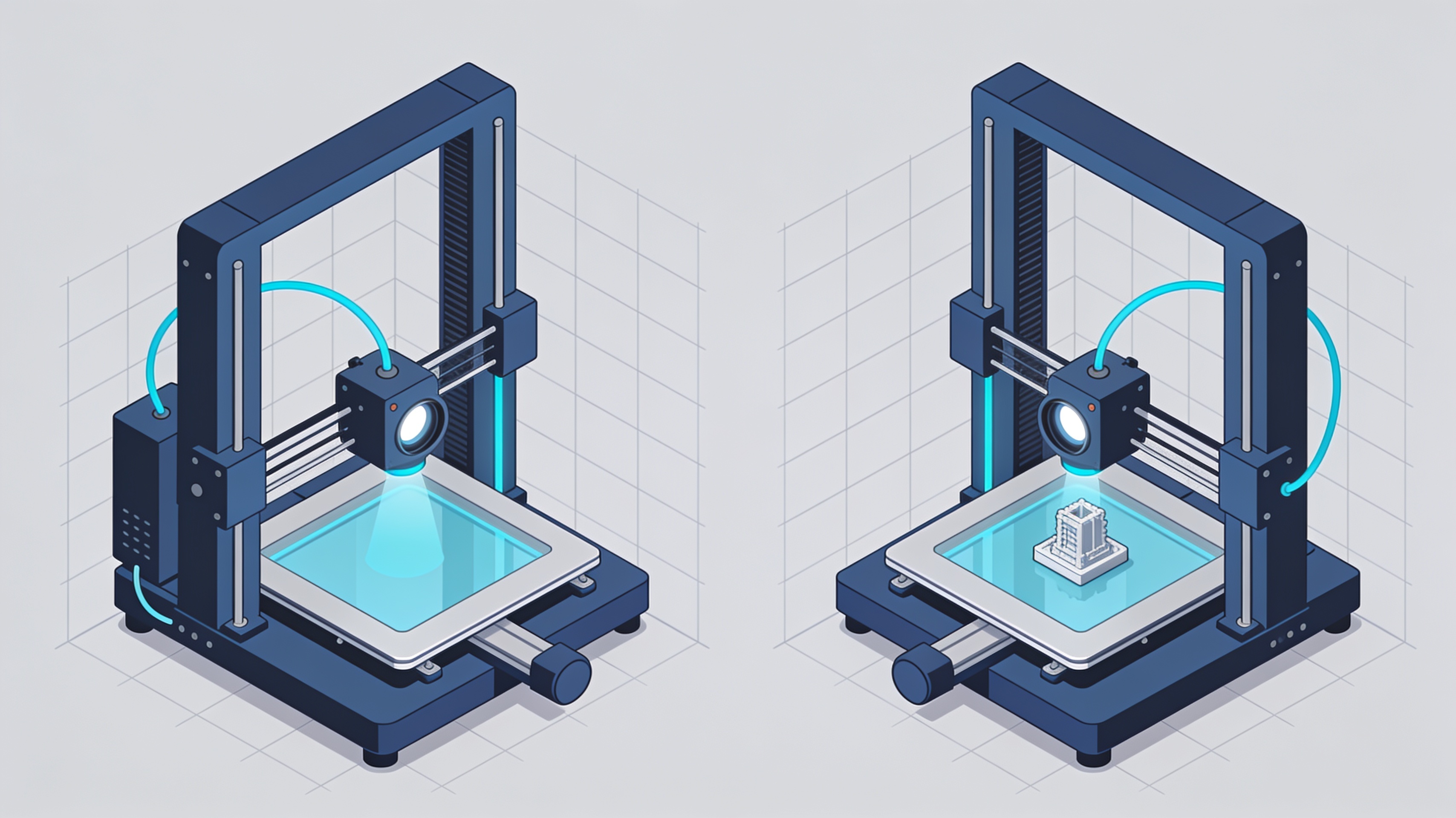
Nano-XS3DTech lands in North America: four micro-DLP printers from 2 to 35 µm
VoxTech3D becomes exclusive distributor for the United States, Canada and Mexico. The agreement brings to the North American market a range of microstereolithography systems with optical resolutions up to 2 micrometers.
The Chinese manufacturer Nano-XS3DTech, also known as Xingsheng Precision, has signed a distribution agreement with the US company VoxTech3D to bring four models of micro-DLP printers to North America. The agreement, announced on October 20, 2026, covers the United States, Canada and Mexico exclusively, with the possibility of resale also in Europe and the United Kingdom.
VoxTech3D, headquartered in Agoura Hills, California, operates as an additive manufacturing service and equipment supplier. This is not an acquisition or the opening of a US facility, but a commercial agreement for the distribution of machines already developed by the company in Jiangmen, in China's Guangdong province.
The micro-DLP printer range
The four models cover an optical resolution range from 2 to 35 micrometers, with build volumes differentiated for different industrial applications.
| Model | Optical resolution | Build volume |
|---|---|---|
| Micro P102 Plus | 2 μm | 60 × 60 × 50 mm |
| Micro P110 Plus | 10 μm | 115 × 128 × 65 mm |
| Micro P215 Plus | 15 μm | 84 × 63 × 70 mm |
| Micro P135 | 35 μm | 67.2 × 37.8 × 150 mm |
All systems use photopolymerizable resins and are based on micro-DLP technology. The choice of model depends on the trade-off between the required resolution and the size of the component to be produced.
The commercial model: service first, then the machine
VoxTech3D offers a gradual approach that allows customers to test the technology through a production service before investing in a purchase.
The commercial approach provides that a customer can initially commission components from VoxTech3D as a service. Only if demand justifies it can the company evaluate installing a printer in-house.
This path reduces the initial risk for companies approaching micro 3D printing for the first time. The availability of local support, spare parts, and training becomes crucial when purchasing complex technology from a foreign manufacturer.
In resin micro 3D printing, optical resolution, minimum reproducible feature size, dimensional accuracy, and layer thickness do not indicate the same property. A few micrometers can make the difference between a geometry that can be achieved and one that is impossible to obtain with sufficient repeatability.
How micro-DLP technology works
The DLP process projects a light image onto photopolymerizable resin, simultaneously solidifying an entire cross-section instead of tracing point by point.
In the DLP process, an optical system projects onto a resin a light image corresponding to a section of the model. The light selectively solidifies the material in the exposed areas. By repeating the cycle, the component is built layer by layer.
Unlike architectures based on a light point that traces the section, projection simultaneously exposes an entire region. This can be advantageous for certain geometries and quantities, although the overall time depends on resin replacement, machine movements, and subsequent treatment.
Applications and target markets
The main applications include microfluidics and medical devices, sectors where dimensional precision at the micrometer level is crucial.
DLP microstereolithography finds application in sectors such as microfluidics and medical devices. In these areas, the ability to reproduce complex geometries with tight tolerances can enable functionalities otherwise unattainable with conventional technologies.
The presence of a local distributor with technical support capabilities is an important element for industrial adoption. For many North American manufacturing companies, the possibility of testing components through a service before investing in equipment can accelerate technology qualification.
- Nano-XS3DTech brings four micro-DLP models with resolutions from 2 to 35 μm to North America
- VoxTech3D becomes exclusive distributor for the USA, Canada, and Mexico
- The business model involves production service first, then possible purchase of the machine
- Target applications: microfluidics, medical devices, and precision components
article written with the help of artificial intelligence systems
Q&A
Which micro-DLP printer models does the Nano-XS3DTech range distributed in North America include?
The range includes four models: Micro P102 Plus (2 µm optical resolution, 60 × 60 × 50 mm volume), Micro P110 Plus (10 µm, 115 × 128 × 65 mm), Micro P215 Plus (15 µm, 84 × 63 × 70 mm) and Micro P135 (35 µm, 67.2 × 37.8 × 150 mm). All use photopolymerizable resins and micro-DLP technology.
Who is the exclusive distributor of Nano-XS3DTech in North America and which territories does the agreement cover?
VoxTech3D, headquartered in Agoura Hills, California, is the exclusive distributor for the United States, Canada and Mexico. The agreement also provides for the possibility of resale in Europe and the United Kingdom.
Does the agreement between Nano-XS3DTech and VoxTech3D involve opening a facility in North America?
No, it is neither an acquisition nor the opening of an American facility. It is a commercial agreement for the distribution of machines already developed by Nano-XS3DTech in Jiangmen, in China's Guangdong province.
What business model does VoxTech3D propose to North American customers?
VoxTech3D offers a gradual approach: the customer can initially commission components as a production service. Only if demand justifies it can the company evaluate installing a printer in-house, reducing the initial risk.
What is the difference between optical resolution, minimum reproducible feature size, dimensional accuracy and layer thickness in resin micro 3D printing?
In resin micro 3D printing these quantities do not indicate the same property. A few micrometers of difference can determine whether a geometry is feasible or not, so it is important not to confuse them when choosing a model.