Xerox and dual UV wavelengths: a historic patent for material jetting
A 2017 Xerox patent proposes using two different UV wavelengths to solve a recurring problem in material jetting 3D printing: a sticky or uneven final surface. Application US20180304548A1, filed on April 25, 2017, and granted as US11192299B2 on December 7, 2021, came back into the spotlight on November 11, 2026, with a Chinese publication from the same patent family.
The method applies specifically to material jetting processes, where photopolymerizable material is selectively deposited and solidified with UV light. It is not a universal solution for all resin printers.
- First UV source (390-400 nm) for intermediate layers
- Second UV source (360-370 nm) for the final surface
- Objective: eliminate stickiness without sacrificial layers
- Patent granted in 2021, revisited by the press in 2026
The problem of the final surface
The last deposited layer in material jetting technologies can retain not fully crosslinked material, resulting in a sticky or uneven surface.
This defect is typical of certain material jetting processes. The photopolymerizable material is deposited and solidified layer by layer, but the surface exposed to air can have areas with incomplete polymerization.
Surface oxygen and exposure conditions influence the degree of crosslinking. The result is a non-optimal surface finish that requires corrective measures.
The dual-wavelength solution
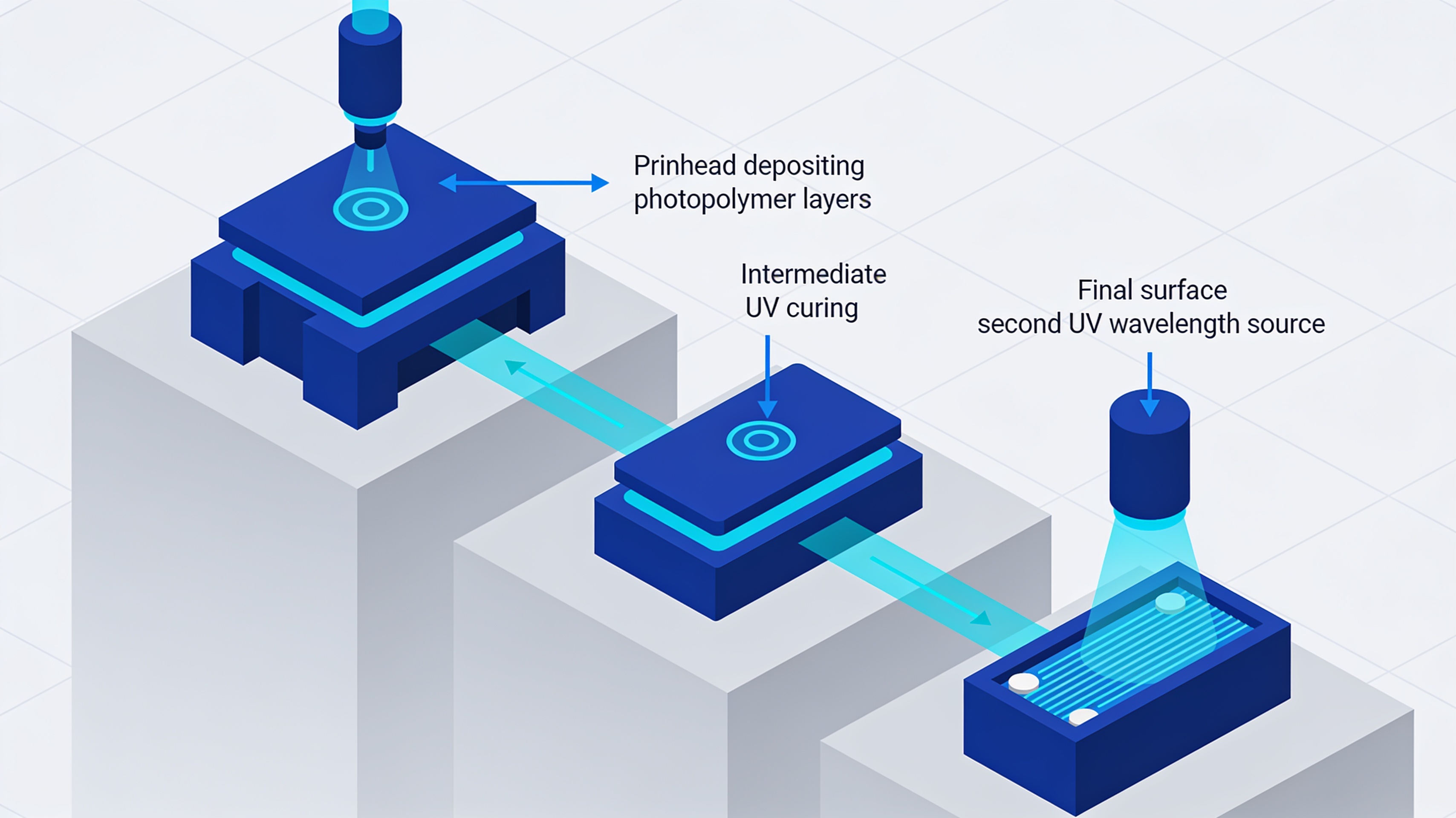
Xerox proposes changing the UV wavelength between the construction of the inner layers and the treatment of the final surface.
The first source operates between 390 and 400 nanometers, with a specific example at 395 nm. This is used during the construction of the intermediate layers.
The second source works between 360 and 370 nm, typically at 365 nm. This treats exclusively the last layer to improve surface polymerization.
| Parameter | First source | Second source |
|---|---|---|
| Wavelength | 390-400 nm | 360-370 nm |
| Specific example | 395 nm | 365 nm |
| Application | Intermediate layers | Final surface |
Why change wavelength
Changing the wavelength is not an aesthetic choice, but a strategy to optimize the chemical response of the material.
The photoinitiators present in the formulations respond to radiation according to their absorption spectrum. The depth of penetration and the energy available for the reaction depend on the combination of material, intensity, and wavelength.
The same formulation can behave differently by changing the spectral distribution of light. This allows the construction of the layers and the final finishing to be optimized separately.
The patent documents tests with light intensity varying from 15% to 200% of a reference value, demonstrating the importance of parametric control in polymerization.
Stated objectives and advantages
The main objective is to obtain a uniform and glossy surface without adding sacrificial layers to be removed subsequently.
The method aims to improve surface polymerization while maintaining the quality of the internal layers. Eliminating the need for sacrificial layers reduces material waste and post-processing times.
The resulting surface finish should be more uniform and less sticky. This represents a direct advantage for applications requiring ready-to-use surfaces.
Scope of application and limitations
The patent applies specifically to material jetting, not to all resin 3D printing technologies.
Material jetting and vat photopolymerization have different modes of material distribution, exposure, and layer construction. The technical solutions are not interchangeable between different processes.
Observations on the relationship between surface oxygen, exposure conditions, and stickiness may have analogies across technologies. However, the technical scope of the claims must be read in the context of the specifically described process.
Patent timeline
The original application dates back to 2017, not to 2026 as recent media attention might suggest.
The timeline is precise: filed on April 25, 2017, published as US20180304548A1 in 2018, granted as US11192299B2 on December 7, 2021. The journalistic coverage of November 11, 2026 concerns a Chinese publication of the patent family.
Xerox is also cited in the patent as a manufacturer of piezoelectric printheads, a technology relevant to the controlled deposition of material in material jetting systems.
article written with the help of artificial intelligence systems
Q&A
What is the problem that the Xerox patent aims to solve?
In material jetting 3D printing, the last deposited layer may retain material that is not fully cross-linked, resulting in a sticky or uneven surface. Surface oxygen and exposure conditions influence the degree of cross-linking, causing a suboptimal finish that requires corrective measures.
What UV wavelengths does the patented method use?
The method involves two sources: the first operates between 390 and 400 nm (specific example 395 nm) for the intermediate layers, the second between 360 and 370 nm (typically 365 nm) to treat exclusively the last layer and improve surface polymerization.
To which 3D printing processes does the patent apply?
The method applies specifically to material jetting processes, where the photopolymerizable material is selectively deposited and solidified with UV light. It is not a universal solution for all resin printers.
When was the Xerox patent filed and granted?
Application US20180304548A1 was filed on April 25, 2017 and was granted as US11192299B2 on December 7, 2021. On November 11, 2026 it came back into the spotlight with a Chinese publication of the same patent family.
Why change wavelength between intermediate layers and the final surface?
The wavelength change is not an aesthetic choice, but a strategy to optimize the chemical response of the material. Photoinitiators respond to radiation based on their absorption spectrum, and penetration depth varies with wavelength, allowing surface cross-linking to be improved without sacrificial layers.