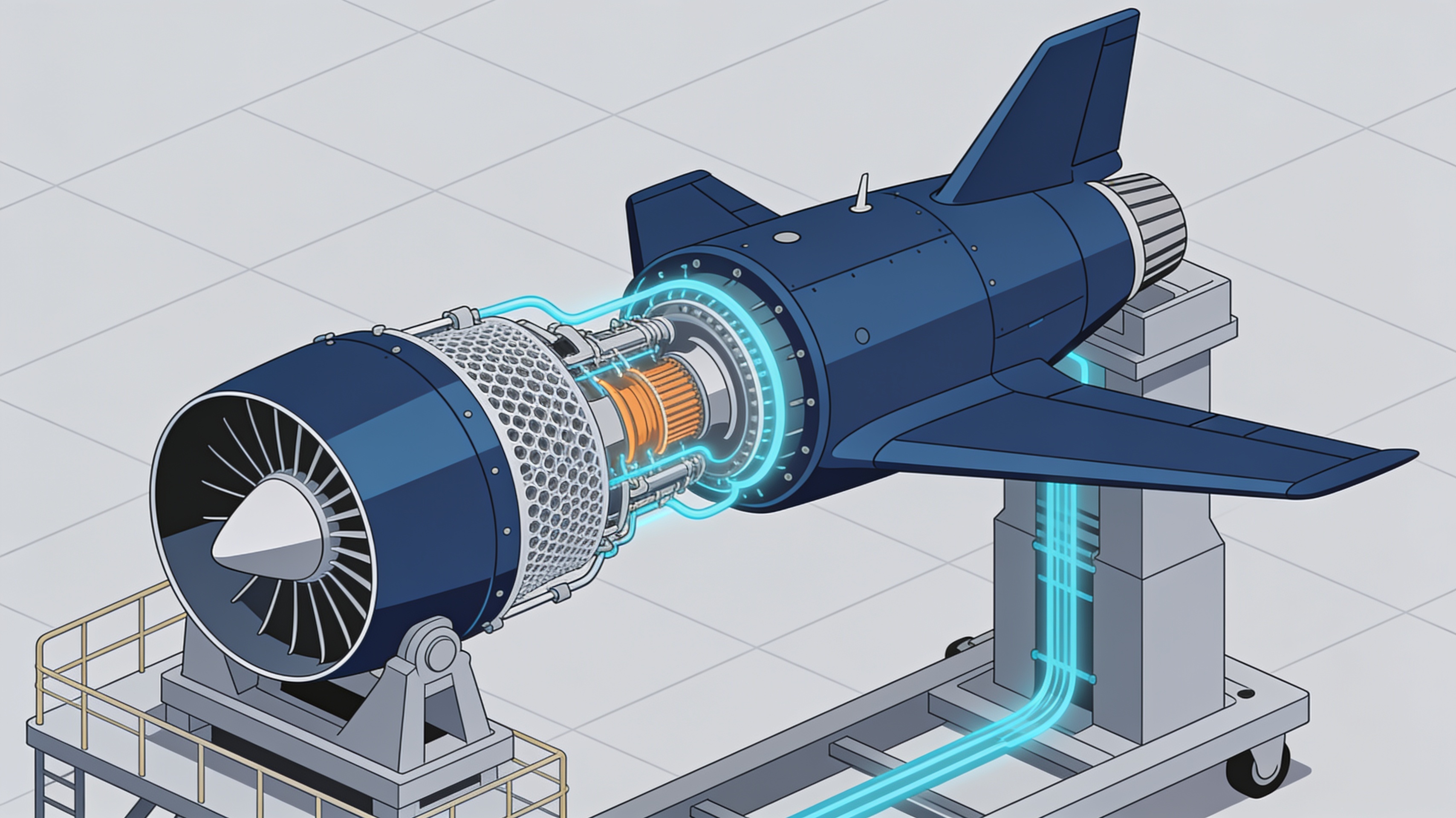
Beehive Industries tests the Frenzy 6 engine: from design to test bench in four months
Beehive Industries has completed testing of its 100 pound-force (450 Newton) Frenzy 6 jet engine and aims to fly it in 2027. The propulsion system, developed for the US Air Force, is intended for UAVs, long-range munitions and interceptor drones.
The path from requirements definition to testing lasted only four months. A result made possible by the additive manufacturing-based approach, according to the company.
Military applications and strategic context
The Frenzy 6 responds to urgent operational needs of the U.S. Air Force, which requires inexpensive propulsion systems that can be produced in high volumes for unmanned platforms.
The engine can equip loitering munitions, interceptor drones, small attack missiles or systems similar to the Russian Geran 5 Jet drone. The Air Force is particularly interested in platforms such as the Miniature Air-Launched Decoys (MALD), the Golden Horde swarm munitions and missile simulators.
The operational context is critical. The United States used at least a third of its precision munitions in Iran in 40 days. Ukraine will produce more than 10 million drones this year.
- 450-Newton engine for UAVs and extended-range munitions
- Development completed in 4 months thanks to additive manufacturing
- US Air Force program worth $29.7 million
- Flight expected in 2027
The role of additive manufacturing
Beehive Industries has built its competitive advantage on additive manufacturing, which enables development speed and scalability impossible with traditional methods.
David Kimball, Chief Technology Officer of Beehive Industries, explained that the Frenzy 8 validated the ability to design and scale a concept at unprecedented speed. The lessons from that program made it possible to iterate even more rapidly on the Frenzy 6.
The Frenzy 8 demonstrates leading-class performance and high-altitude start capability. These characteristics should transfer to the Frenzy 6, according to the company.
Gordie Follin, Chief Product Officer, emphasized that the Frenzy 6 encapsulates all the advantages of the Frenzy 8 in a smaller form factor. The goal is to enable “affordable mass” for American defense.
Investments and production capacity
The company is scaling rapidly with massive investments in additive technologies, positioning itself as a strategic supplier for the volume needs of US defense.
Beehive Industries recently purchased more than $50 million of EOS equipment and two NXG systems. It has also invested $70 million in Ohio.
The Frenzy program benefits from $29.7 million in funding from the US Air Force for the development of the entire engine family.
Additive manufacturing makes it possible to overcome the bottlenecks of investment casting and traditional forging. This approach reduces prototyping times, mitigates supply chain risks, and accelerates the fabrication of complex components.
Challenges of traditional manufacturing
Fighter jet engines are among the most complex machines ever built, and traditional methods struggle to meet Air Force specifications within the required timelines.
Engines require single-crystal turbine blades, advanced nickel superalloys, titanium forgings, and ceramic coatings. Internal temperatures often exceed the melting point of the metal itself, requiring precision internal cooling systems.
Pratt & Whitney, an engine supplier for the F-35 program, has faced persistent production and sustainment problems. A 2025 Government Accountability Office report found that the company “is still not delivering engines according to contract specifications after 20 years of production.”.
The Air Force is therefore pushing toward thousands of low-cost, disposable engines for unmanned drone swarms. Additive manufacturing offers a fundamental paradigm shift in the design, production, and maintenance of these propulsion systems.
Future perspectives
The Frenzy 6 represents a versatile platform that can meet significant requirements and support high-volume production. The additive manufacturing-enabled approach offers unique advantages in meeting the customer's speed, performance, cost, and scale needs.
Beehive Industries' stated goal is to ensure that America has what it needs, when it needs it. The completed testing of the Frenzy 6 demonstrates the company's commitment to all relevant platforms.
article written with the help of artificial intelligence systems
Q&A
How long did Beehive Industries take to develop the Frenzy 6 engine?
Beehive Industries completed the path from requirements definition to bench testing in just four months. This result was made possible by the additive manufacturing-based approach, according to the company.
What are the main features of the Frenzy 6 engine?
The Frenzy 6 is a 100-pound-force (450 Newton) jet engine intended for UAVs, long-range munitions and interceptor drones. According to Gordie Follin, Chief Product Officer, it packs all the advantages of the larger Frenzy 8 into a smaller form factor.
Which military platforms could the Frenzy 6 equip?
The engine can equip loitering munitions, interceptor drones, small attack missiles or systems similar to the Russian Geran 5 Jet drone. The Air Force is particularly interested in platforms such as the Miniature Air-Launched Decoys (MALD), the Golden Horde swarm munitions and missile simulators.
What is the value of the Frenzy program and when will the engine fly?
The Frenzy program benefits from $29.7 million in funding from the US Air Force. Beehive Industries aims to fly the Frenzy 6 engine in 2027.
How did the Frenzy 8 contribute to the development of the Frenzy 6?
According to David Kimball, CTO of Beehive Industries, the Frenzy 8 validated the ability to design and scale a concept at unprecedented speed. The lessons from that program enabled even faster iteration on the Frenzy 6, and the Frenzy 8's class-leading performance and high-altitude starting capability should transfer to the smaller model.