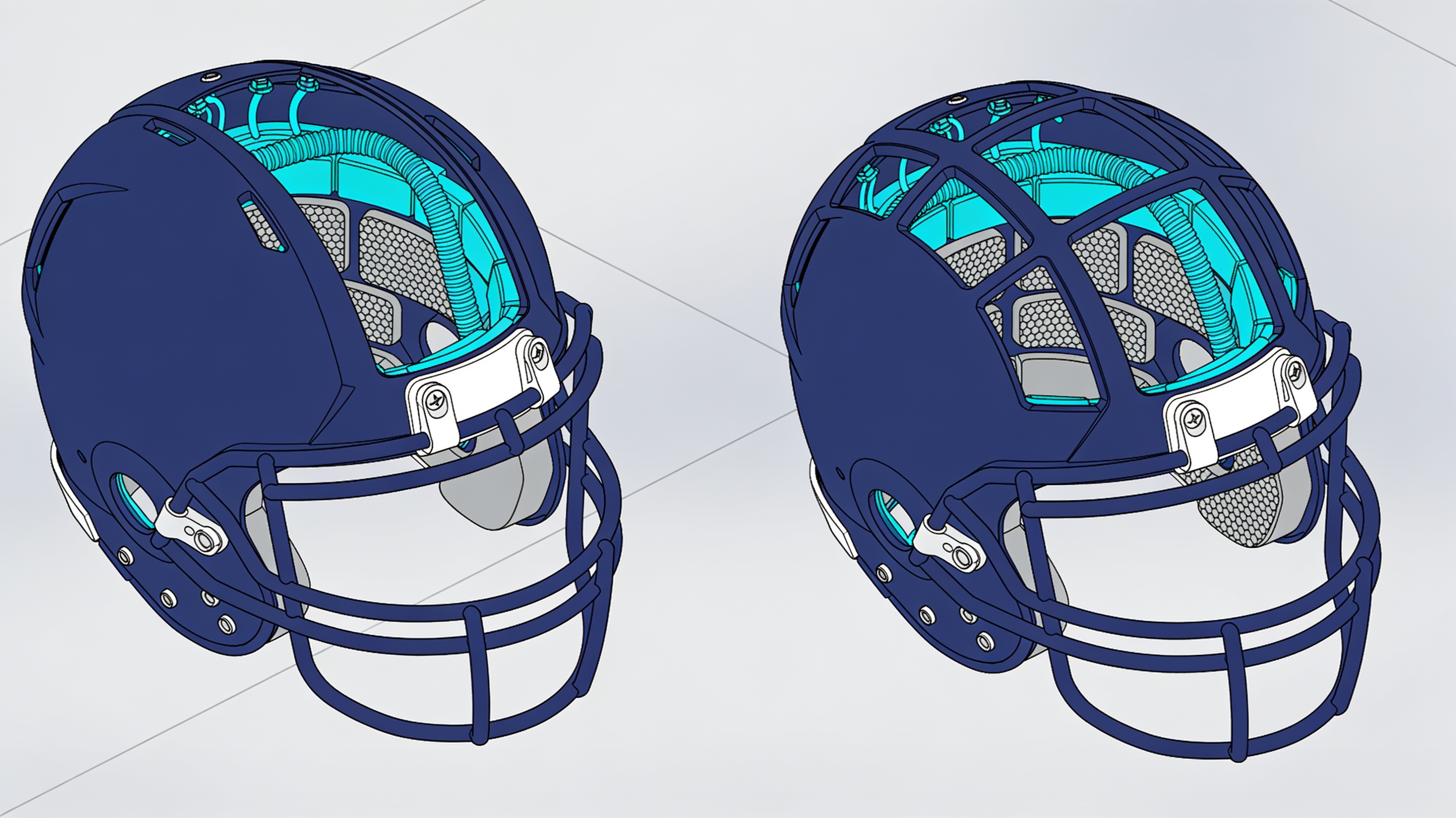
Pellet 3D printing for football helmets: 30% less weight than injection molding
Pollen AM and RHEON Labs have qualified a cushioning material on the Pam Pro pellet 3D printer. The first protective components printed for an NFL football helmet weigh 30% less than their injection-molded counterparts while maintaining equivalent cushioning performance.
The collaboration between the French manufacturer of pellet 3D printers and the cushioning polymer specialist aims to overcome the limits of traditional molding. The components have been integrated into the Xenith Shadow XR, a helmet already equipped with RHEON materials.
- 30% weight reduction compared with injection molding
- RHEON P3D 001 material qualified on Pam Pro printer
- First tests on NFL Xenith Shadow XR helmet
- Elimination of tooling costs of up to €150,000
The problem with traditional molds
Injection molding requires high investments and long lead times before producing the first functional component.
A typical batch comprises 5,000 to 10,000 helmets. Each helmet contains 1 to 12 protective components. The process works for these volumes but has prohibitive initial costs.
Tooling can cost up to €150,000 with lead times of up to three months. Before seeing the first component, the investment has already been fully incurred.
The mold imposes rigid design constraints: draft angles, uniform wall thickness, minimal undercuts. Internal lattice structures or variations in mechanical properties within a single component are almost impossible.
The advantage of pellet technology
Pellet 3D printing eliminates the mold and its constraints, offering geometric freedom and access to specialized materials.
Pollen AM's PAM technology proves particularly suitable for cushioning materials. RHEON P3D 001 is strain-rate sensitive: its stiffness depends on how quickly it is deformed.
The component remains soft and flexible during normal use but stiffens on impact. This characteristic is ideal for sports protection.
Pellet 3D printing uses plastic pellets as raw material instead of filaments. This approach reduces material costs and broadens the range of available polymers, including technical and specialized ones.
Comparison with resin
Resin 3D printing has already demonstrated advantages for football helmets, but pellet technology offers specific material benefits.
Resin offers greater geometric freedom, cost-effective customization, and weight reduction compared with molding. 3D printing is already used for football helmets.
Pellet additive manufacturing adds access to specialized cushioning polymers. These materials are not available in filament or photopolymer resin form.
| Characteristic | Injection molding | Pellet 3D printing |
|---|---|---|
| Tooling cost | Up to €150,000 | Zero |
| Setup time | Up to 3 months | Immediate |
| Component weight | Baseline | -30% |
| Geometric freedom | Limited | High |
Future perspectives
The full integration will be presented at Formnext 2026, with applications planned in defense, motorcycles and cycling.
Victor Roux, co-founder and president of Pollen AM, and Sarah Karmel, CSO of RHEON Labs, will present the full integration at Formnext 2026 in Frankfurt.
Future applications include the defense sector for superalloys, as well as protective devices for motorcycles and bicycles. The sports sector is only the beginning.
The qualification of the RHEON P3D 001 material on the Pam Pro opens up possibilities for small-scale custom components. Eliminating the mold makes the production of small batches or one-off parts economical.
article written with the help of artificial intelligence systems
Q&A
Which materials have been qualified on the Pam Pro printer?
Pollen AM and RHEON Labs have qualified the RHEON P3D 001 cushioning material on the Pam Pro pellet 3D printer. The material is strain-rate sensitive: it stays soft during normal use but stiffens on impact.
In which NFL helmet have the printed components been integrated?
The 3D-printed protective components have been integrated into the Xenith Shadow XR, an NFL football helmet already featuring RHEON materials. The first components show 30% lower weight than their injection-molded counterparts.
How much does injection molding tooling for helmets cost?
Injection molding tooling can cost up to €150,000, with lead times of up to three months. Pellet 3D printing eliminates the mold and these upfront costs, making it possible to produce the first functional component without prohibitive investment.
What design constraints does injection molding impose?
Injection molding requires draft angles, uniform wall thickness, and minimal undercuts. These constraints make internal lattice structures or variations in mechanical properties within a single component nearly impossible.
How many protective components does a helmet contain and what volumes does injection molding require?
A typical batch comprises 5,000 to 10,000 helmets, and each helmet contains 1 to 12 protective components. Injection molding works for these volumes but has prohibitive upfront tooling costs.