Experimental microneedle patch 3D-printed for therapy and sweat monitoring
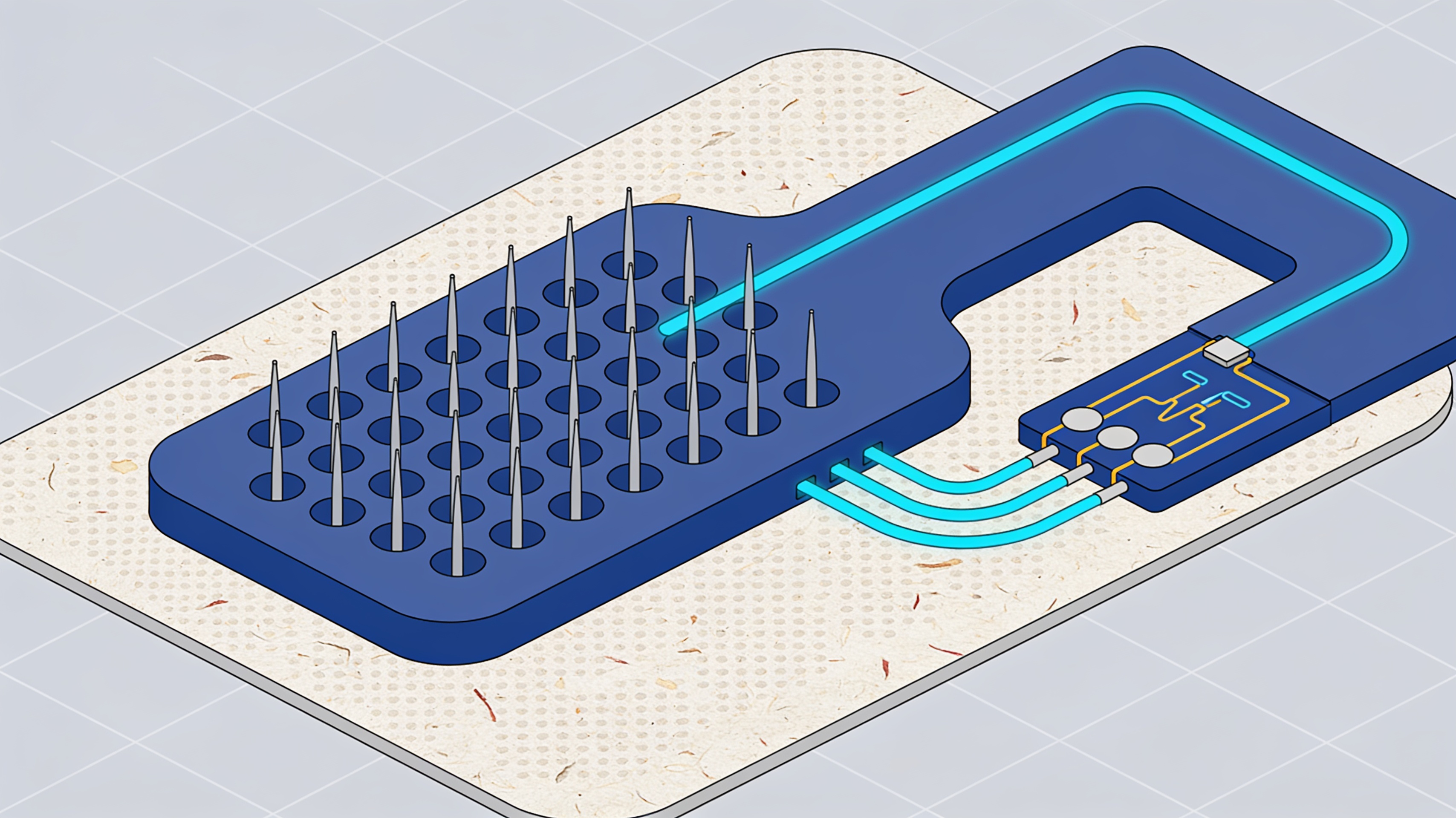
A research group has developed an experimental device that combines traditional mulberry paper, microneedles produced by vat photopolymerization, and printed electrodes. The goal is twofold: to deliver substances through the skin and to measure uric acid in sweat.
The term “theranostic” describes this combination of delivery and monitoring. The device is not approved for medical use and does not yet represent a standalone therapeutic cycle.
- Experimental microneedle patch 3D-printed with integrated electrochemical sensor
- Mulberry paper substrate for breathability and sweat management
- Optimized N4 configuration achieves 25.36% loading of the model substance
- Enzyme-free sensor detects uric acid from 0.01 to 8 micromolar
Mulberry paper as a functional substrate
The choice of substrate is not aesthetic but addresses a technical problem: the accumulation of sweat under waterproof sensors.
Waterproof skin sensors cause sweat accumulation between the skin and the device. This alters contact and makes readings unstable.
The fibrous and porous structure of mulberry paper promotes capillary transport of liquid and breathability. The MP3 sample shows a rapid decrease in contact angle, from about 72.19 to 7.96 degrees in six seconds.
This measurement indicates wettability under the tested conditions. It does not represent a direct indicator of clinical comfort.
Geometric optimization of microneedles
Researchers tested four configurations by modifying the lateral surface of the microneedles to improve loading and release.
The N4 variant achieves a model substance loading of 25.36%, compared with 12.6% for the N1 configuration. The measured release is 56.41% versus 53.54%.
| Configuration | Loading | Release | Penetration |
|---|---|---|---|
| N1 | 12,6% | 53,54% | n/a |
| N4 | 25,36% | 56,41% | 954.32 ± 5.98 μm |
The N4 configuration achieved a penetration depth of 954.32 ± 5.98 micrometers without any observed structural deformation. These are experimental measurements, not a clinical dose or a human safety trial.
Enzyme-free electrochemical sensor
The screen-printed electrodes use nickel oxide and gold nanoparticles to detect uric acid without enzymes.
The electrochemical configuration reports a linear range from 0.01 to 8 micromolar, with a detection limit of 9.3 nanomolar.
Measurements were performed on sweat samples and buffer solutions. The analytical comparison also includes liquid chromatography coupled with mass spectrometry.
The presence of the wireless sensor shows the possibility of transferring the signal, but does not demonstrate continuous clinical monitoring.
Obstacles to medical application
The physical integration of the components represents only the first step. Critical issues for clinical use remain to be addressed.
Sterilization, biocompatibility, and skin adhesion require validation. The dose actually transferred and stability after prolonged use must be demonstrated.
The release and measurement experiments constitute a basis for future developments. They do not represent a clinical validation of the device.
Vat photopolymerization enables the fabrication of complex geometries for microneedles. Screen printing allows controlled deposition of the electrodes. The integration of these additive manufacturing technologies with traditional materials such as mulberry paper opens research scenarios for multifunctional wearable devices.
article written with the help of artificial intelligence systems
Q&A
What materials make up the 3D-printed microneedle patch?
The device combines traditional mulberry paper as a substrate, microneedles produced by vat photopolymerization, and screen-printed electrodes. The mulberry paper ensures breathability and capillary transport of sweat.
What is the difference between the N1 and N4 microneedle configurations?
The N4 variant achieves a model substance loading of 25.36% versus 12.6% for N1, and a release of 56.41% versus 53.54%. N4 also achieved a penetration of 954.32 ± 5.98 micrometers with no observed deformation.
How does the sweat uric acid sensor work?
The screen-printed electrodes use nickel oxide and gold nanoparticles to detect uric acid without enzymes. The sensor reports a linear range from 0.01 to 8 micromolar with a detection limit of 9.3 nanomolar.
Why was mulberry paper chosen as the substrate?
Waterproof skin sensors cause sweat accumulation that alters contact and makes readings unstable. The fibrous and porous structure of mulberry paper promotes capillary transport and breathability, with the contact angle dropping from about 72.19 to 7.96 degrees in six seconds in the MP3 sample.
Is the patch approved for medical use?
No, the device is experimental and is not approved for medical use. It does not yet represent a standalone therapeutic cycle: the reported measurements are experimental and do not constitute a clinical dose or proof of safety in humans.