Hexagon completes the acquisition of Waygate Technologies for 1.45 billion dollars: what changes for quality control in metal 3D printing
Hexagon concluded the acquisition of Waygate Technologies from Baker Hughes on November 2, 2026, for an enterprise value of approximately 1.45 billion dollars. The transaction brings into the group's portfolio non-destructive testing technologies that are crucial for verifying the internal quality of metal-printed components, a segment of the additive supply chain that is less visible than machines but essential for critical industrial applications.
Waygate Technologies, with approximately 1,500 employees across 25 locations and 2025 revenue close to 630 million dollars, is consolidated into Hexagon's Manufacturing Intelligence area from November 1, 2026.
- Hexagon acquires Waygate Technologies for 1.45 billion dollars, completing the transaction on November 2, 2026
- Waygate brings tomography, industrial radiography, ultrasound, and remote visual inspection technologies
- The acquisition strengthens internal quality control of metal additive components, where optical scanners and calipers do not reach
- Expected initial negative impact on margins: -3% for Manufacturing Intelligence, -1,5% for the group
The acquired technologies and the operating scope
Waygate Technologies covers the entire range of industrial non-destructive testing, from radiography to computed tomography, with applications that go beyond 3D printing.
Waygate's portfolio includes industrial radiography, X-ray computed tomography, remote visual inspection, ultrasound and image acquisition and interpretation systems. These technologies serve different sectors: aerospace, energy, plant maintenance, inspection of cast components, welds and in-service inspections.
The breadth of application makes the acquisition a structural industrial move, not a simple catalogue expansion for users of LPBF systems. Hexagon thus adds to dimensional metrology and analysis software tools capable of inspecting the interior of components without destroying them.
Why tomography matters in laser powder bed fusion
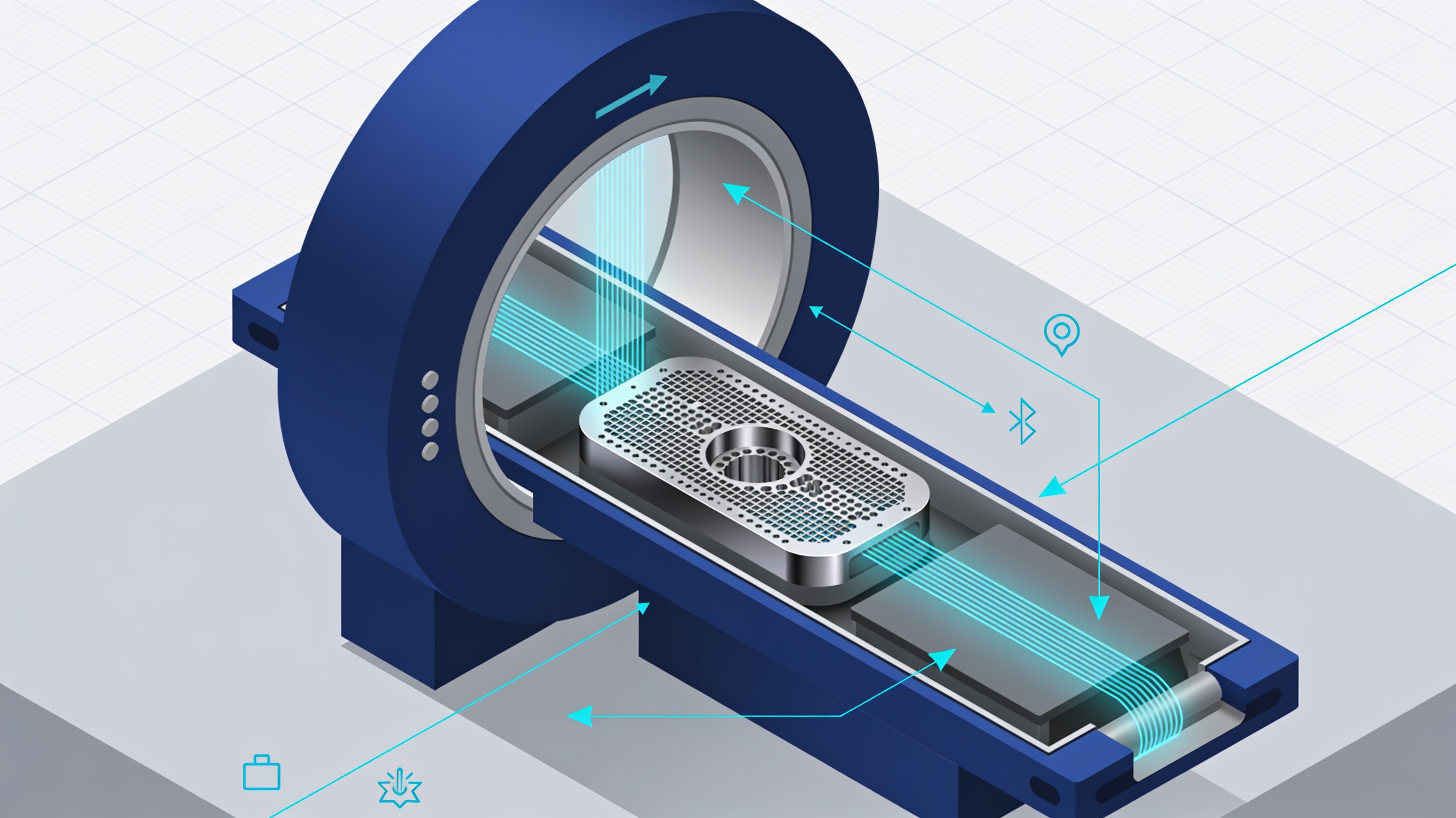
In metal 3D printing, external geometry can be corrected while invisible internal defects compromise mechanical performance. X-ray tomography reveals porosity, inclusions and microcracks before the part enters service.
Laser powder bed fusion produces components whose external geometry can meet dimensional tolerances, but which may contain critical internal defects. Porosity, unmelted powder inclusions and microcracks cannot be detected with surface measurement instruments.
X-ray computed tomography makes it possible to analyze the internal quality of the material without cutting or destroying the component. Hexagon already has Volume Graphics, software for dimensional analysis, CAD comparison and inspection of pores and inclusions. Integration with Waygate's hardware closes the loop from scanning to interpretation of volumetric data.
Financial impact and integration plans
Hexagon expects an initial negative impact on margins, with the goal of bringing Waygate's profitability to the group's standards through operational integration and cross-selling.
The integration of Waygate will initially reduce the margin of the Manufacturing Intelligence area by about three percentage points and that of the group by about one and a half points, on a pro forma basis referring to 2025. Hexagon then intends to bring the profitability of the acquired business closer to the area's target range of 21–24% EBITAC margin.
Total expenses for the transaction, separation from the seller, and integration are estimated at around 50 million euros. These costs relate to the corporate transaction, not to specific investments in additive manufacturing.
Planned initiatives include operational integration, localized production, and cross-selling between Hexagon's existing product lines and those of Waygate. The goal is to leverage the shared customer base in aerospace, automotive, and energy, where both dimensional metrology and non-destructive testing are required.
What it means for the additive supply chain
The acquisition does not bring new printers, but it strengthens a critical segment: verifying that what has been built matches the design requirements, even where traditional tools cannot reach.
For additive manufacturing, the significance of the transaction is not the arrival of new printing machines, but the strengthening of a part of the supply chain that is often less visible: verification of conformity with design requirements, including in areas inaccessible to traditional tools.
The integration of dimensional metrology, analysis software, and non-destructive testing creates a complete ecosystem for the qualification of metal additive components. This is particularly relevant for critical applications in aerospace and energy, where certification requires documented evidence of internal integrity as well as external geometric precision.
article written with the help of artificial intelligence systems
Q&A
How much did Hexagon's acquisition of Waygate Technologies cost?
Hexagon acquired Waygate Technologies from Baker Hughes for an enterprise value of approximately 1.45 billion dollars. The transaction was completed on November 2, 2026.
What quality control technologies does Waygate bring to Hexagon?
Waygate brings industrial radiography, X-ray computed tomography, remote visual inspection, ultrasound, and image acquisition and interpretation systems. These technologies make it possible to inspect the interior of components without destroying them.
Why is tomography important in laser powder bed fusion?
Laser powder bed fusion can produce components with conforming external geometry but with critical internal defects such as porosity, unmelted powder inclusions, and microcracks. X-ray tomography reveals these defects before the part goes into service.
In which area of Hexagon is Waygate Technologies consolidated?
Waygate Technologies is consolidated into Hexagon's Manufacturing Intelligence area as of November 1, 2026. The transaction brings approximately 1,500 employees across 25 sites and 2025 revenue close to 630 million dollars.
What impact on margins does Hexagon expect from the acquisition?
Hexagon expects an initial negative impact on margins: -3% for Manufacturing Intelligence and -1.5% for the group.