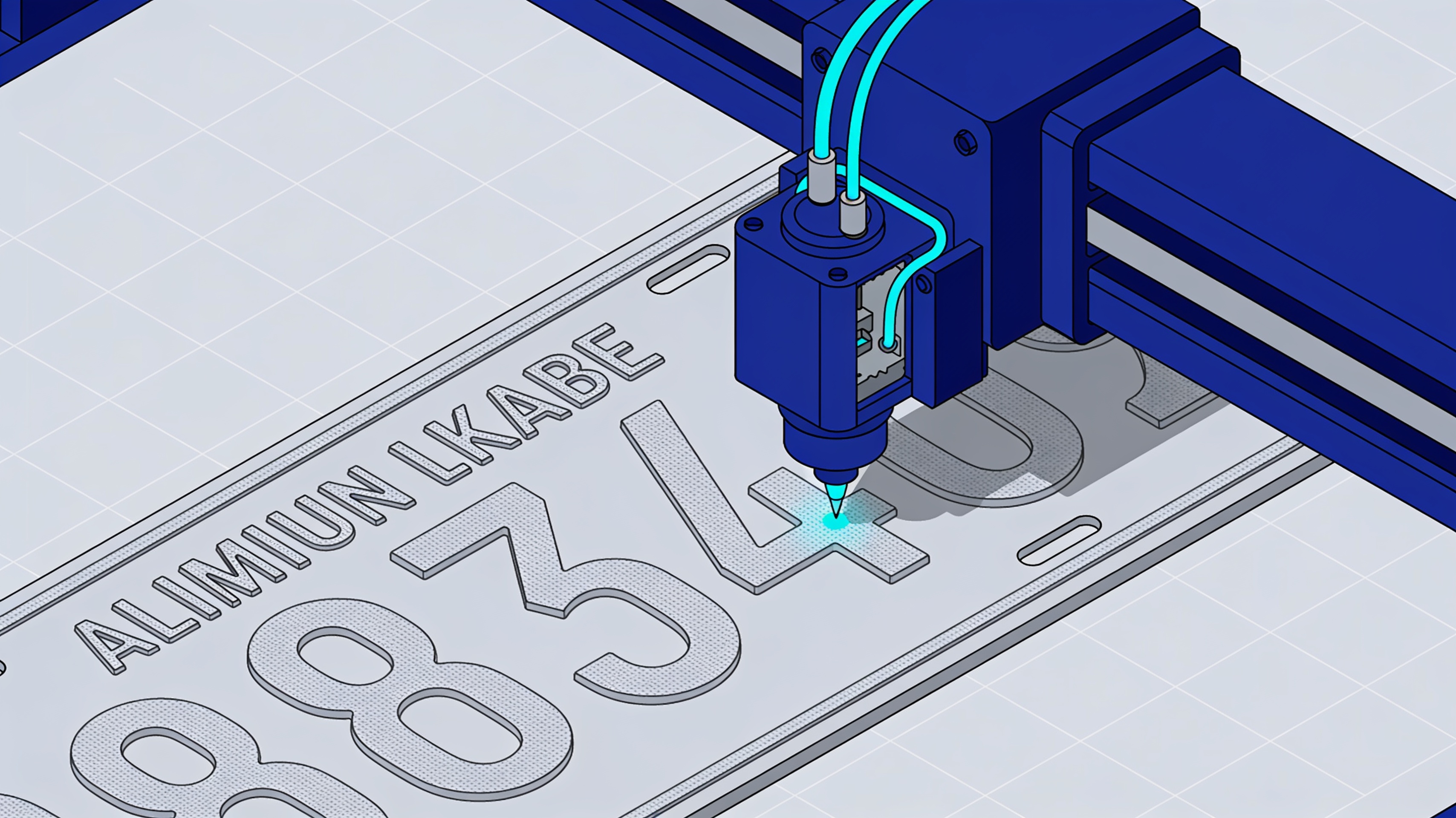
License plates with 3D-printed characters: Utsch presents N3XTPLATE
The German company Erich Utsch GmbH has introduced N3XTPLATE, a car license plate in which letters and numbers are produced by additive deposition directly onto the aluminum base. The product is certified according to DIN 74069 and compliant with German FZV regulations, and is therefore approved for road use in Germany.
The main innovation concerns the method of manufacturing the characters. In traditional plates, the relief is obtained by mechanical deformation of the sheet metal. In N3XTPLATE, however, the characters are 3D-printed onto the metal surface.
From the traditional process to additive deposition
Conventional production of metal plates is based on embossing. Utsch proposes a different approach, applying the characters by means of 3D printing.
The standard metal plate involves an aluminum sheet that is prepared and then embossed to create the relief of letters and numbers. Finishing operations and application of coatings follow.
In the N3XTPLATE system, the principle changes. The characters are deposited directly onto the aluminum surface through an additive process. This does not mean that the entire plate is printed in metal or that the aluminum is melted by laser.
The public documentation does not specify the deposition procedure or the formulation of the materials used for the characters. Defining the process as LPBF, FDM, or resin-based would be an extrapolation not supported by the available sources.
Geometric characteristics and regulatory compliance
The height of the characters is double compared to standard embossed plates. The product is certified for road use in accordance with German regulations.
Utsch declares that the characters of N3XTPLATE have double the height compared to those of conventional embossed aluminum plates. This increase changes the three-dimensional effect and the visual perception of the plate.
The height of the relief represents only one parameter of the overall design. In the license plate sector, stroke width, spacing, legibility, contrast, reflective behavior and mechanical resistance also matter.
A taller character can improve the three-dimensional effect but requires attention to shading variations and appearance from different angles. The surface must maintain legibility under variable light conditions.
- Certification according to DIN 74069
- Compliance with the German Fahrzeug-Zulassungsverordnung (FZV)
- Approval for road use in Germany
Difference between an approved license plate and a decorative product
Road-traffic license plates must meet precise requirements that go beyond aesthetic appearance. N3XTPLATE positions itself as an approved product, not a decorative one.
Certification according to DIN 74069 and FZV compliance distinguish N3XTPLATE from decorative plates made for exhibitions, trade fairs, or private use. The requirements for approved plates concern more than just graphics.
The requirements include measurable physical characteristics, legibility under standardized conditions, and resistance to environmental and mechanical stresses. Utsch states that it has subjected the product to UV tests to assess material aging.
The manufacturer initially plans glossy finishes and a “carbon effect” option. The latter designation indicates an aesthetic treatment, not the use of carbon fiber as a structural material.
Prospects for the license plate market
The initially planned format is the standard Euro size. The additive approach could offer flexibility in customization compared with embossing processes.
The commercial launch of N3XTPLATE is planned in the standard Euro format, the most widespread in Europe. Choosing an established format facilitates adoption by workshops and registration centers already equipped for standard dimensions.
The application of 3D printing in a highly regulated sector such as automotive license plates represents a particular case of additive manufacturing. The product must balance process innovation and strict regulatory compliance.
The possibility of depositing characters instead of deforming sheet metal could open up space for more complex geometries or customizations within regulatory limits. It remains to be seen how the market will receive a product that changes a process established for decades.
article written with the help of artificial intelligence systems
Q&A
What is N3XTPLATE by Utsch?
It is a license plate in which letters and numbers are created by additive deposition directly onto the aluminum base. It is produced by the German company Erich Utsch GmbH and is approved for road use in Germany.
What certifications does N3XTPLATE have?
N3XTPLATE is certified according to DIN 74069 and complies with the German Fahrzeug-Zulassungsverordnung (FZV). This makes it approved for road use in Germany.
How does N3XTPLATE differ from traditional plates?
In traditional plates, the relief of letters and numbers is obtained by mechanical embossing of the aluminum sheet. In N3XTPLATE, the characters are instead deposited directly onto the metal surface through an additive process.
Are N3XTPLATE characters taller than standard plates?
Yes, Utsch states that the characters of N3XTPLATE have double the height compared to those of conventional embossed aluminum plates. This increases the three-dimensional effect and the visual perception of the plate.
Is it known which 3D printing technology is used for N3XTPLATE?
No, the public documentation does not specify the deposition procedure or the formulation of the materials used for the characters. Defining the process as LPBF, FDM, or resin would be an extrapolation not supported by the available sources.