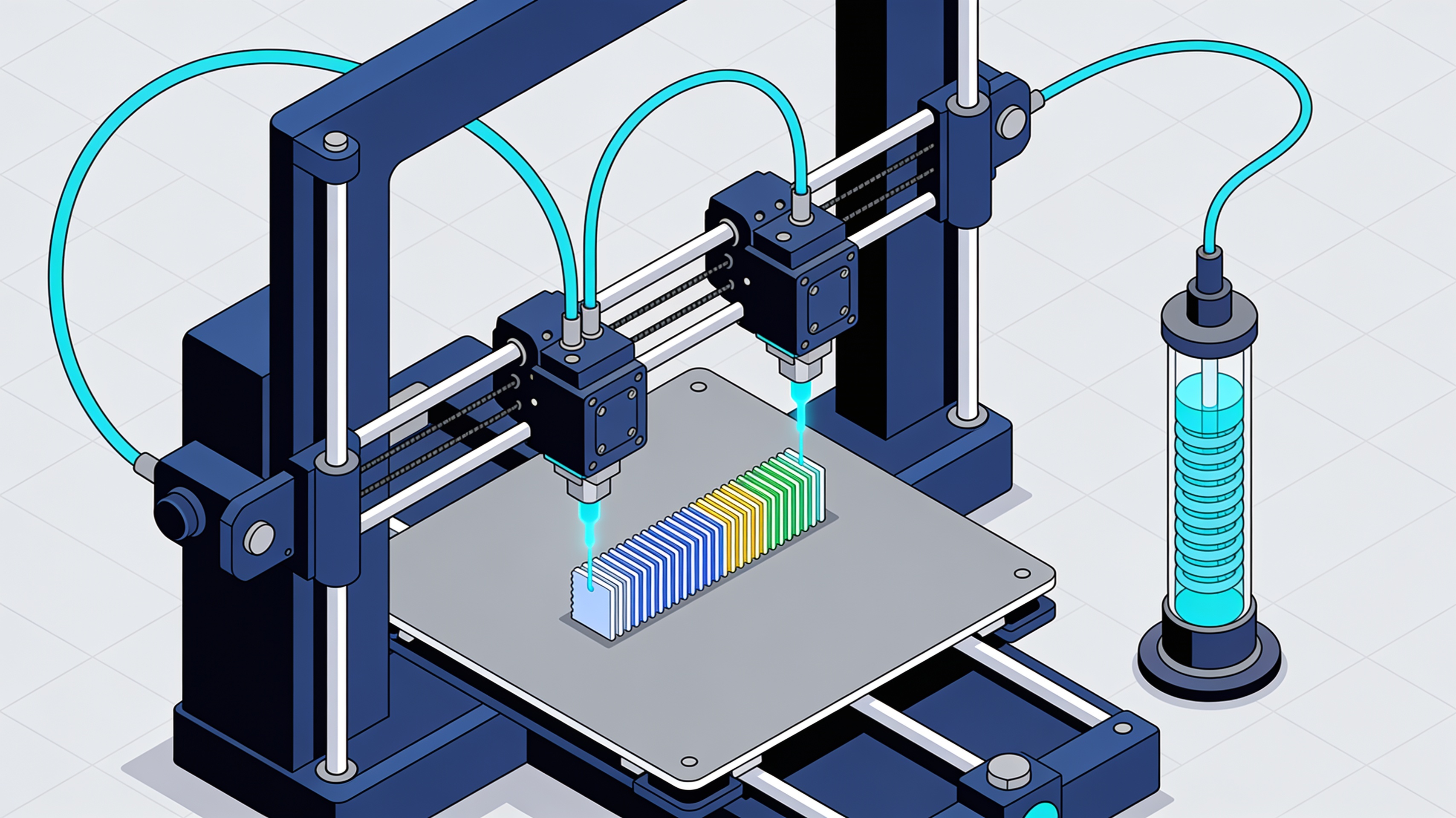
Alternating layers of PLA and TPU: mechanical strength without blending, but machine learning should be treated with caution
A group of researchers from the Chaitanya Bharathi Institute of Technology in Hyderabad tested a simple approach to combine rigidity and flexibility in a single printed component: alternating layers of PLA and TPU instead of mixing them in a composite filament. The best result reached 40.8 MPa tensile strength, but predictive models based on machine learning have significant limitations.
The research, published in August 2026 in the SSRG International Journal of Mechanical Engineering, raises interesting questions both on the materials side and on the data validation side.
Polymer sandwich instead of blend: fewer problems, same machine
The researchers printed specimens with alternating layers of PLA and TPU using a dual-extruder FFF printer. The approach eliminates the typical problems of mixed filaments.
Mixing different polymers creates problems of compatibility, dispersion, and predictability after extrusion. Layering requires only an FFF machine with a dual extruder capable of handling nozzle changes and routine purge cleanly.
The researchers used an AKAR 600 PRO to print tensile specimens according to ASTM D638. Each sample contained PLA and TPU in a 1:1 ratio, but not as a mixed filament: the component became a polymer sandwich with alternating rigid and flexible layers.
- PLA offers stiffness and dimensional precision but breaks in a brittle manner
- TPU guarantees flexibility and abrasion resistance but does not hold its shape
- Layering makes it possible to position these behaviors through the thickness of the part
- Any dual-extrusion printer can do it without special filaments
81 mechanical tests with a Taguchi L27 design
The team varied six printing parameters using a structured experimental approach. The optimal configuration combined thin layers and high temperatures.
The researchers tested several parameters using a Taguchi L27 design: layer thickness, printing speed, TPU and PLA nozzle temperatures, number of shells, and bed temperature. For each of the 27 combinations, they printed three ASTM D638 specimens, obtaining 81 tensile data points.
The best configuration used 0.18 mm layers, a speed of 45 mm/s, nozzle temperatures of 240°C for TPU and 230°C for PLA, four shells, and a bed at 55°C. This setup achieved 40.795 MPa tensile strength and a Young's modulus of 1.188 GPa.
Finer layers mean more bonded interfaces and fewer voids. Reduced speeds give the material more time to melt. Higher nozzle temperatures improve adhesion between layers, although they bring the usual trade-offs such as oozing.
Machine learning with near-perfect R²: too good to be true
The authors trained machine learning algorithms on the experimental data, obtaining exceptional metrics. But the numbers should be interpreted with extreme caution.
In the second part of the work, the researchers used the 81 mechanical tests to train machine learning algorithms. With XGBoost, they obtained R² coefficients of 0.9988 for tensile strength and 0.9971 for elastic modulus.
Such high values seem to indicate exceptional predictive capability, but they require caution. The data come from only 27 truly different parameter combinations, each repeated three times.
If replicates of the same configuration were randomly distributed between the training and test sets, the model may have predicted samples almost identical to those already seen during training. This artificially inflates the accuracy metrics.
The work provides an additional experimental set on the behavior of layered PLA/TPU structures. But it also represents an example of how easy it is to obtain seemingly extraordinary machine learning metrics from small and highly structured experimental datasets.
Potential applications and future developments
Coarse layering is only the beginning. Future slicers could vary the material sequence by region or load path.
Combining stiffness and flexibility through the thickness of the part opens up possibilities for protective cases, energy-absorbing inserts, grips, or custom wearable components.
Alternating entire layers is a relatively coarse approach. A future slicer could vary the material sequence by region, load path, or intended bending point.
The physical result of 40.8 MPa with certain parameters deserves attention. The implicit claim that an AI model can already predict material behavior with almost absolute precision, however, requires much larger datasets and, above all, validation built on configurations that have truly never been seen.
article written with the help of artificial intelligence systems
Q&A
What is the difference between layering PLA and TPU and using a blend filament?
Layering alternates rigid PLA layers and flexible TPU layers within the same component, avoiding the compatibility, dispersion, and predictability issues typical of mixed filaments. It only requires an FFF printer with dual extruders with nozzle change and clean purges, without special filaments.
Which printing parameters gave the best mechanical strength?
The optimal configuration involved 0.18 mm layers, 45 mm/s speed, 240°C nozzle for TPU and 230°C for PLA, four shells, and a 55°C bed. This setup achieved 40.795 MPa tensile strength and a Young's modulus of 1.188 GPa.
How was the experimental plan of the research structured?
The researchers used a Taguchi L27 design varying six parameters: layer thickness, printing speed, TPU and PLA nozzle temperatures, number of shells, and bed temperature. For each of the 27 combinations, they printed three ASTM D638 specimens, obtaining 81 tensile data points.
Why do thinner layers and higher temperatures improve strength?
Thinner layers create more bonded interfaces and reduce voids between layers. Lower speeds give the material more time to fuse, while higher nozzle temperatures improve adhesion between successive layers.
What limitations do the machine learning models present in the study?
Despite the best result of 40.8 MPa, predictive models based on machine learning show significant limitations. The research therefore raises doubts both on the materials side and on the data validation side.