Addireen updates the XH-M350G-2HR: focus on productivity and stability for pure copper
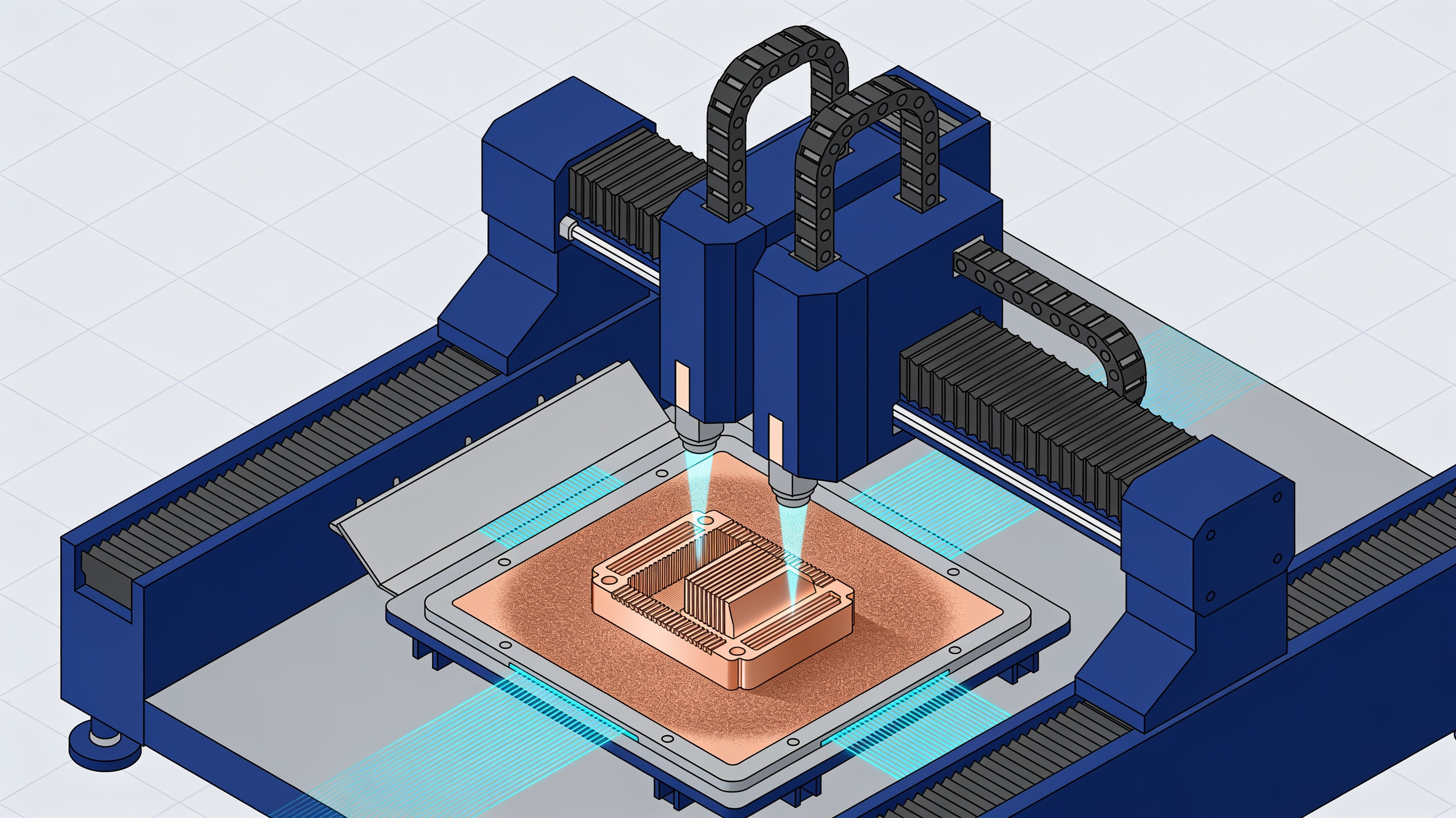
Chinese manufacturer Addireen has presented the third generation of the XH-M350G-2HR, a Laser Powder Bed Fusion system with dual green lasers designed for series production of pure copper and copper alloy components. The upgrade focuses on production efficiency, stability during prolonged cycles, and uniformity of results across full build plates.
The machine uses internally developed green lasers with 500 W and 1 kW configurations. The build volume is 350 × 350 × 550 mm, with parameter settings for layer thicknesses of 30, 40, and 80 µm.
- Dual green laser at 532 nm (500 W or 1 kW)
- Build volume: 350 × 350 × 550 mm
- Pure copper build rate: up to 24.24 cm³/h (40 µm layer)
- Over 100,000 printing hours recorded by the XH-M350G series
Why the green laser for copper
Pure copper absorbs green light at 532 nm about eight times more effectively than conventional near-infrared wavelengths at room temperature.
Green laser technology represents a specific advantage for copper. The higher coupling directs more energy into the powder and reduces the reflected load on the optical system. The focused spot diameter, between 40 and 60 μm, offers process engineers a practical basis for developing fine geometries.
Pure copper has high thermal conductivity. The heat introduced by the laser is rapidly distributed into the surrounding material, making it difficult to maintain a stable melt pool. The low ability to absorb radiation at 1.064 nm (typical of infrared lasers) causes reflections that reduce process efficiency.
Improvements for continuous production
Third-generation updates focus on optical stability, fume management, and powder recoating, critical elements for prolonged jobs.
Addireen has revised the optical path and key optical hardware, adding active temperature control to reduce thermal drift. The chamber uses separate airflow levels: the lower flow removes fumes and spatter from the powder bed area, while the upper one limits deposits near the protective window.
Under the recorded conditions, the variation in airflow in the build area was 3%. The protective window remained clean for over 360 hours.
The bidirectional variable-speed recoating system reduces the time required to prepare each new layer. The chamber purge and sealing systems have also been updated.
A significant update connects motion, recoating, and monitoring into a single control loop. Linear scale feedback and servo control maintain precise positioning throughout the entire process.
Application case: heat sinks for optical transceivers
A recent 140-hour build produced approximately 400 pure copper heat sinks for optical transceivers on a single plate, with closely spaced fins and local wall thicknesses below 0.5 mm.
This example demonstrates the machine's ability to handle complex geometries in continuous production. The XH-M350G series has logged over 100,000 total printing hours, confirming the platform's maturity.
“For our customers, scaling up AM for copper means producing more parts per build, sustaining reliable operations over long production cycles, and maintaining consistent quality from batch to batch. The third-generation XH-M350G-2HR focuses on these production priorities to help customers scale pure copper production with confidence,” said Yujing Xu, Director of Global Business at Addireen.
Declared productivity: pay attention to maximum values
Addireen's primary documentation states a build speed of up to 24.24 cm³/h with 40 µm layers for pure copper.
This value represents a maximum declared by the manufacturer, obtained with specific parameters and conditions. It is not a guaranteed productivity for any geometry, orientation, or quality requirement. Actual values depend on scan strategy, fill density, geometric complexity, and surface quality requirements.
| Parameter | Value |
|---|---|
| Pure copper build speed | Up to 24.24 cm³/h |
| Layer thickness | 30, 40, 80 µm |
| Laser spot diameter | 40–60 μm |
| Air flow variation | 3% in the build area |
Operational conclusions
The update to the XH-M350G-2HR positions itself as a response to the needs of repetitive production in the copper sector. Extended optical stability, improved fume management, and integrated process control address concrete challenges of large-scale additive manufacturing.
Green laser technology remains the main differentiator for processing pure copper. Improved absorption and reduced thermal load on the optical system enable more stable processes compared with conventional infrared lasers.
article written with the help of artificial intelligence systems
Q&A
What is the advantage of green laser for copper printing?
Pure copper absorbs green light at approximately 532 nm about eight times more effectively than conventional infrared lasers. This improves energy coupling, reduces reflections, and stabilizes the melt pool.
What are the build volume specifications of the XH-M350G-2HR?
The machine offers a build volume of 350 × 350 × 550 mm. It supports parametric settings with variable layer thicknesses of 30, 40, and 80 μm.
How fast is pure copper construction with this system?
With a layer thickness of 40 μm, the system achieves a build speed of up to 24.24 cm³/h. This performance is enabled by dual green lasers of 500 W or 1 kW.
How does the machine manage fumes and cleanliness during long cycles?
The system uses separate airflow streams to remove fumes from the powder bed and protect the optical window. In recorded tests, the window remained clean for over 360 hours with minimal flow variations.
What hardware improvements were introduced in the third generation?
The optical path with active temperature control and the bidirectional recoating system with variable speed have been upgraded. These changes reduce thermal drift and layer preparation times.