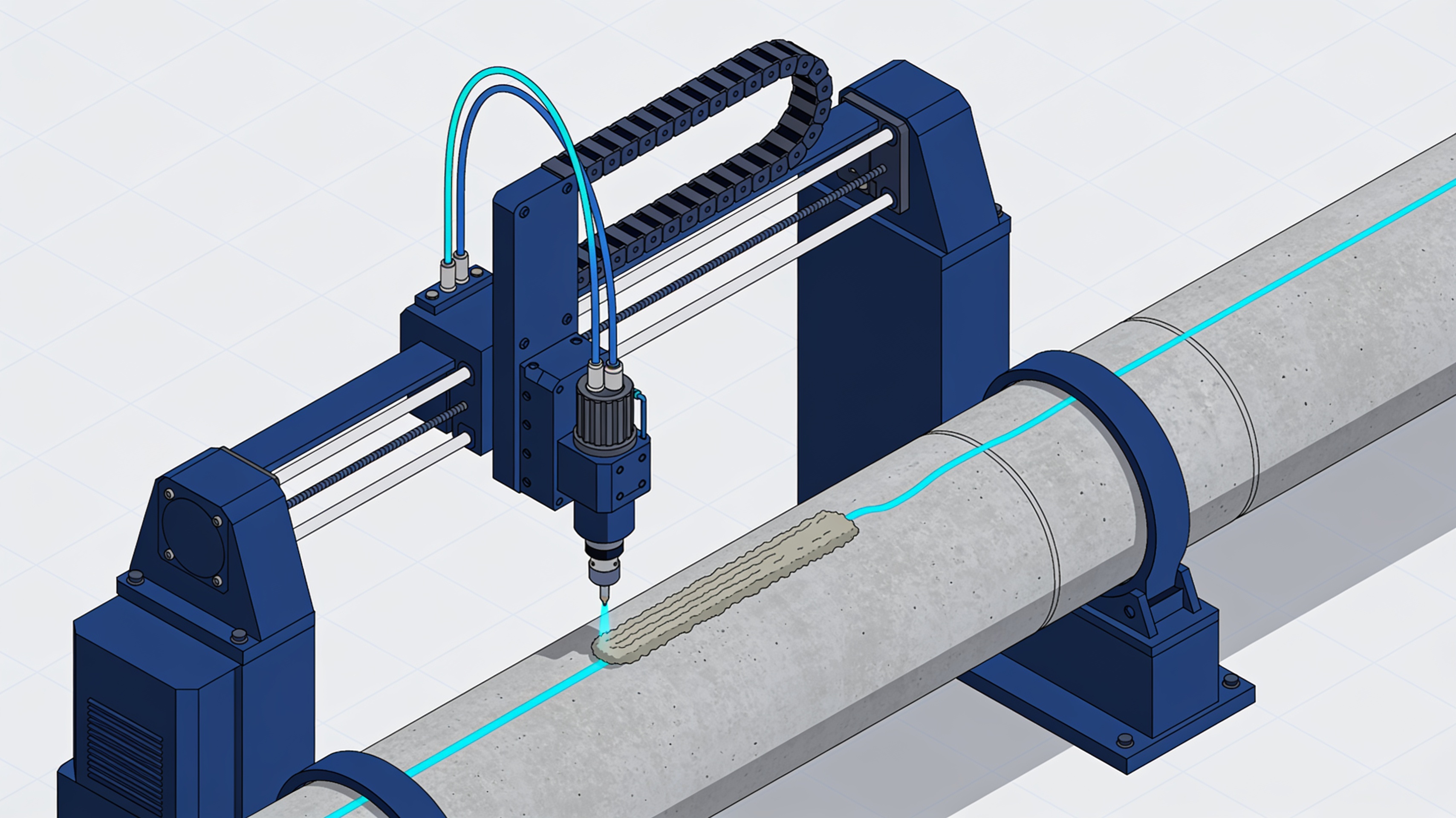
How 3D printing is transforming water infrastructure
Global water infrastructure faces growing challenges: obsolete facilities, leaks, inefficiencies, and rising demand due to population growth. 3D printing is emerging as a concrete solution for building and maintaining these critical systems, offering advantages in terms of speed, sustainability, and customisation.
Additive manufacturing technology is moving from the experimental phase to real-world implementation in the water sector, with pilot projects already operational in the United Kingdom and applications ranging from filtration to the production of structural components.
The Printfrastructure project: from theory to practice
The United Kingdom is leading the industrial adoption of 3D printing for water infrastructure with a collaborative project involving utility companies and research centres.
United Utilities has launched the project “The Water Industry Printfrastructure” in collaboration with ChangeMaker3D, PrintCity of Manchester Metropolitan University, and Scottish Water. The initiative represents a concrete case of implementation on an industrial scale.
The company has opened a centre dedicated to concrete 3D printing at the Wigan wastewater treatment plant. This facility produces infrastructure components used by both United Utilities and Scottish Water.
- First 3D concrete printing centre dedicated to water infrastructure in the United Kingdom
- Collaboration between water operators, manufacturers and universities
- Components already in operational use at treatment plants
Applications in filtration and treatment
Additive manufacturing makes it possible to create complex geometries that are impossible to achieve with traditional methods, opening up new possibilities for water filtration.
Researchers at the University of Bath have developed ceramic lattice structures for filtration using 3D printing. These optimised geometries improve the efficiency of the purification process.
A 2023 study entitled “3D-Printed Materials for Wastewater Treatment” documented the use of additive technologies to produce membrane components. DLP and SLS technologies proved particularly suitable for these high-precision components.
The Royal Netherlands Navy has produced replacement water filters via 3D printing. This case demonstrates how the technology can solve spare parts supply problems, especially in remote contexts.
Structural components and fittings
From small components to large concrete structural elements, 3D printing covers the entire range of infrastructure needs.
Joshua Pearce, a researcher at Western University, designed and 3D printed PETG pipe fittings. This material offers adequate chemical resistance and durability for water applications.
The United Utilities center produces 3D-printed concrete manholes, such as the one installed at the Esholt wastewater treatment plant. These structural components demonstrate the scalability of the technology.
| Technology | Application | Main advantage |
|---|---|---|
| DLP | Precision components | High resolution for membranes |
| SLS | Functional prototypes | Medium-volume production |
| Concrete extrusion | Structural elements | Large dimensions, customization |
| Polymer extrusion | Fittings and filters | Speed, low costs |
The challenges of modern water infrastructure
Understanding the sector's issues is essential to assess the potential impact of additive manufacturing.
Water infrastructure includes drinking water treatment plants, distribution networks with pipes and pumps, storage tanks, and wastewater treatment plants. These complex systems require constant maintenance and technological upgrades.
Many plants are obsolete and suffer from leaks and inefficiencies. Growing demand due to population growth further aggravates the situation.
Drinking water is easily accessible in many developed areas, but the underlying infrastructure is often neglected. Efficient water systems are essential for public health and environmental protection.
Advantages of additive manufacturing for the water sector
Speed, sustainability and customization are the three pillars that make 3D printing attractive for water infrastructure.
Additive manufacturing enables faster production times than traditional methods. Custom components can be produced on demand, reducing plant downtime.
The technology offers more environmentally friendly solutions thanks to reduced material waste. The ability to produce locally also reduces the impact of transport.
Customization is perhaps the most significant advantage. Every plant has unique characteristics, and 3D printing makes it possible to adapt components to specific needs without additional costs for molds or tooling.
Future perspectives
The transition from experimentation to operational implementation, as demonstrated by the Printfrastructure project, marks a turning point for the sector. The opening of dedicated production centers indicates that the technology has passed the validation phase.
Collaborations between water operators, universities and additive technology manufacturers are creating an ecosystem conducive to innovation. Scottish Water and United Utilities are already using 3D-printed components in their daily operations.
The challenge now is to scale these solutions and standardize production processes. As materials and printing technologies evolve, the role of additive manufacturing in water infrastructure is set to grow significantly in the coming years.
article written with the help of artificial intelligence systems
Q&A
What is the Printfrastructure project in the UK?
It is a collaborative initiative led by United Utilities with ChangeMaker3D, PrintCity, and Scottish Water to implement 3D printing in water infrastructure. The project resulted in the creation of a dedicated concrete 3D printing center at the Wigan facility.
What advantages does 3D printing offer for water filtration?
Additive manufacturing enables the creation of complex ceramic lattice geometries impossible with traditional methods, optimizing purification efficiency. Technologies like DLP and SLS are ideal for producing these high-precision components.
Who is already using the 3D-printed components produced in Wigan?
The infrastructural components made at the Wigan center are already in operational use by both United Utilities and Scottish Water. This demonstrates the technology's transition from the experimental phase to real-world implementation.
How does 3D printing help with spare parts maintenance?
The technology allows for on-demand production of filters and replacement parts, solving supply chain issues especially in remote contexts. A concrete example is the production of water filters by the Royal Netherlands Navy.
Which additive technologies are cited for wastewater treatment?
The 2023 study highlights the effective use of DLP (Digital Light Processing) and SLS (Selective Laser Sintering) technologies for producing membranes and components for wastewater treatment.