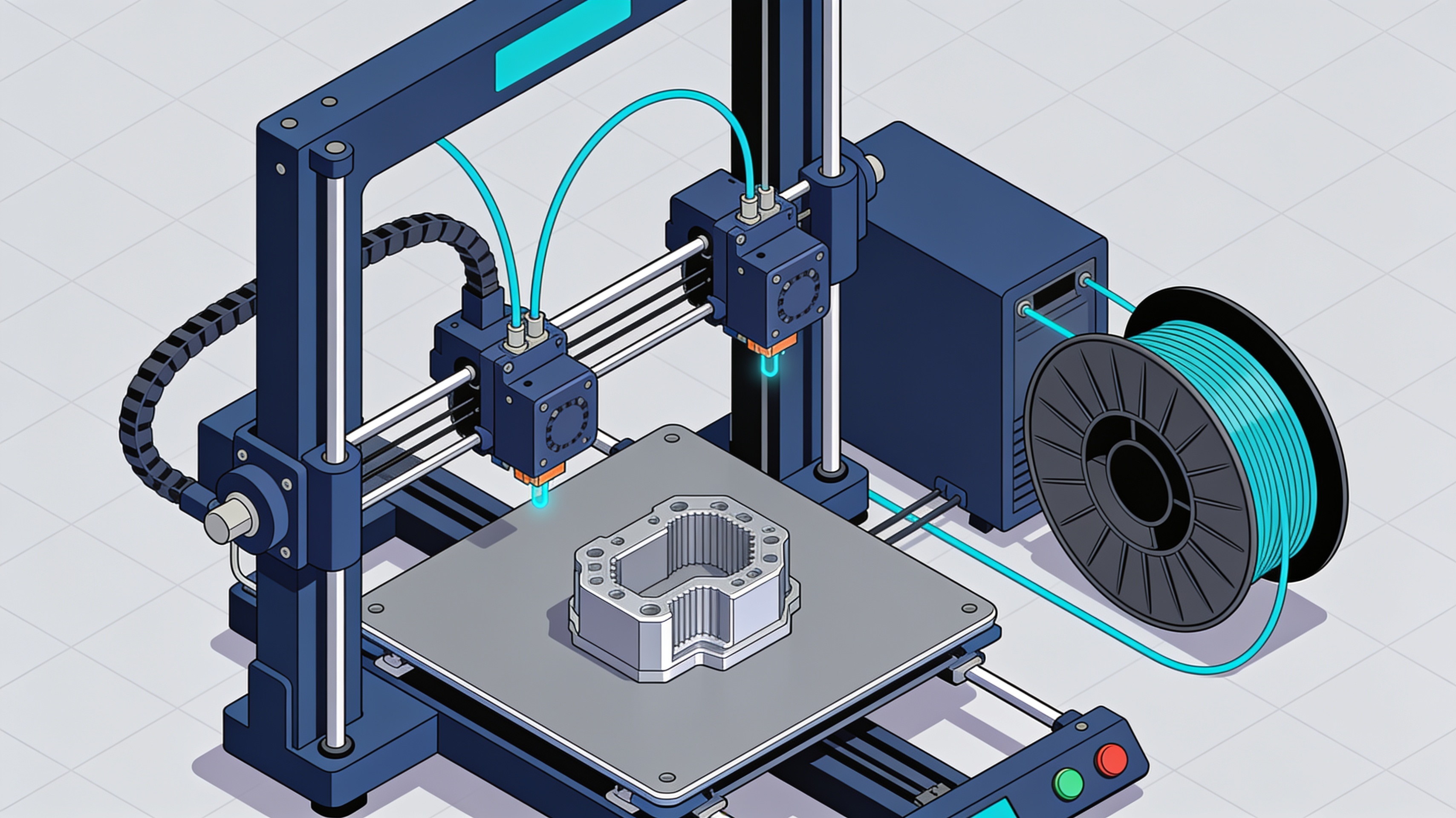
Public 3D printing markets: sector growth but challenges for listed companies
Publicly traded additive manufacturing companies show mixed results in Q2 2026, while the global manufacturing industry records signs of growth. The analysis of quarterly earnings reveals an expanding sector, but with benefits distributed unevenly.
Macroeconomic indicators paint a positive picture for manufacturing. The ISM PMI and AMT machine tool data show favorable trends ahead of IMTS in Chicago. However, this growth is not uniformly reflected in the financial statements of publicly traded 3D printing companies.
- The 3D printing industry grows, but the benefits do not reach public companies equally
- Stratasys, 3D Systems, Velo3D, Materialise, Xometry, and Protolabs show differentiated performance
- Competition with Chinese manufacturers and low-cost systems intensifies pressure on margins
- SpaceX emerges as an influential player in shaping Velo3D's business and that of the entire sector
Stratasys and 3D Systems: the veterans under pressure
The two historic industry leaders face growing competitive challenges, with 3D Systems also announcing a leadership transition.
Stratasys reported results that reflect an increasingly competitive market. The company is facing not only traditional competition, but also new entrants aggressive on price.
3D Systems reported its Q2 2026 figures along with the announcement of a transition in the CEO position. This leadership change comes at a crucial time for the company.
Analysts point out that competitive pressure does not come only from Chinese 3D printing companies. Alternative technologies such as pellet-based systems (for example: AIM3D) could also disrupt the polymer additive manufacturing market.
Velo3D and the influence of SpaceX
The metal AM systems manufacturer shows how large aerospace customers can determine the fortunes of a company in the sector.
Velo3D reported its second-quarter results in a context strongly influenced by aerospace industry dynamics. SpaceX plays a direct and indirect role in shaping Velo3D’s business and the entire 3D printing industry.
This dependence on large strategic customers represents both an opportunity and a risk for manufacturers specializing in aerospace applications.
Service bureaus and digital platforms
Materialise, Xometry, and Protolabs represent different business models compared to hardware manufacturers, with their own competitive dynamics.
Materialise reported results that reflect its positioning as an engineering company in the AM sector. The company operates in a different segment compared to pure machine manufacturers.
Xometry and Protolabs, direct competitors in the digital service bureau market, reported performance that highlights the challenges of scalability in this model. Both companies compete for market share in a rapidly evolving segment.
The broader competitive landscape
In addition to listed companies, numerous private players and new entrants are redefining the sector's balance.
The analysis mentions several companies that, although not publicly listed, significantly influence the market. Among them: EOS, Nikon SLM Solutions, Divergent, VulcanForms, Freeform, and Bambu Labs.
The presence of these private competitors complicates the analysis of the sector. Many have substantial funding and can operate with longer time horizons than public companies.
| Company | Status | Main segment |
|---|---|---|
| Stratasys | Listed | Polymer hardware |
| 3D Systems | Listed | Multi-technology hardware |
| Velo3D | Listed | Aerospace metal AM |
| Materialise | Listed | Software and services |
| Xometry | Listed | Digital platform |
| Protolabs | Listed | Service bureau |
Outlook for the sector
The growth of global manufacturing offers opportunities, but market fragmentation and price pressure require differentiated strategies.
Positive macroeconomic indicators ahead of IMTS suggest a favorable environment for additive manufacturing. However, publicly traded companies must find ways to capture this growth.
The main challenge remains converting market expansion into sustainable financial results. Companies that manage to differentiate themselves technologically or consolidate positions in high-value niches will be more likely to succeed in future quarters.
article written with the help of artificial intelligence systems
Q&A
What is the overall trend of the 3D printing market in Q2 2026?
The 3D printing industry records overall growth supported by positive macroeconomic indicators such as the ISM PMI. However, the benefits of this expansion are not evenly distributed among publicly listed companies.
How are Stratasys and 3D Systems performing?
Both industry veterans face growing competitive pressures due to aggressive new entrants undercutting prices. Additionally, 3D Systems announced a leadership change in the CEO position during the quarterly earnings release.
What role does SpaceX play in Velo3D's results?
SpaceX emerges as an influential player directly and indirectly shaping Velo3D's business and the entire sector. Heavy reliance on major strategic customers in the aerospace industry represents both a significant opportunity and risk.
What factors are compressing 3D printing companies' margins?
Margins are under pressure due to competition with Chinese manufacturers and low-cost systems. Alternative technologies, such as pellet-based systems, also threaten to disrupt the polymer additive manufacturing market.
Which service bureau companies are mentioned in the analysis?
The article cites Materialise, Xometry, and Protolabs as examples of service bureaus and digital platforms. These entities operate with business models different from hardware manufacturers and face their own competitive dynamics.