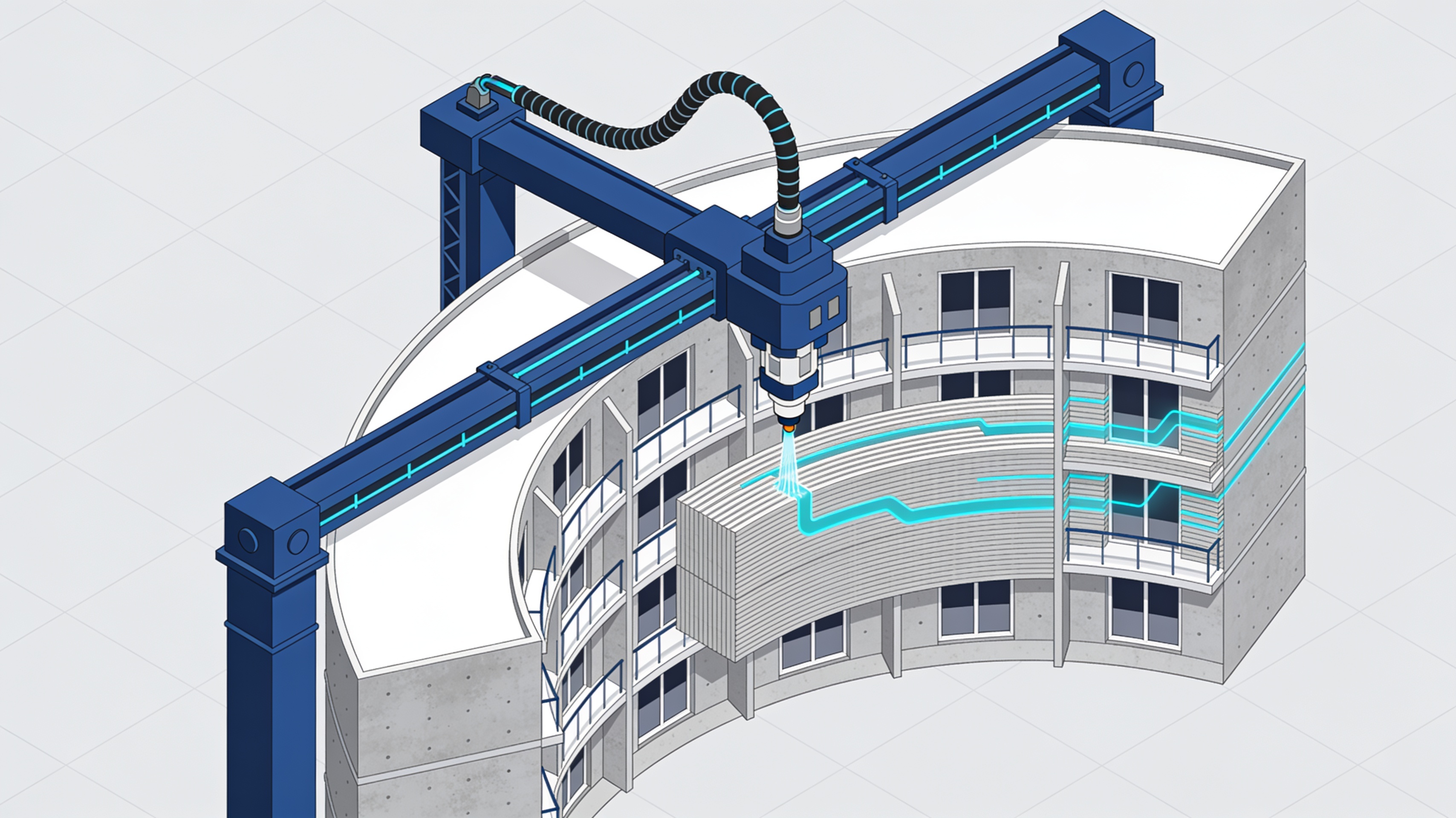
In Denmark, Europe's largest 3D-printed residential complex welcomes its first students
In Holstebro, Denmark, Skovsporet has been completed, Europe's largest 3D-printed residential complex. The student village comprises 36 apartments spread across six buildings, built with a COBOD BOD3 printer by 3DCP Group on behalf of the housing association NordVestBO.
The project demonstrated how 3D printing can overcome the particularly restrictive cost limits imposed by Denmark for subsidized housing. The first students have already moved into the apartments, located next to VIA University College.
- 36 3D-printed apartments, the largest residential complex of this kind in Europe
- Cost of €1,880/m², below the Danish legal limit
- Three operators printed a six-apartment building in five days
- Curved shapes achieved at no extra cost compared with straight lines
Below the cost limit with sculptural shapes
The project complied with the strict economic constraints of Danish subsidized housing while maintaining a complex architectural design.
Skovsporet covers 1,650 m² with apartments ranging from 38 to 50 m². The buildings were delivered at 1,880 euros per m², excluding design, engineering, utility connections, and landscaping.
For residents, monthly rents start at 670 euros for a 50 m² apartment. The architectural design was developed by SAGA Space Architects together with MS+.
| Feature | Value |
|---|---|
| Total area | 1,650 m² |
| Number of buildings | 6 |
| Total apartments | 36 |
| Apartment area | 38-50 m² |
| Cost per m² | 1.880 € |
| Monthly rent (50 m²) | from €670 |
The advantage of curved forms
In 3D printing, creating curved walls does not entail additional costs compared to straight lines, overturning traditional construction logic.
With conventional methods, every curve increases costs through custom formwork, shaped bricks, or special prefabricated elements. In 3D printing, however, printing a curved line does not cost more than a straight one.
The rounded and sculptural forms of Skovsporet therefore did not entail any surcharge. This advantage made it possible to create aesthetically distinctive buildings while remaining well below the legal cost limit.
Local materials and emission reduction
The project used a local cementitious formulation with CO₂ emissions reduced by up to 30% compared to traditional cement.
3DCP Group was able to source materials locally, including a specific cementitious formulation. This mix produces up to 30% less CO₂ than traditional cement.
The use of local materials helped contain costs and reduce the project's environmental impact.
The COBOD BOD3 printer used for the project was managed by a team of only three people for the entire duration of the works, a number much lower than a conventional construction site of these dimensions.
Reduced construction times
A complete building with six apartments was printed in just five working days.
All 36 apartments were printed on site with a single COBOD BOD3. To complete a building with six apartments, with an area of 275 m², five working days were enough.
The team of three operators managed the entire printer for the entire duration of the project. This represents a significant labor saving compared to traditional construction methods.
Implications for affordable housing
The success of Skovsporet demonstrates how 3D printing can make subsidized housing economically sustainable even in restrictive regulatory contexts.
Denmark applies one of the strictest cost limits in Europe for subsidized housing. These constraints have held back the construction of new affordable housing for years.
The Holstebro project demonstrates that 3D printing can overcome this obstacle. The combination of low costs, reduced times, and design freedom opens new possibilities for affordable residential housing in Europe.
article written with the help of artificial intelligence systems
Q&A
How many apartments does the Skovsporet complex include?
The Skovsporet residential complex consists of 36 apartments distributed across six distinct buildings. It is the largest 3D-printed housing project realized in Europe.
What is the construction cost per square meter of the project?
The buildings were delivered at a cost of 1,880 euros per square meter. This figure excludes design, engineering, utility connections, and landscaping, but complies with the strict limits of subsidized housing.
How do curved shapes affect costs in 3D printing?
Unlike traditional methods, creating curved walls in 3D printing incurs no additional costs compared to straight lines. This allowed for a sculptural design without exceeding the planned budget.
How long did it take to print one building?
Three operators managed to print an entire building comprising six apartments in just five days. The speed of execution is one of the key advantages demonstrated by the project.
Which technology was used for the construction?
Construction was carried out using a COBOD BOD3 printer operated by the 3DCP group. The machine enabled the use of a local cementitious formulation, reducing CO₂ emissions.