Why is the 3D market splitting in two?
The global 3D printing market reached $16 billion in 2025, growing 10% year over year. But this recovery hides deeply divergent dynamics: entry-level systems under $2,500 are recording growth above 30%, while high-end industrial platforms continue to suffer from slow and cautious investment.
The bifurcation is not only about price. Three specific industrial sectors — aerospace, defense, and healthcare — are driving demand for professional systems, while the rest of the industrial market remains in a consolidation phase. Meanwhile, the consumer and maker segment is accelerating with completely different dynamics.
Bifurcated growth: who accelerates and who slows down
The market expansion shows two faces: on one side entry-level systems and on the other high-end industrial ones, with sharply different trends.
In the third quarter of 2025, global hardware revenue grew by 5% year over year, but this average hides a sharp split. Printers under $2,500 recorded growth above 30%, while systems between $20,000 and $100,000 saw shipments fall by 13%.
- Entry-level systems (under $2,500): +30% year over year
- Mid-range ($20,000-$100,000): -13% in units shipped
- Industrial metal PBF: +25% driven by China, aerospace, and defense
- Industrial systems above $100,000: +3% in units, but demand still cautious
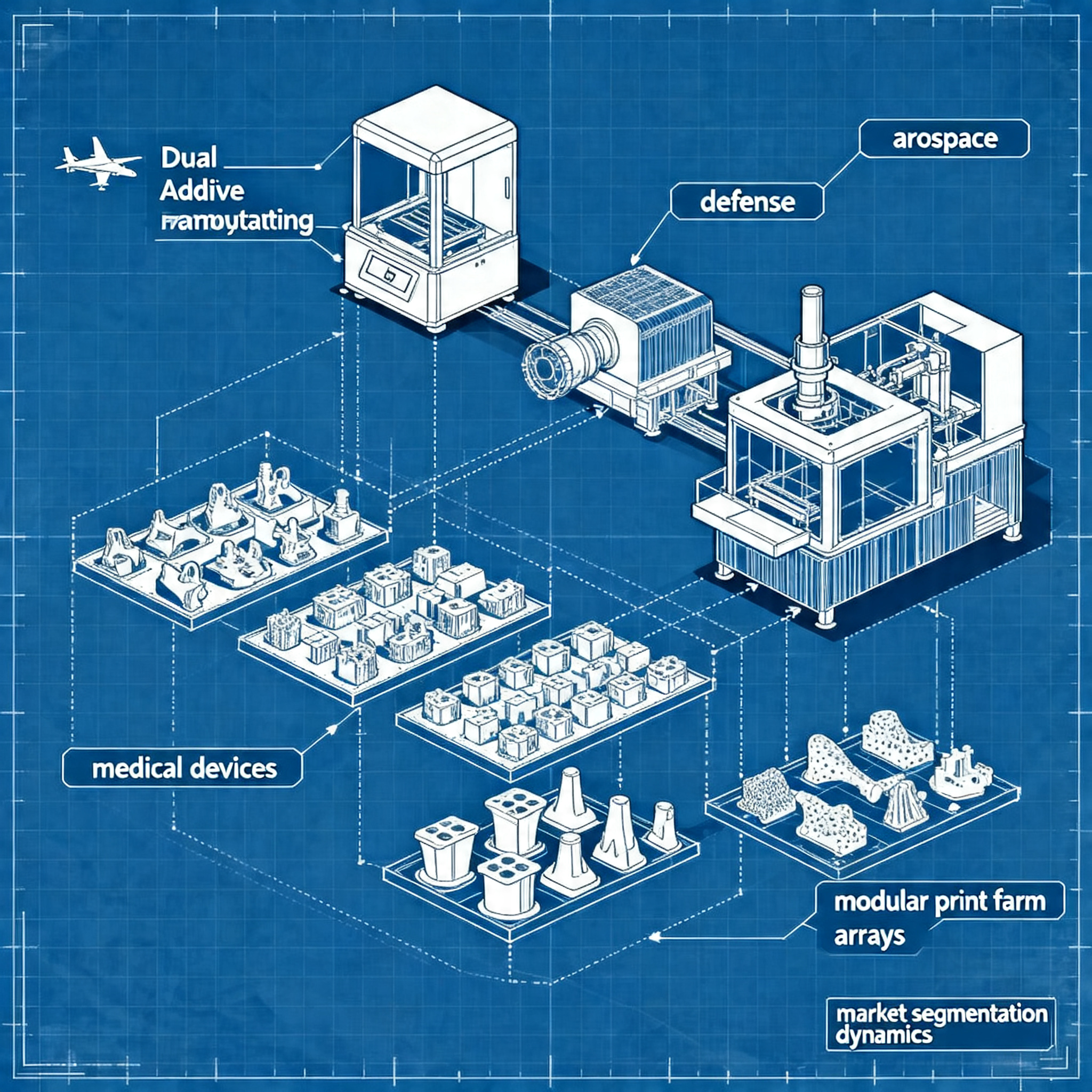
CONTEXT data show that demand for entry-level systems no longer comes only from hobbyists. Industrial companies are building “print farms” with dozens of low-cost machines instead of investing in individual industrial systems costing hundreds of thousands of dollars. This approach reduces capital risk and increases production redundancy.
On the opposite front, industrial platforms above $100,000 grow only by 3% in units. Macroeconomic uncertainty, trade tariffs and the weakness of the European manufacturing sector weigh on investment decisions. The market has shifted from a phase of “expansion at all costs” to a focus on sectors where AM generates clear economic value.
Driving sectors: aerospace, defense and healthcare
Three industrial sectors are driving demand, with applications ranging from rapid prototyping to direct additive manufacturing.
AM Research identifies three verticals with growth rates above 20% per year over the last four years: medical/dental, aerospace and defense. These sectors no longer use 3D printing as an experimental technology, but as a core production method.
In the space sector, rocket engine production represents one of the most significant value drivers for the next decade. Military OEM manufacturers and defense startups use AM to solve supply chain problems and produce drones and next-generation components.
| Sector | Annual growth | Main applications |
|---|---|---|
| Aerospace | >20% | Rocket engines, lightweight structural components |
| Defense/Maritime | >20% | Drones, on-demand spare parts, resilient supply chain |
| Medical/Dental | >20% | Custom implants, surgical guides, dental prostheses |
3D Systems has confirmed that medical tech, dental, and aerospace/defense are the three markets on which it focuses product development. These sectors offer opportunities for sustained growth over the next decade, with regulatory barriers that protect margins and increasingly integrated workflows.
China represents a particular case: shipments of metal PBF systems grew by 35% year over year, with most machines remaining in the domestic market. Chinese customers operate mainly in aerospace and the private space sector.
The gap between makers and industry is widening
The needs of the hobbyist market and those of the industrial sector are becoming increasingly less overlapping, requiring distinct approaches.
The desktop segment under €10,000 is no longer reserved for hobbyists. AMPOWER notes that this segment is gaining industrial relevance, with companies investing in low-cost printer farms instead of relying exclusively on expensive single industrial systems.
This evolution calls into question traditional market classifications. Entry-level printers now offer sufficient precision and reliability for low-volume production applications, while reduced operating costs enable economies of scale impossible with industrial machines.
Industrial companies no longer see entry-level systems as alternatives to professional ones, but as complementary. A farm of 20 $3,000 printers costs $60,000 versus $150,000–300,000 for a single industrial system, offering greater redundancy and flexibility.
On the opposite front, high-end industrial systems focus on applications where quality, certification, and repeatability are critical. Metal PBF for certified aerospace components, systems for custom medical implants, and large-format platforms for series production require investments that the maker segment cannot justify.
The result is an increasingly segmented market, where product, pricing, and go-to-market strategies must be radically different. Suppliers that try to cover both segments with the same approach risk losing relevance in both.
Penetration strategies for separate segments
Companies must redefine their market strategies to address the specific needs of each segment without compromise.
The divestitures of non-core assets by 3D Systems (Geomagic to Hexagon for 123 million), TRUMPF (AM business to DUBAG/LEO III), and Materialise (RapidFit via MBO) signal a clear trend: vertical specificity beats horizontal coverage.
Businesses that thrive after restructurings are narrowly focused. Stratasys focuses on FDM consumables, aerospace, and dental. Materialise Medical focuses on custom implants and software. ATLIX (formerly TRUMPF AM) targets medical and aerospace with full-service application consulting.
Strategic approach by segment
- Entry-level/Maker: Focus on volumes, ease of use, and a content and community ecosystem. Margin comes from scale and recurring materials.
- Industrial generalist: Focus on 2-3 specific verticals with integrated workflows. Avoid spreading across too many sectors.
- Certified high-end: Invest in material qualification, process certifications, and application support. The value lies in reducing customer risk.
AM Research predicts that services will become the largest segment over time, surpassing hardware and materials. This reflects a transition from “selling machines” to “selling certified parts” or “guaranteed production capacity.” Companies that cannot compete on this dimension risk being marginalized.
The expected average annual growth of 13,5% through 2029 from AMPOWER confirms that the market continues to expand. But this growth will not be distributed evenly: it will concentrate in segments where AM solves real economic problems, not where it is adopted for experimentation or technological hype.
The future of 3D printing will depend on the ability to adapt to the diverging dynamics of market segments. Companies that try to serve makers and the aerospace industry simultaneously with the same strategy risk failing at both. Vertical specialization, integrated workflows, and service-based business models will define the winners of the next decade.
Analyze your positioning: are you in the growing segment, or do you risk being left behind?
article written with the help of artificial intelligence systems
Q&A
What is the annual growth rate of the global 3D printing market in 2025?
The global 3D printing market grew by 10% annually in 2025, reaching $16 billion.
How do the performances of entry-level and industrial systems differ in the third quarter of 2025?
Entry-level systems under $2,500 saw growth exceeding 30%, while industrial systems priced between $20,000 and $100,000 experienced a 13% decline in shipments.
Which industrial sectors are driving demand for advanced 3D printing systems?
Aerospace, defense, and healthcare are the three sectors driving demand, with applications ranging from rapid prototyping to direct production of components.
Why are industrial companies preferring fleets of entry-level printers over expensive single systems?
Companies are building 'print farms' with low-cost printers to reduce financial risk, increase production redundancy, and achieve economies of scale impossible with individual industrial machines.
How is the role of entry-level printers changing in the industrial context?
Entry-level printers are no longer seen as alternatives to professional systems but rather complementary solutions, thanks to their increasing accuracy and reduced operating costs.