Printing 90° overhangs without supports? Here's how
Thanks to a new printhead movement technique based on wave propagation theory, it is now possible to overcome the traditional limit of unsupported overhangs in standard FDM printers.
Wave theory applied to the toolpath
The new approach modifies the printhead movement to simulate waves that distribute material continuously and in a controlled manner.
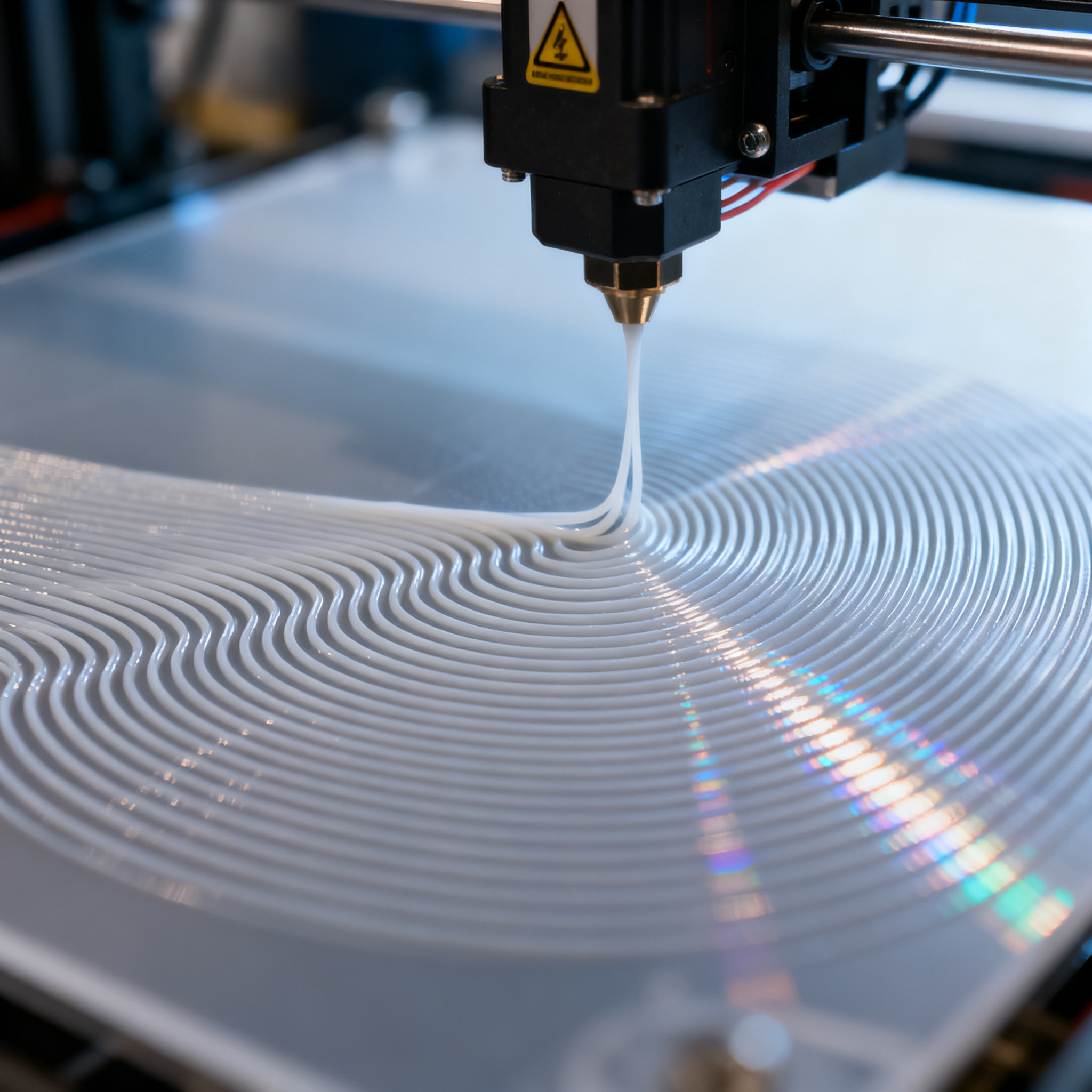
The secret to printing horizontal overhangs without supports lies in the wave propagation theory. Instead of depositing traditional lines of plastic, the system generates continuous paths that behave like radiating waves.
These paths exhibit behavior similar to diffraction. They can bend and naturally navigate around complex geometric shapes. The printhead no longer follows linear or arc trajectories, but wavy movements that distribute material progressively.
- Wavy paths replace traditional linear trajectories
- Diffraction-like behavior makes it possible to work around complex geometries
- The progressive deposition reduces the gravitational load on the suspended material
The software that implements this technique is called WaveOverhangs, currently available as a fork of OrcaSlicer. The idea is to create rings of deposited material that attach to the previous ones in the same layer.
How wavy layering works
By inverting the logic of traditional planar layering, the effective weight of the suspended material during deposition is reduced.
When the printer deposits a layer in empty space, the plastic material attaches to the supported edge. The next ring hooks onto the previous one, already cooled, creating a self-supporting structure.
The process leverages differential temperature. The freshly extruded material is hot and malleable, but finds support on the previous, already solidified one. Each ring acts as a base for the next.
This technique requires precise calibration. The software offers numerous adjustable parameters and two different algorithms. There are no universal presets yet: experimentation is needed to find the optimal settings for each geometry.
The cooling rate of the material becomes crucial: too slow and the material sags, too fast and the adhesion between rings fails.
Practical results on complex geometries
Overhang tests up to 90° confirm feasibility without mechanical supports, even with standard PLA and ABS.
The researchers tested the technique by printing standard PLA on an open-frame FDM printer. The wavy paths clearly outperformed the traditional arch paths. Less sagging, much better coverage, fewer gaps even on complex shapes.
The team printed a multilayer demonstrator. Once the first wavy layer was deposited without support, subsequent layers deposit reliably on top. The measured dimensional deviations are comparable to those of parts with conventional supports.
| Parameter | Traditional paths | Wavy paths |
|---|---|---|
| Sagging | Significant | Minimum |
| Surface coverage | Patchy | Complete |
| Gap between lines | Frequent | Rare |
| Dimensional accuracy | With supports | Comparable |
Four different 3D geometries were printed, representing common industrial overhang configurations. This demonstrates the versatility of the strategy. Some thermal deformation is observed near the edges of the overhangs, but the overall result is usable.
Limits of the old FDM paradigm
The overhang limit is not physical, but the result of toolpath programming that ignores the dynamics of material flow.
The 45° rule for overhangs has never been an intrinsic limit of the FDM process. It is a side effect of the way we have always programmed the printer's movements.
As author Janis A. Andersons explains: “The 45° rule was never really an intrinsic limitation of the FDM process. It is a side effect of how we have always told printers to move. Change the slicing, and the limits shift with it.”
The problem was in the slicing logic. Traditional software does not consider the dynamics of material flow during deposition. They treat each layer as independent, ignoring how hot plastic behaves when extruded into the void.
The new strategy recognizes that the material has physical properties that can be exploited. Viscosity, surface tension, cooling rate: all factors that the wavy paths integrate into the toolpath calculation.
This new strategy redefines the boundaries of support-free in FDM, paving the way for geometries previously impossible without supports. Try implementing this strategy in your FDM projects: you could eliminate supports even on critical geometries.
article written with the help of artificial intelligence systems
Q&A
What is the theoretical principle behind the new supportless overhang printing technique?
The technique is based on wave propagation theory. The print head movement simulates radiating waves that distribute material in a continuous and controlled manner, allowing it to overcome the traditional limitations of overhangs in standard FDM printers.
What does the print head movement consist of in this innovative technique?
The print head no longer follows linear or arc trajectories, but undulatory movements. These continuous paths behave like radiating waves and exhibit behavior similar to diffraction, bending and circumventing complex geometric shapes.
How does this technique manage to reduce the load on the suspended material during overhang printing?
The progressive deposition of material through undulatory paths reduces the gravitational load on the suspended material. Furthermore, by reversing the logic of the traditional planar layer, the effective weight of the suspended material during deposition is reduced.
What is the name of the software that implements this technique and how is it available?
The software is called WaveOverhangs and is currently available as a fork of OrcaSlicer. It allows generating the undulatory paths necessary to print horizontal overhangs without supports.
How does the wavy layering mechanism work to maintain overhang stability?
The system creates rings of deposited material that attach to previous ones within the same layer. This approach allows building the structure progressively, preventing the collapse of the suspended material.