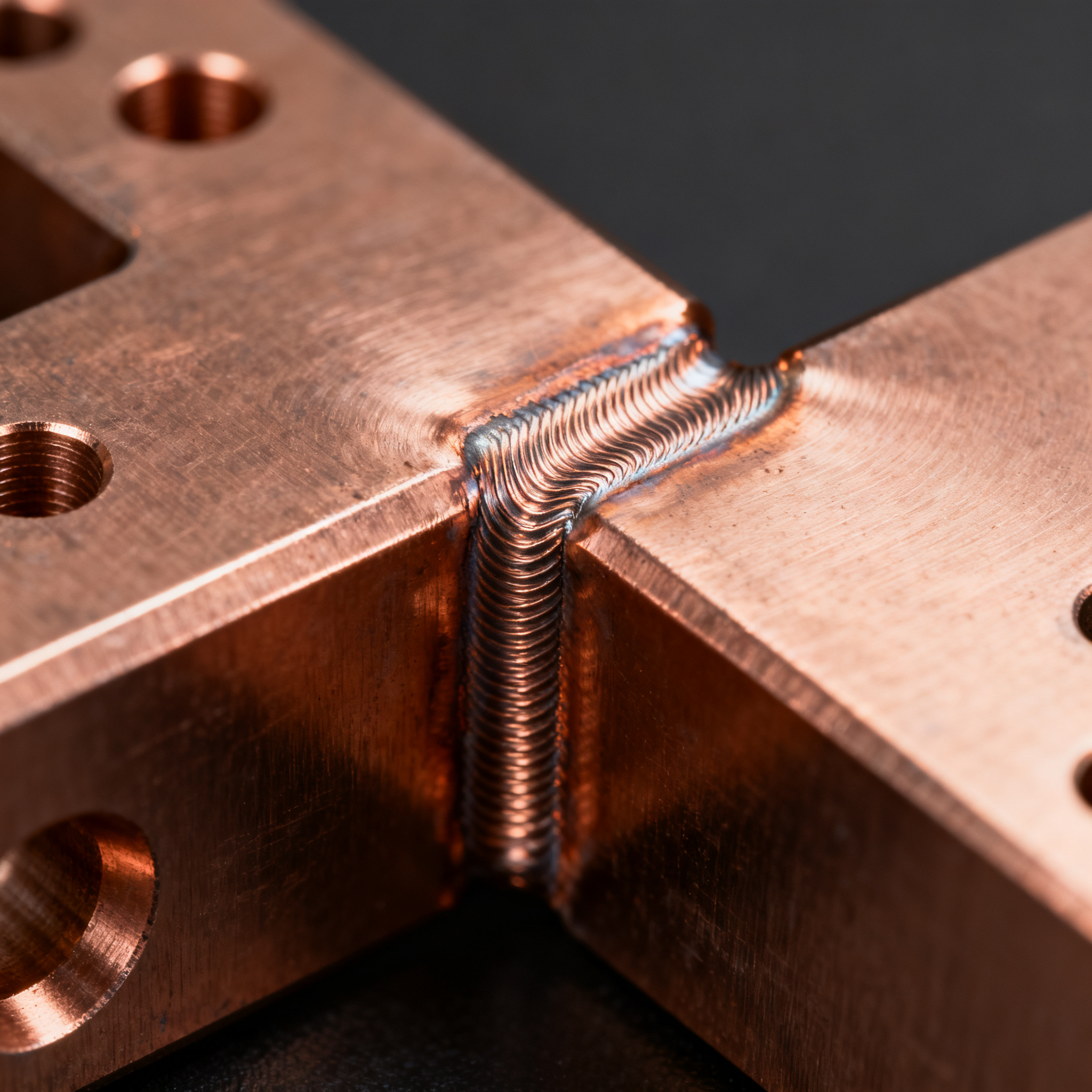
FSW in additive processes: when is it convenient?
Friction Stir Welding is not just a joining technique, but a strategic lever to make the production of complex metal components more efficient and modular. Integrating FSW into additive processes can reduce economic risks and improve production flexibility, but requires precise evaluations to avoid hidden inefficiencies.
Why combine additive and FSW?
The combination of additive manufacturing and Friction Stir Welding opens new possibilities for modularity and savings on complex parts, reducing the risk of scrap on expensive components.
A large copper alloy component printed in LPBF can be very expensive. The material is valuable, the machine time is high, and the risk of scrap increases with the duration of the job. Dividing the component into smaller sections reduces some concrete risks.
If a section fails, the entire assembly is not lost. If the sections can be reliably welded, modular design becomes more economically interesting. FSW can therefore have a role that goes beyond simple technical joining.
- Reduction of scrap risk on long and expensive jobs
- Possibilità di sostituire singole sezioni senza rifare l’intero componente
- Greater flexibility in managing production and precious materials
FSW allows joining modular sections of additive components, improving the welded zone and strongly reducing porosity. This is particularly important for alloys that are difficult to produce without defects, such as 3D-printed copper. Welding adds a production step and requires dedicated equipment, but the advantage must be evaluated case by case.
Practical cases: when FSW makes the difference
In applications requiring large, expensive, or modular components, FSW proves useful for joining critical sections without compromising metal quality.
For simple and small components, FSW may not be necessary. For large, expensive, or modular components, it can become an important part of the production process. The technology is particularly interesting when the value of the material and machine time make it risky to rely on very long single jobs.
Field research shows that friction stir welding can be an effective technique for joining CuNiSiCr alloys produced by LPBF. The result is important because 3D-printed copper is difficult to produce without defects, and many thermal components require precisely this combination of material and complex geometry.
FSW becomes interesting when the component is large, the material is valuable, the risk of scrap is high, or production requires modular flexibility. It is not a universal solution, but a specific tool for well-defined situations.
The research work of the Politecnico di Torino and the J-Tech@PoliTO laboratory is part of a broader line on joining technologies for materials produced by additive manufacturing. Metal additive manufacturing also develops with joining, treatment, inspection, and qualification technologies, not only with new printing machines.
Constraints and choices: it is not always the ideal solution
L’integration requires precise evaluations of geometry, materials, and costs to avoid hidden inefficiencies and ensure that the overall process is truly cost-effective.
Welding adds a production step. It requires dedicated equipment, trained personnel, and specific quality controls. The economic advantage must therefore be evaluated case by case, comparing the cost of FSW with the risk of scrap on monolithic components.
FSW could allow more flexible production of complex thermal components, reducing dependence on very long single jobs. Naturally, this advantage only manifests when the component is large and expensive enough to justify the investment in equipment and joining processes.
| Scenario | FSW recommended | FSW not necessary |
|---|---|---|
| Component size | Large, multi-section | Small, monolithic |
| Material cost | High (e.g., copper alloys) | Low or standard |
| Scrap risk | High on long jobs | Low, consolidated process |
| Geometric complexity | Modular, assemblable | Simple, integrated |
In the future, it might be interesting to also study friction stir processing, i.e., the use of the tool to modify the surface or specific areas of a part without necessarily joining it to another. This could allow local densification of critical areas, improve the microstructure, and reduce defects in selected points.
Roadmap for integration
A phased operational plan to evaluate, test, and implement FSW in an existing production flow, starting from the technical-economic analysis up to component qualification.
The integration of FSW into additive processes cannot happen without a structured evaluation. The first step is to identify candidate components: large, expensive ones, with modular geometries or with high scrap risk in monolithic production.
The second step is to evaluate the necessary investment. FSW equipment, personnel training, process parameter development, and quality controls all have a cost that must be compared with the expected savings from waste reduction and increased production flexibility.
FSW integration phases
- Techno-economic analysis: identificare componenti candidati e stimare costi/benefici dell’approccio modulare.
- Parameter development: Test combinations of materials, joint geometries, and thermal cycles on representative samples.
- Process qualification: Validate mechanical properties, porosity, microstructure, and reliability of joints.
- Production integration: Implement FSW in the existing flow with defined quality controls and operating procedures.
The combination of LPBF and FSW shows a maturation of the sector. It is not about choosing between 3D printing and traditional processes, but about combining different techniques to obtain better components. Without joining, treatment, inspection, and qualification technologies, many additive components remain limited to the demonstration phase.
Conclusion
Friction Stir Welding is not a universal tool, but a key technology for those aiming to safely scale up additive metal production. It allows building complex components in a modular way, reducing the economic risk on large and expensive parts.
The value of FSW emerges when the component is large enough to justify division into sections, when the material is valuable, and when the risk of scrap on long jobs is high. In these cases, FSW becomes a strategic lever to make production more efficient and flexible.
Evaluate your most critical projects: where could FSW modularity open new efficiency margins? Analyze dimensions, material costs, machine times and scrap risks to identify the components where the integration of Friction Stir Welding can really make a difference.
article written with the help of artificial intelligence systems
Q&A
When is it advantageous to integrate FSW into additive processes?
FSW becomes beneficial when the component is large, the material is valuable, and the risk of scrap on long jobs is high. In these cases, dividing the part into smaller sections to be joined subsequently reduces economic risks and improves production flexibility. It is not indicated for small, simple components or those achievable with established low-risk processes.
What are the main advantages of modularity with FSW?
Modularity allows reducing the risk of scrap on long and expensive jobs, since the failure of a single section does not result in the loss of the entire assembly. It also allows replacing specific sections without remaking the complete component. FSW ensures reliable joints with low porosity, making the modular approach economically attractive.
Why is FSW particularly useful for alloys such as 3D printed copper?
Copper and its alloys, such as CuNiSiCr produced by LPBF, are difficult to manufacture without defects and involve high costs for material and machine time. FSW makes it possible to join modular sections improving the quality of the weld zone and significantly reducing porosity. This is essential for complex thermal components that require exactly this combination of material and geometry.
Is FSW always cost-effective for every type of additive component?
No, FSW is not a universal solution but a specific tool for well-defined situations. For small, simple, and monolithic components, or when the material has a low cost and the process is already established, the addition of welding may not be economically justified. It is necessary to evaluate case by case geometry, materials, and costs to avoid hidden inefficiencies.
What are the main phases to integrate FSW into an existing production flow?
Integration involves a technical-economic analysis to identify candidate components and estimate costs and benefits. This is followed by the development of process parameters on representative samples and qualification with validation of mechanical properties and microstructure. Finally, actual production integration takes place, with quality controls and defined operating procedures.
What is meant by friction stir processing and what potential does it offer?
Friction stir processing is an evolution of FSW that uses the tool to locally modify the surface or specific areas of a part without joining it to another component. This technique could allow densifying critical areas, improving the microstructure, and reducing defects in selected points of additive components.