Winning collaborations in custom consumer: the strategy behind celebrity partnerships
*Collaborations between 3D printing companies and celebrities are redefining the custom consumer market, but behind every successful launch there is a precise strategy.*
Partnerships between additive manufacturing producers and celebrity brands are no longer isolated experiments. They have become a structured business model that requires strategic vision and technical expertise. Zellerfeld collaborated with Justin Bieber, Baron Davis, and Jaylen Brown. Decibel created furniture for the Coachella set of the Canadian singer.
These cases show that the custom consumer market requires much more than a good printer. A methodical approach is needed that integrates niche selection, technological alignment, and building lasting relationships.
Strategic niches to maximize visibility
*Choosing sectors like fashion and sports allows for greater exposure and media return.*
The fashion and sports sector offers the maximum impact for collaborations. Professional athletes are becoming entrepreneurs: Baron Davis launched OverDose after an NBA career, while Jaylen Brown created 741 Performance. This trend opens continuous opportunities for additive manufacturing producers.
- Fashion and sneakers: recovery sneaker market growing, average price $199
- Professional sports: athletes as entrepreneurs seek personalized products
- Mass events: collaborations for festivals like Coachella generate immediate media coverage
The choice is not random. Zellerfeld built a repeatable model by working with Nike and then expanding to athletes and musicians. The Brooklyn-based design house identified an “attractive lane” in partnerships with athletes seeking a second entrepreneurial career.
Baron Davis represents the perfect prototype: former NBA, now active in Hollywood, cannabis, venture capital, and fashion. His $199 OD Easy PZ sneaker is positioned in the recovery segment, an expanding area of the footwear market.
Materials and technologies aligned with the brand
*Consistency between technical performance and aesthetics is crucial to meet the partner's expectations.*
Mass customization requires the ability to produce variants without redesigning the entire line. It is not about printing unique pieces for a few customers, but about making the production of many variants sustainable. This is the difference between an experiment and a scalable business.
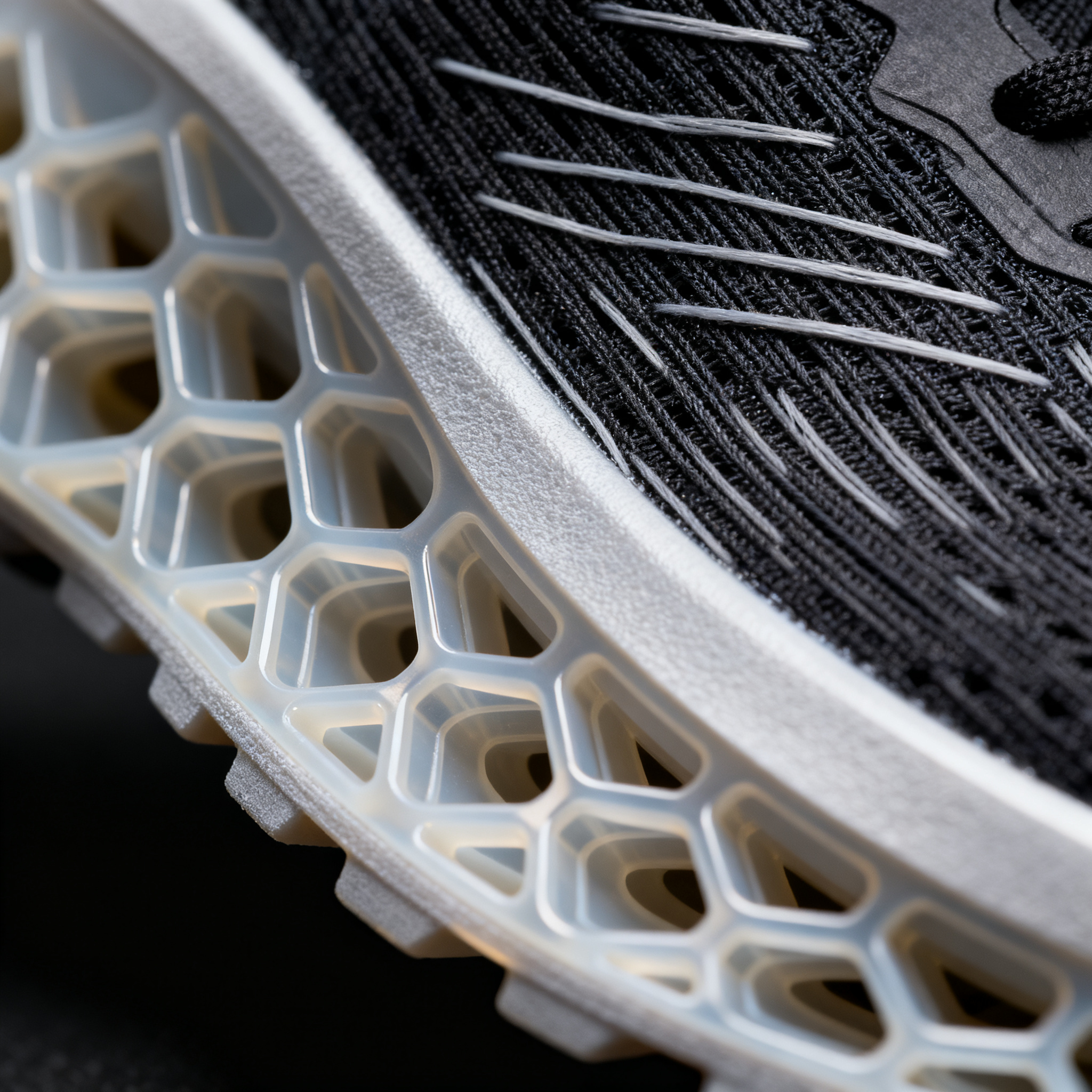
Technology must support both functional and aesthetic needs. Printed sneakers must ensure comfort and durability. Event furniture must withstand intensive use. Bryson DeChambeau's golf clubs must offer competitive performance.
The company produces 500,000 personalized gummies per day with 3D printing. The transition from demonstration to commercial scale requires integration with automation, quality control, and packaging. The printer alone is not enough.
Material-brand alignment determines success. Parametric designs allow adapting the product while maintaining consistency. Artificial intelligence is entering the design process to manage the complexity of variants.
Building long-term relationships
*A structured approach fosters continuity and the development of long-lasting partnerships over time.*
Repeated collaborations generate more value than single launches. Zellerfeld has worked multiple times with Justin Bieber: first the sneakers at the end of last year, then the furnishings for Coachella via Decibel. This continuity builds trust and allows refining the process.
Baron Davis created Business Inside the Game (BIG), a venture capital fund to support “multi-hyphenates” like him. This approach institutionalizes partnerships and creates a long-term ecosystem.
Building lasting partnerships
- Identification: Seek creators and athletes with an entrepreneurial vision, not just one-time endorsements.
- Value alignment: Davis talks about “From Analog to AI” and ownership for creators. Technology must support this narrative.
- Repeatable structure: Create processes that allow multiple launches without starting from scratch each time.
Davis's philosophy perfectly reflects the Zellerfeld approach: “I come from an era where play, culture, and product were connected, but ownership was not. It's about changing this. Creators must control what they create.”
Conclusion
*Collaborations in custom consumer require a combination of strategic vision, technological expertise, and consistency in perceived value.*
Success in the celebrity-driven partnership market is not a matter of luck. It requires identifying the right niches, technologies aligned with brand expectations, and the ability to build relationships that go beyond the single product.
Zellerfeld, Decibel, and others are demonstrating that a repeatable model exists. The key is to transform collaboration from an isolated event into a long-term strategy.
**Start today mapping brands compatible with your offering: the next success could come from a tailor-made idea.**
article written with the help of artificial intelligence systems
Q&A
Why are partnerships between 3D printing companies and celebrities no longer considered simple experiments?
They have evolved into a structured business model that requires strategic vision and technical expertise. Success depends on the methodical integration of niche selection, technological alignment, and building lasting relationships. Companies like Zellerfeld and Decibel demonstrate that there is a repeatable and scalable approach.
Which sectors offer the maximum impact for collaborations in the consumer custom market?
The fashion and sports sector guarantees the greatest exposure and media return. Professional athletes are becoming entrepreneurs, such as Baron Davis with OverDose and Jaylen Brown with 741 Performance, opening up ongoing opportunities. Mass events like Coachella also generate immediate media coverage.
What distinguishes an isolated experiment from a scalable business in mass customization?
A scalable business requires the ability to produce many variants without redesigning the entire line, making production sustainable. Integration with automation, quality control, and packaging is necessary, as demonstrated by REM3DY Health with its 500,000 customized gummies per day.
Why is it fundamental to build long-term relationships rather than settling for single launches?
Repeated collaborations generate more value, build trust, and allow the production process to be refined. Zellerfeld has worked multiple times with Justin Bieber, while Baron Davis created the BIG fund to institutionalize partnerships and create a stable entrepreneurial ecosystem over time.
How must materials and technologies align with the celebrity partner's brand?
Consistency between technical performance and aesthetics is crucial to meeting the partner's expectations. Products must guarantee both functional requirements, such as comfort and durability for sneakers, and narrative consistency with the brand. Parametric design and artificial intelligence help manage this complexity while maintaining coherence.
Who is Baron Davis and why does he represent an ideal partner for additive manufacturing companies?
He is a former NBA player turned entrepreneur active in Hollywood, cannabis, venture capital, and fashion. He perfectly embodies the concept of 'multi-hyphenate' and seeks ownership of the products he creates, such as the OD Easy PZ sneaker in the recovery segment, aligning with the creator control philosophy promoted by Zellerfeld.